

How many credit cards should I have?
Two cards suit most people in Canada: one primary card and one backup on a different network, with a third worth adding only when a specific spending category earns meaningfully more on it. Beyond that point the count itself stops mattering, because the number of cards you hold is not one of the factors the credit bureaus score.
That last part surprises people, so it is worth being precise. The Financial Consumer Agency of Canada publishes the list of common factors that move a Canadian credit score, and card count is absent from it. The list covers how long you have had credit, how long each account has been on your report, the types of credit you use, whether you carry a balance, whether you miss payments, how much you owe, how close you are to your limit, and how often you apply for new credit (FCAC). Every one of those is about behaviour on the accounts you have. None is a headcount.
Credit utilization is the ratio of what you owe to the credit available to you, and it is the factor most often used to argue for more cards. Credit mix is the variety of credit types on your file, such as cards, loans and a mortgage. Both are real. Neither one rewards a card for existing.
So the practical answer comes from the other direction: hold the number of cards you can pay in full, on time, every month, plus one spare so a declined transaction is an inconvenience rather than a problem.
- One card is enough if you are new to credit, rebuilding, or worried about overspending.
- Two cards covers the case that actually happens in Canada, where a merchant accepts Visa but not Mastercard, or the reverse.
- Three cards makes sense when a category you spend heavily in (groceries, fuel, travel) earns materially more on a dedicated card.
- Four or more needs a reason per card. Rewards on a category you rarely buy is not a reason.
As a benchmark: 88.3% of Canadians owned at least one credit card in 2024, and ownership rises with age, from 80.7% of 18-to-34-year-olds to 92.8% of those 55 and over (Bank of Canada). Roughly 100 million cards are in circulation across the country (Canadian Bankers Association). Divide one by the other and you get the "average Canadian has 2 to 2.5 cards" figure that circulates widely. Treat it as cards in circulation per adult, since it includes retail cards, private-label cards and cards issued to businesses.
Does opening another credit card really lower your credit utilization?
It lowers the ratio only if the balance your issuer reports stays where it was, and that condition fails for a third of Canadian cardholders. The advice to open a card in order to dilute utilization is repeated almost everywhere, and it is right in the arithmetic and wrong in the assumption.
Two mechanics decide whether it works for you.
The first is what gets reported. Your issuer sends the bureaus the balance shown on your statement date, not the balance left after you pay. Someone who charges $1,800 a month on a $3,000 limit and clears it in full every month still shows 60% utilization on that card, because the statement closed before the payment landed. Paying before the statement date, rather than before the due date, moves that number more than a new card does.
The second is whether the new limit stays unused. Extra credit only helps while your reported balances hold flat. The Bank of Canada's payment survey tracks how often that assumption breaks: 33% of Canadian credit card holders did not pay their full balance in the month surveyed in 2024, up from 27% in 2022 and the highest share the survey has recorded (Bank of Canada).
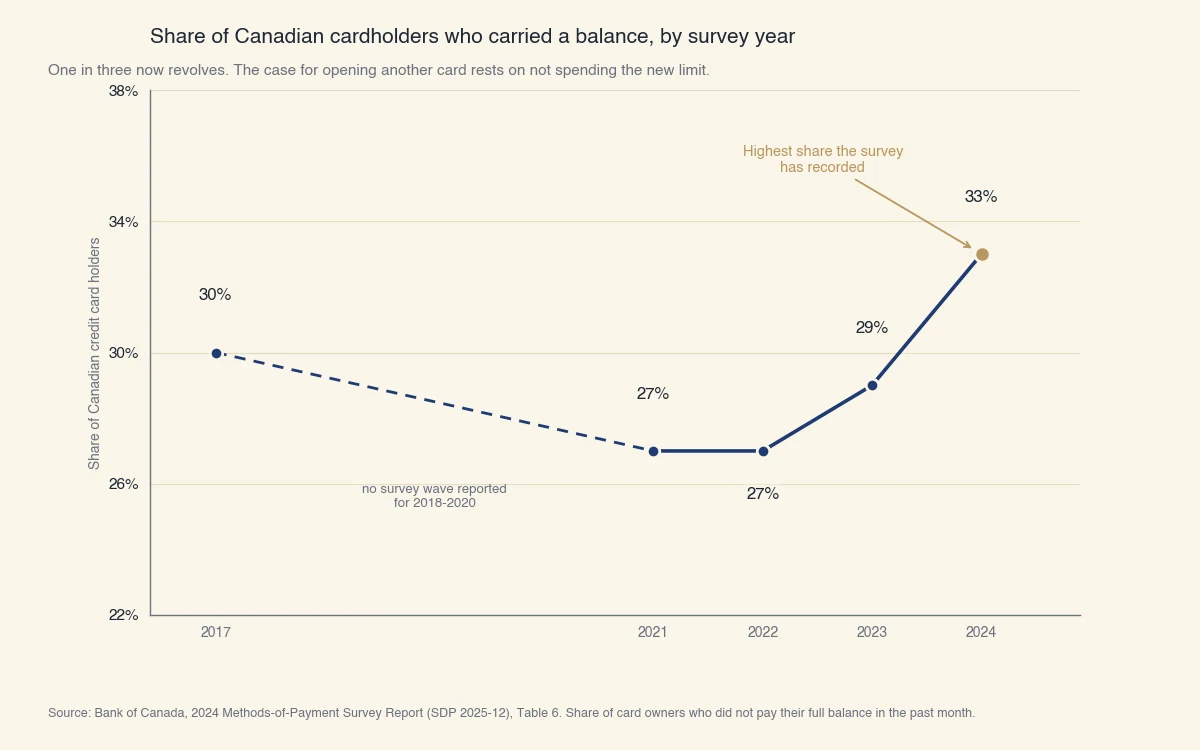
Source: Bank of Canada, 2024 Methods-of-Payment Survey Report (Staff Discussion Paper 2025-12), Table 6. Share of credit card owners who did not pay their full balance in the past month.
There is also a difference between the two utilization figures a lender can see. Aggregate utilization uses every card together. Highest single-card utilization looks at your most loaded account on its own. Opening cards fixes the first and leaves the second untouched if your spending stays on the original card. Take a fixed $1,200 statement balance and $3,000 of limit per card:
| Cards held | Total limit | Where the $1,200 sits | Aggregate utilization | Highest single-card utilization |
|---|---|---|---|---|
| 1 card | $3,000 | on the only card | 40% | 40% |
| 2 cards | $6,000 | all on the original card | 20% | 40% |
| 2 cards | $6,000 | split evenly | 20% | 20% |
| 3 cards | $9,000 | all on the original card | 13% | 40% |
| 3 cards | $9,000 | split evenly | 13% | 13% |
Source: Sphera Credit calculation on a $1,200 statement balance and $3,000 of limit per card.
The two middle rows carry the point. Same number of cards, same balance, two different pictures of the same borrower. Spreading the balance did as much work as opening the account did.
How many credit cards should you have at your stage?
The right number changes with what you are doing with credit right now, and for two of these stages the answer overrides everything else on this page. Most guidance answers for one reader: an established salaried Canadian with a normal file and normal discipline. Here is the version that accounts for the rest.
| Your situation | Suggested cards | What drives the answer |
|---|---|---|
| New to credit, or new to Canada | 1 | Building a domestic file at all comes first. A secured card is the usual entry point. |
| Student | 1 to 2 | Low limits keep mistakes small while payment history starts accumulating. |
| Established, pays in full monthly | 2 to 3 | Rewards and network coverage are real gains at no interest cost. |
| Carries a balance most months | 1 | Interest cost outweighs any rewards. Consolidating onto the lowest rate beats spreading out. |
| Applying for a mortgage within 6 months | Hold at current count | New inquiries and new accounts land at the worst possible moment. |
What should newcomers to Canada do?
A credit history built in another country does not follow you here, because Equifax and TransUnion only collect information about your credit activity in Canada (FCAC). Someone with twenty years of spotless repayment abroad arrives with an empty domestic file, and the first question is not how many cards to hold but how to get the first one reported.
Two routes work. Some lenders will review a foreign credit report if you bring it to a branch meeting. Failing that, a secured credit card, where you provide a deposit and the issuer sets your limit at or above it, gets an account reporting immediately (FCAC). One card used lightly and paid in full for a year does more for a new file than three cards opened at once, which produces three inquiries and no payment history.
Why should you stop applying before a mortgage?
Inquiries stay on your Equifax Canada credit report for 3 years, a year longer than the two-year window US articles describe, and every application you make in the run-up to a mortgage is visible to the lender reviewing it (Equifax Canada). Rate shopping for a mortgage or car loan is usually grouped, since the pattern is obviously one purchase. A cluster of card applications is not, because it reads as a person seeking more credit lines.
A new account also resets nothing in your favour. It shortens the average age of your accounts, and it arrives with no payment history attached. Six months of no new applications before you apply is a cheap, entirely controllable improvement to the file a lender sees. If you want to see what else that file contains, our guides on how a credit rating is calculated and how to read a credit report go through it line by line.
What does an extra credit card actually cost?
Every card beyond the first carries three costs that rewards math usually ignores: the annual fee, the interest you pay if a balance ever sits on it, and the attention it takes to never miss a due date. The first two are calculable, so calculate them before you apply.
Annual fees are the easiest to test. FCAC's worked example: a card with an $85 annual fee paying 1% cash back on $4,800 of yearly spending returns $48 in rewards against $85 of fee, for a net loss of $37. The same test on a $25 fee card earning 10 points per dollar on $4,000 of groceries, redeemed at $10 per 10,000 points, returns $40 against $25, for a net gain of $15 (FCAC). Run your own spending through that arithmetic rather than the issuer's headline rate.
Interest dwarfs both figures the moment a balance stays. FCAC's comparison of a $4,000 balance paid off over a year puts $472 of interest on a 21% standard card against $199 on a 9% low-rate card carrying a $50 annual fee, a $273 difference in favour of the card with the fee (FCAC). If you revolve, the rate on your one card matters more than the rewards on your next three. Our credit card payoff calculator shows how long a given balance takes to clear at your current rate.
Two Canadian details worth adding to the ledger:
- Merchants outside Quebec may add a surcharge for credit card payment, which can reach 2.4% of the purchase (FCAC). A 1% cash back card is under water on those transactions.
- An additional cardholder on your account usually carries its own annual fee, lower than the primary one but not zero.
Should you close a credit card you no longer use?
Usually no, and the reason is that the damage from closing arrives on a delay rather than immediately. Two separate effects are at work, and most guidance blurs them into one.
The immediate effect is utilization. Closing a card removes its limit from the total, so the balances on your remaining cards represent a larger share of a smaller number. Equifax Canada is explicit that closing a paid-off account can push your utilization up if balances remain elsewhere (Equifax Canada). That effect is instant and can be sized in advance: recompute your ratio without the limit you are about to remove.
The delayed effect is history length, and it is the one people get wrong. An account reported as paid as agreed stays on your Equifax Canada file for up to 6 years from the date the lender reports it closed (Equifax Canada). Closing your oldest card today does not shorten your credit history today. It sets a timer, and the average age of your accounts drops in six years, quite possibly in the middle of a mortgage renewal you have not thought about yet.
When closing is still the right call:
- The annual fee exceeds what the card returns, and the issuer will not move you to a no-fee version of the same account.
- The card genuinely drives spending you would not otherwise do.
- It is a joint or authorized-user account you need to be separated from.
When it is worth keeping open: an old no-fee card with a meaningful limit, used for one small recurring charge and paid automatically, holds its limit in your utilization calculation and keeps its age on your file at no cost.
One more thing to check before you decide anything based on your report: in most provinces a business needs your consent to pull it, but in Nova Scotia, Prince Edward Island and Saskatchewan they only have to tell you they are doing so (FCAC). If your file shows inquiries you do not recognise, that is worth reading up on before you assume an error. Our page on whether applying for a credit card affects your credit rating covers what a lender check does and does not do.
Sphera Credit builds AI agents that work inside lenders' credit decisions for the applications that fall outside a standard credit box. A thin file, a recent cluster of inquiries or a high balance on one card among several are exactly the patterns a rigid rule misreads. The value there is in reading the file accurately and being able to explain the decision that follows.
If you are the borrower, the useful next step is free: pull your own report from Equifax and TransUnion, check what limits and inquiries are actually on it, and compare cards using FCAC's credit card comparison tool rather than an issuer's own page.