Process more applications without growing your underwriting team
The Sphera processor reads every document, extracts every data point, calculates every ratio, and flags every risk. Your underwriters open a complete credit file instead of a stack of PDFs, on every consumer and commercial application.
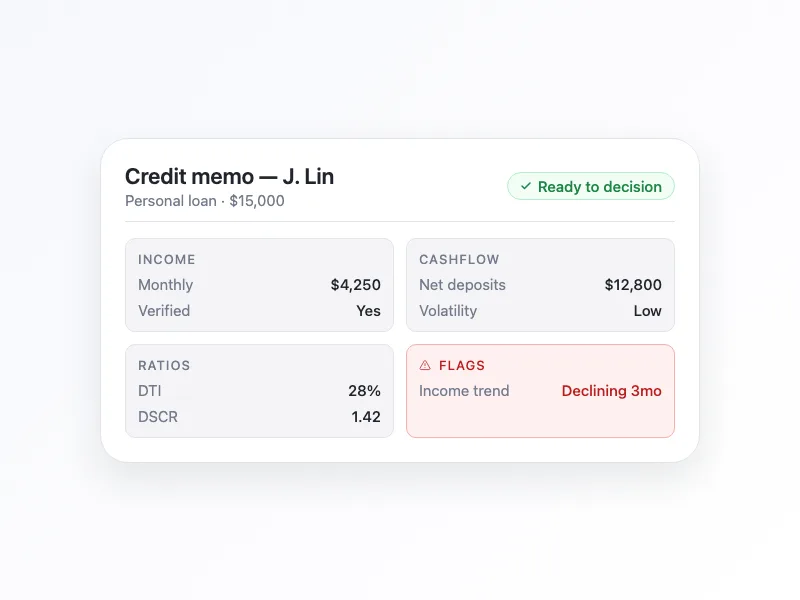
One pass from intake to a complete underwriting file
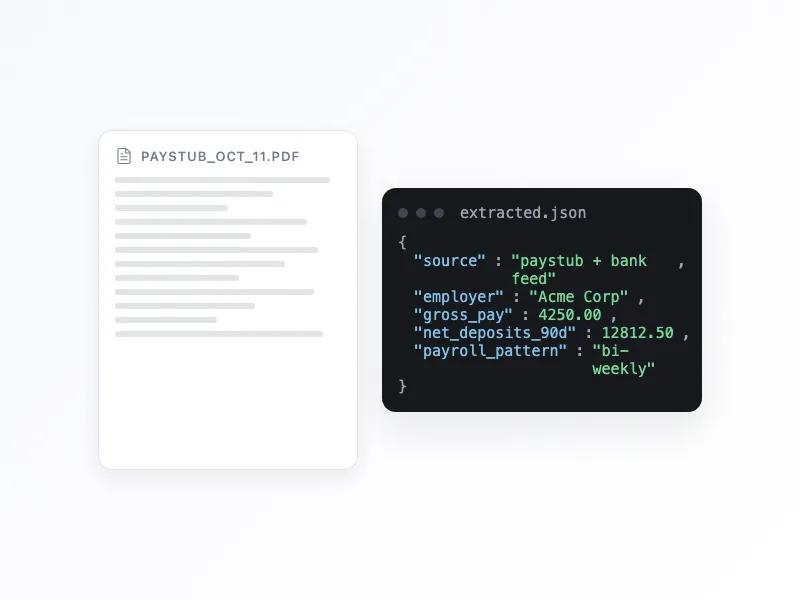
Turn every document and cashflow feed into structured data
Every document type your product touches
Paystubs, T4s, personal and business bank statements, tax filings, merchant processor exports, AR agings, and voided checks. Every field lands labeled, typed, and traceable to its source page.
Line-item data from cashflow feeds
Open banking and merchant processor feeds arrive as transactions, not PDFs. Deposits, payroll, ACH debits, and loan repayments come pre-categorized and tied to the applicant.
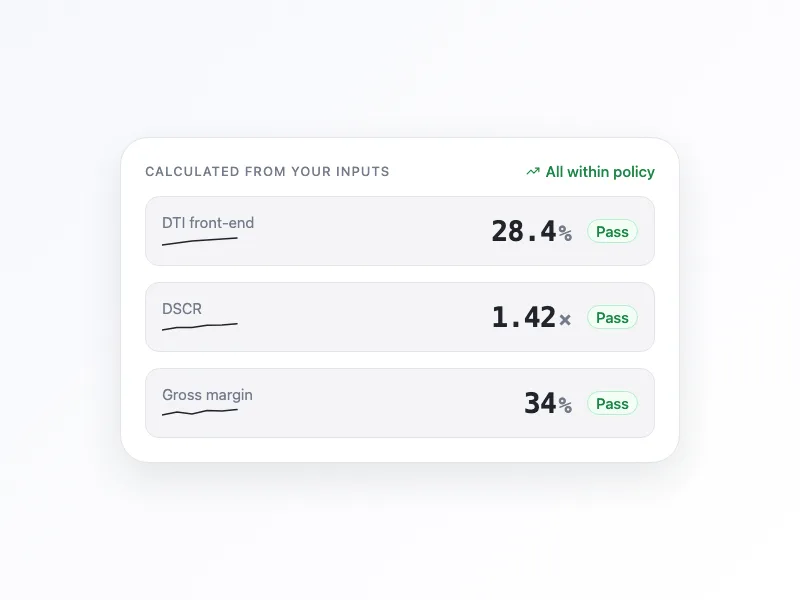
Every ratio your credit memo needs, calculated the moment data lands
Ratios tied to your credit policy
Front- and back-end DTI for consumer files. DSCR, current ratio, and gross and net margin for business files. Override the formula per product and the engine recalculates the moment inputs change.
Trend and seasonality across the whole file
Revenue trend, cashflow volatility, deposit concentration, and month-over-month change surface as numbers, not spreadsheet formulas. Your underwriter opens the file with the picture already drawn.
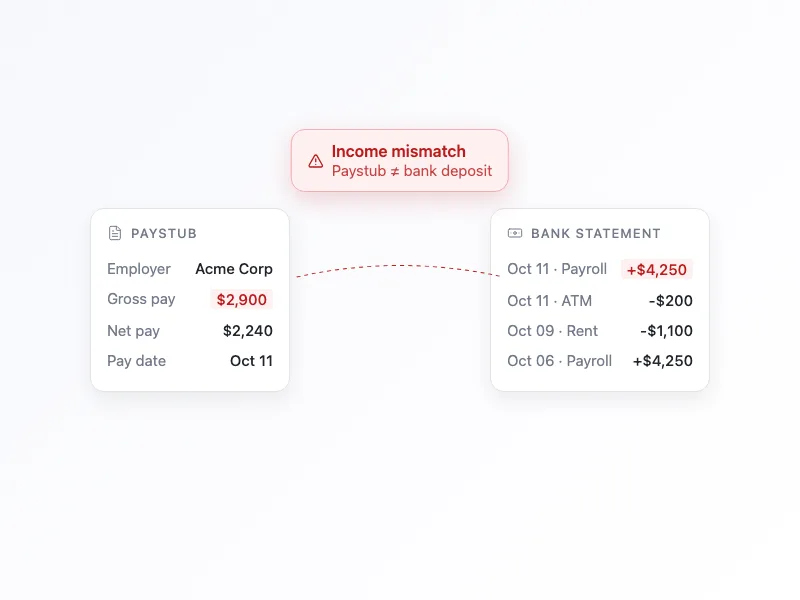
Catches what an underwriter would see on the fifth read
Cross-references every number against every other document
Three paystubs trending down flags an income risk. A bank deposit that doesn't match declared income flags a disclosure gap. A business whose top customer is half its revenue flags concentration risk.
Every flag linked to its evidence
Each flag points to the exact page, line, or transaction that triggered it. Your underwriter verifies the source in a click, not a document hunt.
How many more loans could you process at current headcount?
Plug in your numbers. The calculator shows today's per-loan cost and time, then what your team could process if Sphera removed 30% of the manual work on every file.
Underwriters and loan officers (FTEs)
Sphera Credit loan processing reads every document in a loan file, extracts the data, calculates the ratios and flags the risks, on consumer and commercial applications. Underwriters open a complete credit file with each figure traceable to its source page.
Sphera Credit can read any document needed for underwriting and extract its values. Common examples are paystubs, T4s and W-2s, personal and business bank statements, tax returns, financial statements, rent rolls, appraisals, merchant processor exports and accounts receivable agings. It also takes open banking and merchant processor feeds as transactions, with deposits, payroll, debits and loan repayments categorized and tied to the applicant.
Sphera Credit extracts values in two ways: with large language models, and with higher-precision extraction models that use predefined fields. Lenders set up a Document Processor for each type of document, where they design their own field schema by choosing which fields to extract and defining nested structures. Fields extracted by a Document Processor are highlighted in the document itself, so a reviewer checks each value against its source at a glance, which helps teams that process a high volume of applications.
Sphera Credit calculates the ratios each lender's credit policy calls for, and lenders can set the formula per product. For consumer loans and residential mortgages, that includes front-end and back-end debt-to-income (DTI), gross and total debt service ratios (GDS and TDS in Canada), payment-to-income, loan-to-value (LTV) and combined loan-to-value (CLTV) on second mortgages. For commercial real estate and DSCR loans, it includes net operating income (NOI), debt service coverage ratio (DSCR), debt yield, LTV, cap rate and break-even occupancy. For fix-and-flip and construction loans, it includes loan-to-cost (LTC), loan-to-after-repair-value (ARV) and loan-to-completed-value. For business loans, it includes DSCR and global DSCR, fixed charge coverage, debt-to-EBITDA, current and quick ratios, debt-to-equity and gross and net margins, along with revenue trend, cashflow volatility and deposit concentration.
Sphera Credit cross-references every number against the other documents in the file. It flags, for example, paystubs that trend down, a bank deposit that does not match declared income, or a business that earns half its revenue from one customer. Each flag links to the exact page, line or transaction that triggered it.
Yes. Underwriters ask a question about a loan file in plain language and Sphera Credit answers with direct citations to the documents, so every answer can be checked against the file itself.
No. Sphera Credit prepares the file: it reads, extracts, calculates and flags. The underwriter reviews a complete file, verifies any flag against its source and makes the credit decision.
Tell us how your team processes files today
We'll go over how your team reads and verifies a file, and the systems it works in. Then we'll quote you for an on-site assessment, in which our team maps that work and designs the AI-native process we implement on Sphera.