

Read a credit report in four passes: confirm the identifying information is yours, check that every account listed is one you opened, decode the rating code and dates on each account, then compare what you find against the other bureau's copy. Reading in that order matters, because an unfamiliar address near the top is often the first sign that someone else's file has been merged into yours, and that single finding changes how you read everything below it.
A credit report is a summary of how you have used credit, built by a credit bureau from what your lenders send in each month. Canada has two: Equifax Canada and TransUnion Canada. Both hold a separate file on you, both build it from whichever lenders choose to report to them, and neither one decides whether you get approved. The lender makes that decision using the report as an input.
The report also does not contain your credit score. The score is calculated from the file at the moment someone requests it, which is why the number in a free app can differ from the number a mortgage officer quotes you on the same afternoon. If you want the score rather than the document, how to check your credit score covers the app-by-app differences, and how a credit rating is calculated explains how the entries below roll up into a three-digit number.
Two habits make the rest of this page easier to apply:
- Pull both bureaus. A lender may report to only one. An account missing from Equifax is not necessarily missing from TransUnion.
- Pull the full disclosure, not the app summary. The free score apps show a simplified view. The payment-profile tables and the date fields that this page decodes only appear on the full report. How to check your credit rating for free covers which routes return the complete document.
A Canadian credit report has five sections: identifying information, trade lines, public records and registered items, collections and banking items, and inquiries. The FCAC publishes the full field list, and the two bureaus present the same five groups under slightly different headings (FCAC).
| Section | What it holds | What to check |
|---|---|---|
| Identifying information | Name, date of birth, current and previous addresses and phone numbers, SIN, driver's licence number, current and previous employers and job titles | Every address and employer is genuinely yours |
| Trade lines | One entry per credit card, loan, line of credit, mortgage, and often phone, internet and utility accounts | Every account is one you opened, with the right limit |
| Public records and registered items | Bankruptcies, consumer proposals, court judgments related to credit, liens such as a registered interest in a financed car | Each entry matches a real event, with the right date |
| Collections and banking items | Debts sent to a collection agency, non-sufficient funds payments, bad cheques, accounts closed for money owing or fraud | You recognise the original creditor behind each collection |
| Inquiries | Every lender or organisation that requested your file, plus your own requests | You recognise each hard inquiry |
Two things are deliberately absent. Your report carries no income, no savings balances, no medical history, no criminal record, and no information about your race, religion or political affiliation. And cash purchases never appear, however large, because no lender was involved to report them.
The bureaus refresh the file at least monthly, and each lender reports on its own cycle. That is why a balance you paid off last week can still show as outstanding: the trade line is showing the balance as of the last date that lender reported, not today.
Every trade line carries the same dozen fields, and four of them do almost all the work: the rating code, the credit limit, the balance, and the date of last activity. Most guides stop at the rating code. The example below walks one account across all of its fields, using the labels the Canadian bureaus actually print.
| Field | Example value | What it tells you |
|---|---|---|
| Creditor | Bank credit card | Which lender is reporting the account |
| Account type | R (revolving) | R revolving, I instalment, O open, M mortgage |
| Rating | 1 | 0 to 9 payment status, described in the next table |
| Date opened | 03/2018 | Feeds the length of your credit history |
| High credit | $4,820 | The largest balance this account has ever carried |
| Credit limit | $6,000 | The denominator when a lender calculates utilisation |
| Balance | $1,140 | The numerator, so this line reports 19% utilisation |
| Past due | $0 | Any amount above zero is an active delinquency |
| Payment amount | $75 | The scheduled minimum for the reported period |
| Date of last activity | 07/2026 | The date that starts the purge clock on this account |
| Date reported | 08/2026 | How current the entry is, and how fresh the balance is |
| Months reviewed | 84 | How many months of history the lender has supplied |
| Previous high rate | 2, in 04/2025 | The worst rating ever recorded on this account |
Read the account type and rating together as a two-character code. The letter is the kind of credit and the number is the payment status, so a credit card paid on time reports as R1 and a car loan paid 45 days late reports as I2.
| Code | Meaning |
|---|---|
| 0 | Approved but too new to rate |
| 1 | Paid within 30 days of the due date, as agreed |
| 2 | Paid 31 to 59 days late |
| 3 | Paid 60 to 89 days late |
| 4 | Paid 90 to 119 days late |
| 5 | More than 120 days late, not yet written off |
| 7 | Being repaid under a debt-management arrangement, such as a consumer proposal or credit counselling |
| 8 | Repossession |
| 9 | Written off as bad debt, sent to collections, or included in a bankruptcy |
A 6 is defined in the scale but almost never appears in practice. For what an R7 or R9 does to a mortgage application specifically, see can you get a mortgage with an R7 credit rating. If the R7 would come from a proposal you are still weighing, our page on whether a consumer proposal is worth it sets the credit damage against the debt it clears.
Three fields on that first table deserve more attention than they usually get:
- Previous high rate. The rating field shows today's status. Previous high rate shows the worst status ever recorded, and Equifax keeps it for 6 years even after you bring the account current (Equifax Canada). An account showing R1 today can still be carrying a visible R2 from last year.
- Date of last activity. This is the field that decides when the entry disappears, and it is the one readers most often misread as the date they paid the account off.
- High credit versus credit limit. On accounts with no formal limit, the bureau may use high credit as a stand-in when calculating utilisation, so a large one-off purchase can quietly reset how full the account looks.
Most negative entries fall off a Canadian credit report after six years, but the exact lifespan depends on the item, on the bureau, and in the case of bankruptcies and judgments on your province. The two bureaus publish their own schedules, and those schedules disagree on four common entry types.
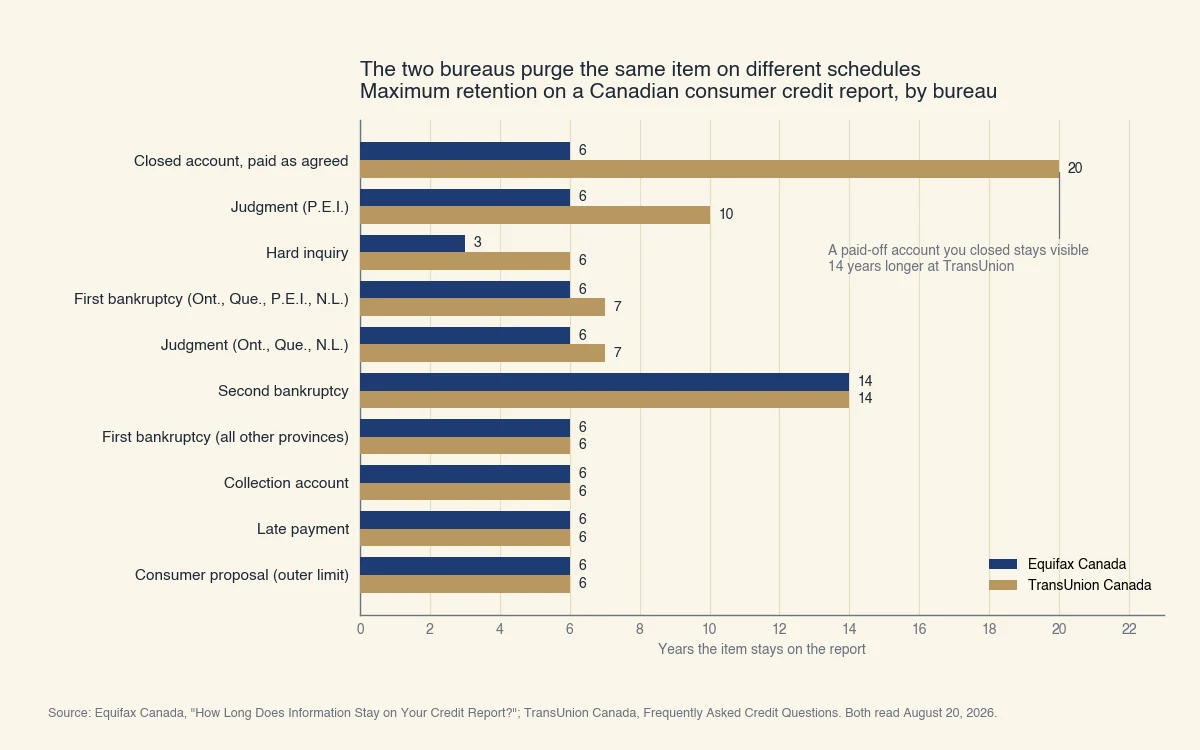
Source: Equifax Canada, "How Long Does Information Stay on Your Credit Report?"; TransUnion Canada, Frequently Asked Credit Questions. Both read August 20, 2026.
| Item | Equifax Canada | TransUnion Canada | Clock starts from |
|---|---|---|---|
| Closed account paid as agreed | 6 years | 20 years | Date reported closed (Equifax), last date of activity (TransUnion) |
| Late payment | 6 years | 6 years | Date reported (Equifax), first delinquency (TransUnion) |
| Collection or charged-off account | 6 years | 6 years | First delinquency with the original creditor |
| Consumer proposal | 3 years after you finish paying, or 6 years from filing, whichever comes first | 3 years after you satisfy it, or 6 years after default, whichever comes first | Completion, or filing and default |
| Credit counselling or orderly payment of debt | Not published separately | 2 years after the program is satisfied, or 6 years after default, whichever comes first | Completion, or default |
| First bankruptcy | 6 years, or 7 years from filing if never discharged | 6 years in B.C., Y.T., N.W.T., Nu., Alta., Sask., Man., N.S., N.B.; 7 years in Ont., Que., P.E.I., N.L. | Date of discharge |
| Second and later bankruptcies | 14 years | 14 years | Each discharge date |
| Judgment | 6 years | 6 years in B.C., Y.T., N.W.T., Nu., Alta., Sask., Man., N.S., N.B.; 7 years in Ont., Que., N.L.; 10 years in P.E.I. | Date of judgment |
| Secured loan or registered item | 6 years | Not published separately | Date filed |
| NSF payment or returned cheque | 6 years | Not published separately | Date reported |
| Hard inquiry | 3 years | 6 years | Date of the inquiry |
| Account review inquiry | Not disclosed to other lenders | 1 year, or 2 years in Quebec | Date of the inquiry |
| Consumer statement | Not published separately | 6 years | Date posted |
Two consequences follow directly from that table, and both change how you read your own file.
Your two reports are supposed to disagree. A card you closed in good standing in 2012 has already left Equifax and will sit on your TransUnion file until 2032. A mortgage rate-shopping trip from four years ago has left Equifax and is still visible at TransUnion. When the thinner report looks cleaner, that is a retention rule doing its job, and disputing the entry on the fuller report will not remove it.
Paying a collection does not remove it. Equifax states the position plainly: if you pay a collection account before the six years are up, the entry remains, though it may weigh less on your score (Equifax Canada). The clock runs from the date you first went delinquent with the original creditor, so paying neither restarts it nor shortens it. Anyone offering to have a paid collection deleted early is describing something the bureaus do not do.
The same logic applies to the date of last activity on an ordinary account. It is an activity marker, not a settlement date, and it is what the purge schedule reads.
Check the four things that are most often wrong and most costly when they are: addresses you do not recognise, accounts you did not open, ratings worse than your records support, and hard inquiries you did not authorise. Everything else on the report is worth reading once and worth disputing only when you can name the specific fact that is untrue.
Work through the file in this order and write down what you find before deciding what to do about it:
- Identifying information. An unfamiliar address or employer suggests either a stale record or a mixed file, where someone with a similar name and SIN has been merged into yours.
- Trade lines you do not recognise. An account you never opened is the clearest fraud signal on the report, and it is the one to act on immediately.
- Limits and balances. A limit reported lower than your actual limit inflates your utilisation on that line, which quietly costs you score for no reason.
- Ratings and previous high rate. Match each rating against your own payment records. A rating worse than your records support is disputable; a rating you earned is not.
- Collections and public records. These carry the most weight, so verify the original creditor, the amount, and the date of first delinquency on each.
- Hard inquiries. An inquiry you did not authorise means an application was made in your name.
Then triage what you found. The distinction that saves the most wasted effort is between a factual error and a retention difference:
- Dispute it when a specific fact is wrong: an account that is not yours, a limit or balance that never matched reality, a rating that contradicts your records, a bankruptcy or judgment with the wrong date, an inquiry you did not authorise.
- Leave it when the entry is accurate and simply older or newer than you expected, or when it appears on one bureau and not the other. That is the retention schedule, and disputing it wastes a cycle.
File the dispute with the bureau carrying the entry, and with both if both carry it. Each bureau contacts the lender to verify what it reported and typically completes the investigation within about 30 days (FCAC). If the investigation confirms the entry but the circumstances matter, both bureaus let you attach a short consumer statement to your file, which stays on the record for six years and which any lender reading the report will see.
One last framing worth carrying into the next review. A report that reads well is mostly a report with nothing on it that should not be there. Building a good file takes years of on-time payments and patient account aging, and none of that can be rushed. Removing an entry that was never yours takes about a month, and it is the only fast improvement the system genuinely allows. That is the strongest argument for reading the document rather than checking the number. For what moves the number once the file is clean, see why did my credit score drop.