

How do you dispute a credit card charge?
You dispute a credit card charge by asking the merchant to fix it in writing first, then telling your card issuer the transaction is wrong and asking it to raise a chargeback, while you keep paying the rest of the bill. The Financial Consumer Agency of Canada treats prompt reporting as the thing that protects your rights, so the date you raise it matters as much as the evidence you bring (FCAC).
Work through it in this order. Each step produces the evidence the next one needs:
- Confirm the charge is actually wrong. Check the posting date, the merchant's trading name (which is often different from its storefront name), and any free trial that converted into a subscription.
- Contact the merchant in writing. Email beats a phone call, because it creates the record your bank will ask for. Say what you want, give a deadline, and keep the reply.
- Gather the file. Receipt or order confirmation, delivery tracking, the cancellation notice you sent and the date you sent it, photos if the goods arrived damaged, and the merchant's response or its silence.
- Tell your issuer. Give the transaction date, the amount, the merchant name, the reason, and the evidence. Ask what its internal deadline is and get the case number.
- Pay everything you are not disputing. Interest keeps accruing on any balance you withhold, and a late payment is reported to the credit bureaus while the dispute is not.
- Follow the clock. If nothing has moved by the date the issuer gave you, escalate rather than wait.
The one step people skip is the second. It feels like a delay your bank invented, and it is not. Under Visa's own rules the issuer has to wait before it can file certain chargebacks, which is covered further down.
What is the difference between a dispute, a chargeback, and fraud?
A dispute is what you file with your bank, a chargeback is what your bank then files against the merchant's bank under the card network's rules, and fraud is a separate category with its own liability cap. The three get used interchangeably everywhere, and the distinction decides which rules apply to your money.
- A dispute is your request to the issuer. You are the party, the issuer decides, and the issuer's internal complaint process is your appeal route.
- A chargeback is the reversal your issuer files with the merchant's bank through Visa, Mastercard, or American Express. You are not a party to it. That is why there is nobody at the network to call when it fails.
- An unauthorized transaction is one you did not make or approve, which is the fraud path rather than the merchant-dispute path.
The fraud path carries a statutory floor under it. When someone uses your credit card without permission, your maximum liability by law cannot be more than $50.00 unless you demonstrated gross negligence, and the networks layer their own zero-liability commitments on top of that, so a promptly reported fraud usually costs you nothing (FCAC). Ontario codifies the same number for lost and stolen cards: you owe nothing for charges after you give notice, and the lesser of $50 or the amount in your cardholder agreement for charges before you give it (O. Reg. 17/05, s. 58).
Gross negligence is where that protection ends. Using your birthdate as a PIN, writing it on the card, sharing it with a family member, or refusing to cooperate with the investigation are the behaviours FCAC lists as putting you back on the hook.
The Ombudsman for Banking Services and Investments draws the same line in its published approach. Unauthorized transactions are usually settled through the networks' zero-liability policies, while a problem that starts with the merchant, such as an overcharge, a billing error, an undelivered item, or a misrepresentation, moves through the chargeback process instead (OBSI).
How long do you have to dispute a credit card charge?
Two clocks run at the same time: your issuer's internal window, usually about 30 days from the statement, and the card network's outer limit, which Visa sets at 120 calendar days for most consumer disputes. Missing the first one is recoverable. Missing the second one ends the network route entirely.
Visa's published rulebook is specific about both ends of the window. For merchandise or services not received, the issuer must wait 15 calendar days from the transaction date, or from the date you expected delivery, before it files. The dispute then has to be processed no later than 120 calendar days from the transaction processing date, or 120 calendar days from the last date you expected the goods or services, capped at 540 days. For a recurring charge that continued after you cancelled, the limit is a flat 120 calendar days from the transaction processing date (Visa Core Rules and Visa Product and Service Rules, 18 April 2026).
Here is how the routes compare once you lay them side by side:
| Route | When the clock starts | Deadline | What you get |
|---|---|---|---|
| Your issuer's own window | Statement date | Commonly about 30 days, set in your cardholder agreement | An internal decision, plus a complaint process if it goes against you |
| Visa network chargeback | Transaction processing date, or the date you expected delivery | 120 calendar days for most consumer conditions | A reversal filed against the merchant's bank, decided under network rules |
| Ontario statutory request | The day the supplier's 15-day refund window closes | 60 days after that window closes | A written answer on a legislated clock, and a right to sue the issuer |
| Quebec statutory request | The day the merchant defaults on the 15-day refund | 60 days following the default | Acknowledgment in 30 days, reversal within 90 days or two statement periods |
The two statutory rows are the ones almost nobody mentions, and they are the subject of the next section.
What is a statutory chargeback, and when does it beat the bank's process?
A statutory chargeback is a written demand you send directly to your card issuer under provincial consumer protection law, and the issuer has to answer it on a legislated timetable that has nothing to do with Visa's rules. It exists in most provinces, it cannot be signed away in a cardholder agreement, and in Ontario you can sue the issuer if it ignores you.
The catch is that it is narrower than the network route. It applies where you cancelled the agreement under the Act, or the payment was collected in breach of the Act, and the supplier then failed to refund you. It is not a general-purpose backup for any charge you dislike. Inside that boundary, it is stronger than anything your bank offers.
The Ontario chain, step by step
Ontario's section 99 gives a consumer who charged a payment to a credit card the right to ask the issuer to cancel or reverse that charge along with any associated interest (Consumer Protection Act, 2002, s. 99). The regulation supplies the numbers:
- Day 0. You cancel the consumer agreement, or demand a refund, in accordance with the Act and give the supplier written notice.
- Day 15. The supplier has 15 days from your notice to refund you (O. Reg. 17/05, s. 79(1)).
- Day 16 to day 75. If no refund arrived, you have 60 days from the end of that refund window to give the issuer your written request (s. 85(1)).
- Within 30 days of your request. The issuer must acknowledge it (s. 85(3)).
- By the second statement after your request. The issuer must either reverse the charge and the interest on it, or send you written reasons why it believes you were not entitled to cancel (s. 99(5) and s. 85(4)).
- If it does neither, section 99(6) lets you start an action against the credit card issuer to recover the payment and the associated charges.
Ontario passed a replacement statute, the Consumer Protection Act, 2023, but it has not been proclaimed into force. The 2002 Act and O. Reg. 17/05 are the law in effect as of the e-Laws currency date of August 24, 2026.
The Quebec chain, step by step
Quebec runs a parallel scheme for distance contracts, which covers most online and telephone purchases. The merchant has 15 days from the cancellation to refund everything you paid. If it defaults, you have 60 days following the default to send the issuer a written chargeback request. The issuer must acknowledge receipt within 30 days, and must complete the chargeback within 90 days or two complete statement periods, whichever comes first (Consumer Protection Act, ss. 54.13 to 54.16).
What the written request has to contain
A request missing a prescribed item is not a valid request, so treat this as a checklist rather than a letter. Both provinces ask for essentially the same file:
- your name as it appears on the card
- the credit card account number and expiry date
- the supplier or merchant name
- the date of the agreement
- each charge you want cancelled, with its amount, its posting date, and a description of the transaction
- a statement that you cancelled the agreement or demanded the refund under the Act
- the date of that cancellation or demand, and the method you used to send it
Ontario requires the request to be signed. Quebec's Office de la protection du consommateur publishes a template you can adapt. Send it by a method that produces proof of delivery and keep the proof, because the acknowledgment clock starts from when the issuer receives it.
What happens if your bank refuses the dispute?
A refusal is the start of the escalation path, and it is free to use. Take the decision through the bank's own complaint process first, then to the Ombudsman for Banking Services and Investments, which became the single external complaints body for all federally regulated banks in fiscal 2025.
The volume tells you how ordinary a refused card dispute is. OBSI opened 5,438 banking cases in 2025, more than double the prior year, and credit cards were the most complained-about product by a wide margin at 1,576 cases, or 29% of the total, up 108% year over year. Chargebacks were the fourth most common issue on their own, at 290 cases (OBSI Annual Report 2025).
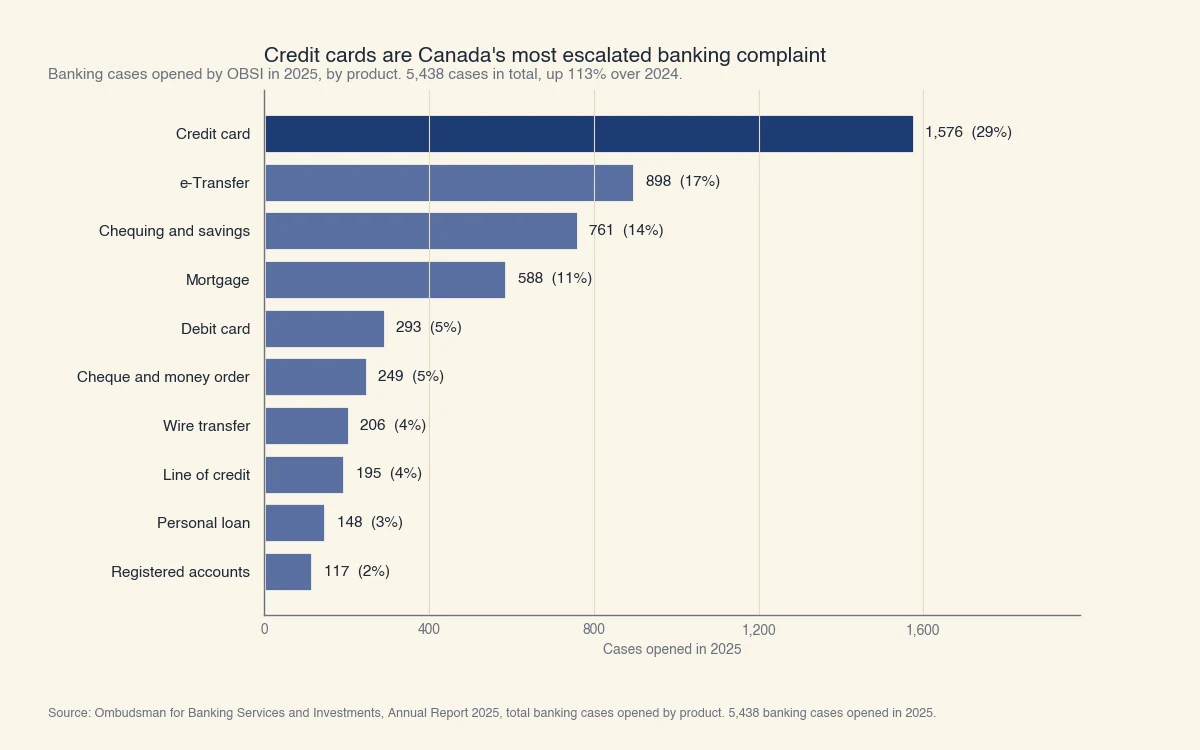
Source: Ombudsman for Banking Services and Investments, Annual Report 2025, total banking cases opened by product. 5,438 banking cases opened in 2025.
Across all case types OBSI recommended roughly $5.8 million in compensation over more than 1,300 cases in 2025, averaging $3,659 per compensated banking case, and it took 43 days on average to finish an investigation.
Knowing what the ombudsman actually weighs changes what you send it. OBSI reviews whether the bank followed the applicable rules and its own procedures, treated you fairly, and reached a reasonable decision on the evidence available. On your side it looks at whether you protected your card and PIN, gave a valid reason for the dispute, raised it inside the required timelines, and cooperated with the investigation (OBSI). The outcome turns on the evidence each party can produce, which is the argument for keeping the written trail from step two.
Two limits are worth knowing before you file. OBSI reviews disputes between you and your bank, so it will not pursue the merchant for you. And it cannot investigate Visa or Mastercard, because the networks are not participating firms. If your complaint is about the bank's conduct rather than the money, the Financial Consumer Agency of Canada supervises federally regulated institutions on their consumer-protection obligations and takes complaints directly.
Which charges can you not dispute?
A chargeback reverses a transaction that was wrong, and it is not a refund mechanism for a purchase you regret. Issuers reject these routinely, and a pattern of them is treated as friendly fraud, which can cost you the account.
| Situation | Why it fails | What works instead |
|---|---|---|
| You changed your mind | The transaction was authorized and delivered as described | Use the merchant's return policy inside its window |
| The merchant's no-refund policy applied | You accepted the terms at purchase | Check whether provincial law overrides the term for your contract type |
| A family member used your card with permission | Authorized use, so it is not fraud | Settle it privately, and remove the supplementary card |
| You forgot about a subscription you never cancelled | The charge is valid until you cancel | Cancel first, then dispute only charges after the cancellation date |
| The goods arrived late but did arrive | Delivery happened, so non-receipt does not apply | Claim under the merchant's late-delivery terms |
| Quality was disappointing rather than misrepresented | Preference is not a dispute condition | Return it under the merchant's policy |
The line that matters is whether the merchant did what it said it would. Undelivered goods, goods materially different from the description, a duplicate posting, an amount that does not match what you agreed, and a recurring charge after a documented cancellation are all defensible. Regret is not.
If the charge you are questioning is on a card you are thinking of closing, deal with the dispute before you close it, because a closed account complicates the reversal. Our guide to cancelling a credit card covers what keeps billing after closure. If the issue turned out to be fraud, checking your file matters as much as reversing the charge, and you can pull your credit report for free from both Canadian bureaus.
Sphera Credit builds AI agents that work inside lenders' credit decisions on the applications that fall outside a standard credit box. A file carrying a disputed balance, a reversed transaction, or a card closed in the middle of a complaint is exactly the pattern a rigid rule misreads as risk. The value there is in reading the file accurately and being able to explain the decision that follows.
If you are the cardholder, the useful next step is dull and effective: put the date, the amount, and the merchant name of the charge in writing today, send it to the merchant, and diarise the day your issuer's window closes.