

How do you cancel a credit card in Canada?
You cancel a credit card by contacting the issuer directly and asking them to close the account, then confirming the closure in writing and checking your credit report about 30 days later. The Financial Consumer Agency of Canada sets out three steps: contact the issuer by phone or in writing, check your statement afterward, and check your credit report to confirm the account shows as closed (FCAC).
The part most people get wrong is the first step. FCAC is explicit that none of the following cancels a credit card account:
- cutting up your card
- letting it expire
- not using it
An untouched card is still an open account. It still reports to the bureaus, it can still carry an annual fee, and some issuers charge an inactivity fee or close the account on their own terms rather than yours.
Before you make the call, four things are worth doing in order, because each one is harder to fix afterward:
- Pay the balance to zero. Issuers will not close an account that still carries a balance, and interest keeps accruing on anything outstanding even after a closure (FCAC).
- Redeem or transfer your rewards. Points and cash back usually disappear with the account. This is the one step that cannot be undone.
- Move your recurring payments. Every subscription, insurance premium, and pre-authorized bill needs a new payment method first.
- Note when the annual fee posts. Closing shortly after the fee lands means you have paid for a year you will not use.
Then contact the issuer. Some Canadian banks accept a closure request through secure online messaging; others still require a phone call. Expect to be offered a lower rate, a fee waiver, or a different card before the representative processes the request. Whichever channel you use, write down the date, the time, and the name of the person you spoke with, and ask for written confirmation of the closure. Keep that confirmation, because it is your evidence if the account resurfaces later.
Does closing a credit card hurt your credit score?
Closing a card has two separate effects on your credit, one immediate and one delayed, and most guidance blurs them into a single warning that is wrong about timing. Separating them tells you what you are actually trading away.
The immediate effect is credit utilization. Your utilization rate is the share of your available credit you are using, and it is one of the heaviest factors in a credit score after payment history. Closing a card removes its limit from your total, so the balances sitting on your other cards suddenly represent a larger share of a smaller number. Nothing about your spending changed, but your ratio did, on the day the account closes. FCAC advises using less than 30% of your total credit limit, and adds a line worth reading twice if you are about to close a card: aim to have a higher credit limit and use only a small portion of it (FCAC).
The delayed effect is the length of your credit history, and it does not arrive when you close the account. A closed account does not vanish from your file. Equifax Canada keeps closed accounts that were paid as agreed on your report for up to 6 years after the lender reports them closed (Equifax Canada). FCAC publishes longer figures still: up to 10 years for closed accounts at Equifax, and up to 20 years at TransUnion, where positive information stays on file even after you close the account (FCAC).
Those two published numbers for Equifax do not agree, and it is worth knowing that rather than picking one. What matters for your decision is the part they agree on: closing your oldest card today does not shorten your credit history today. It starts a clock. The average age of your accounts drops years from now, when the record finally ages off your file, which may land in the middle of a mortgage renewal you have not thought about yet.
So the practical order is reversed from the usual advice. The utilization hit is real, immediate, and something you can calculate before you call. The history hit is deferred by years and is a reason to think about timing, not a reason to keep every card open forever. If your score has moved recently for reasons you cannot place, our page on why a credit score drops walks through the other common causes.
Which credit card should you close?
Close the card with the smallest credit limit you can live without, because the damage to your utilization tracks the limit you remove, not the number of accounts you close. This is the decision most guidance skips. The question is rarely "should I close a card" in the abstract. It is "which of these three".
Take a straightforward Canadian example. You hold three cards and carry a $2,000 balance on the one you use every day:
| Card | Credit limit | Balance |
|---|---|---|
| Oldest no-fee card | $12,000 | $0 |
| Everyday card | $6,000 | $2,000 |
| Store card | $2,000 | $0 |
| Total | $20,000 | $2,000 |
Your utilization today is $2,000 divided by $20,000, or 10%. Now work out each option. Only the two zero-balance cards can be closed, since the issuer will not close an account carrying a balance:
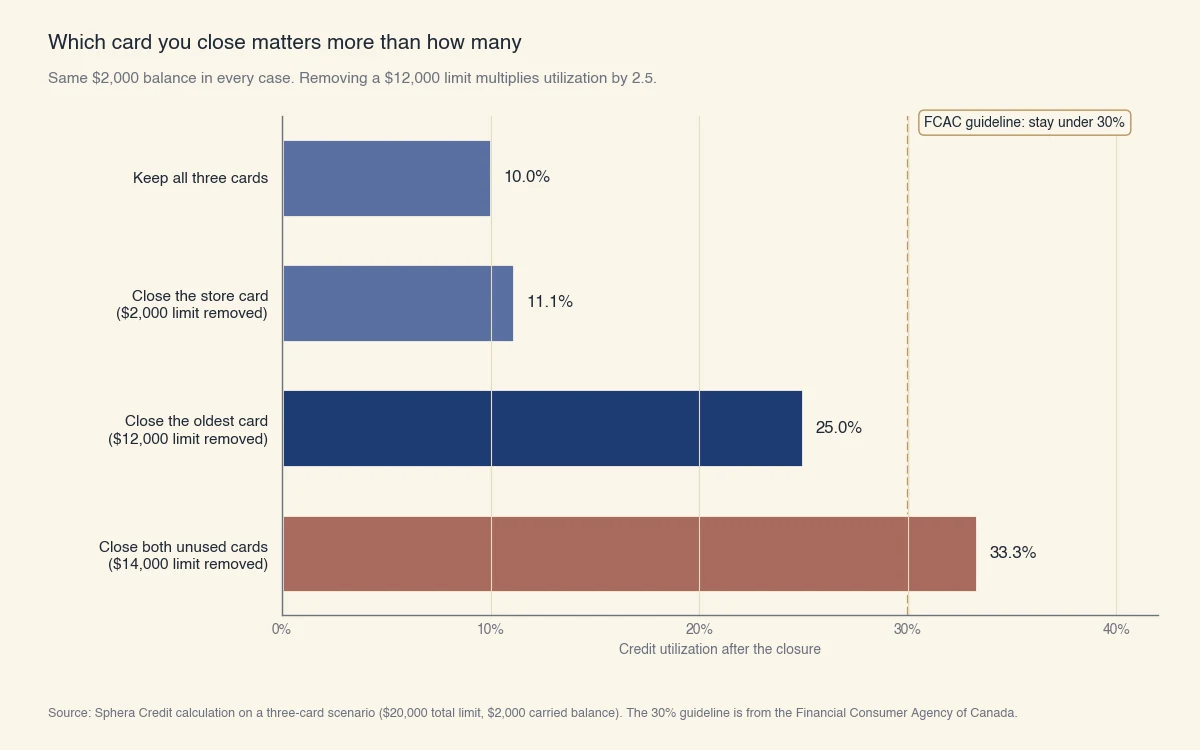
Source: Sphera Credit calculation on a three-card scenario ($20,000 total limit, $2,000 carried balance). The 30% guideline is from the Financial Consumer Agency of Canada.
Closing the store card takes utilization from 10% to 11.1%, which is close to nothing. Closing the oldest card takes it to 25%, because you removed $12,000 of headroom to shed an account you were not paying for. Closing both leaves you at 33.3%, past the level FCAC suggests staying under, on identical spending.
Two rules fall out of the arithmetic:
- The limit is what counts. A card with a large limit and no balance is doing useful work simply by existing. It costs nothing to keep if there is no annual fee.
- Do the division before you call. Take your total balances, divide by your total limit minus the limit you are about to give up, and see where you land. It takes a minute and it is the whole decision.
The number of cards you hold is a separate question from which one to close, and we cover it in how many credit cards you should have. For the score bands these ratios feed into, see what counts as a good credit score.
What does closing a credit card not cancel?
Closing the account does not stop the charges already attached to it, and it does not settle what you still owe. FCAC warns that transactions you approved before the closure can still appear on your statement afterward, along with recurring charges such as a monthly gym membership (FCAC).
Pre-authorized payments are the trap here. Closing the card does not cancel the underlying agreement with the merchant. If you do not contact the company and arrange another payment method or end the service, they keep billing, the charges build up, and you are still responsible for them. Interest continues to apply to any outstanding balance after the account is closed.
Three things to check in the weeks after you close a card:
- Your final statements. Read the closing statement and the one after it, not just the closing one.
- Your credit report. Allow about 30 days for the issuer to report the closure to Equifax and TransUnion, then confirm the account shows as closed (FCAC). If it still shows as open after that, dispute it with the bureau.
- Your written confirmation. Keep it until the credit report matches it.
What happens to supplementary and joint cardholders?
Additional cards issued on your account stop working when the primary account closes, so collect and destroy those too, not only your own card. A supplementary cardholder is spending on your credit, and you carry the liability for the balance, but the account may still appear on their credit report.
A joint account is different, because both people are fully liable for the debt. Closing one is a decision both parties are affected by, and any remaining balance has to be dealt with before the account can close. If you are separating finances from someone else, confirm with the issuer in writing which accounts are joint and which are supplementary before you close anything, because the two are easy to confuse and carry different consequences.
When should you switch cards instead of cancelling?
If the annual fee is the reason you want out, ask the issuer to move you to a no-fee card in the same family instead of closing the account. Issuers generally allow a product change, which keeps the account open, keeps its age on your credit file, and keeps its limit in your utilization calculation, while removing the fee that prompted the call.
Cancelling is usually the better answer when:
- the card drives spending you would not otherwise do
- the issuer will not move you to a version without the fee
- it is a joint account you need to be separated from
- the card charges an inactivity fee you cannot avoid
Keeping the card open is usually better when it is an old no-fee card with a meaningful limit. Put one small recurring charge on it, pay that automatically in full, and it holds its limit in your ratio and its age on your file at no cost.
Before you decide, it is worth comparing what else is available rather than accepting the first retention offer. FCAC runs an independent credit card comparison tool covering fees, rates, and rewards across Canadian issuers. Applying for a replacement card is a separate decision with its own effect on your file, which we cover in whether applying for a credit card affects your credit rating.
Sphera Credit builds AI agents that work inside lenders' credit decisions on the applications that fall outside a standard credit box. A file with a recently closed account, a limit that dropped, or a utilization ratio that jumped for structural rather than behavioural reasons is exactly the pattern a rigid rule misreads. The value there is in reading the file accurately and being able to explain the decision that follows.
If you are the borrower, the useful next step costs nothing: pull your own report from Equifax and TransUnion, confirm which accounts are open and what limits they carry, and run the utilization division before you close anything.