

How do you check your credit rating for free in Canada?
You check your credit rating for free by requesting your credit file directly from Equifax Canada and TransUnion Canada, which every province requires them to disclose to you, and in Ontario and Quebec that disclosure includes the score at no charge. The free consumer apps are a second route, and your bank app is a third, but they answer a narrower question than most people realise (FCAC).
Canada has two national credit bureaus. Equifax Canada and TransUnion Canada each maintain a separate file on you, and each file can say something slightly different, because not every lender reports to both. Checking one is not checking the other.
There are three practical routes to your file, and they do not deliver the same thing:
- Direct from the bureau. The most complete version of your file, including the per-account ratings that lenders read. This is the route the rest of this page is about.
- Free consumer apps. Borrowell, Credit Karma Canada and ClearScore give you a three-digit score at no charge, refreshed weekly or monthly.
- Your bank's app. Most of the Big Six surface a TransUnion score inside online banking for existing clients.
For a side-by-side comparison of the score-app options, which bureau each one uses and how often each refreshes, see how to check your credit score. This page covers the part those apps cannot give you: the credit report itself, the ratings on it, and the law that makes getting it free.
Every one of these routes is a soft inquiry, a look at your own file that no lender sees and no scoring model counts. Only a hard inquiry, which happens when a lender pulls your file to decide on an application, carries scoring weight.
What does Canadian law entitle you to for free?
Free access to your credit file in Canada is a legal entitlement, not a vendor courtesy, and the strongest entitlements are provincial: Ontario guarantees your report and score online once a month plus twice a year by phone or mail, and Quebec guarantees the report and the score outright. Almost every guide on this topic presents "free" as something Equifax or Borrowell chose to offer. That framing leaves you with no recourse when a request is refused or routed into a paid subscription.
Here is what the law actually says, by jurisdiction.
| Where you live | Governing law | What it guarantees | Fee limit |
|---|---|---|---|
| Ontario | Consumer Reporting Act | Report and score online once a month; report and score by phone or mail twice a year; a 200-word explanatory statement on your file | Up to $5 per additional request |
| Quebec | Credit Assessment Agents Act (in force February 1, 2021) | Free credit report and free credit rating, plus security alerts and explanatory statements | No charge to view your report online |
| British Columbia | Business Practices and Consumer Protection Act | A free written copy of your report on request, with two pieces of identification | Fees may apply to online requests |
| Everywhere in Canada | PIPEDA, section 8 | Access to the personal information an organization holds about you, answered within 30 days | A cost only if you were told the approximate amount first and confirmed you still want it |
Three details in that table are worth pulling out, because none of the top-ranking pages on this query mention them.
Ontario gives you 14 free looks a year, not one. Twelve online, one a month, plus two more by phone or mail. Ontario also caps anything beyond that at $5 per request, so an Ontario resident cannot lawfully be pushed into a $24.95 monthly plan simply to read their own file (Government of Ontario).
Quebec's free score is a statute, not a promotion. TransUnion's free online score is available to Quebec residents and not to the rest of Canada, which competing articles report as a quirk. It is the Credit Assessment Agents Act, which came into force on February 1, 2021 after the Desjardins data breach and designated Equifax Canada and Trans Union of Canada as credit assessment agents. It requires them to let Quebec consumers obtain and get an explanation of their credit rating at no charge (Gouvernement du Quebec).
PIPEDA backstops the whole country. Wherever you live, section 8(3) requires an organization to respond to an access request within 30 days, and section 8(6) allows a charge only if the organization told you the approximate cost first and you then confirmed the request stands (Department of Justice Canada). A surprise fee on a credit file request does not meet that test.
Ontario law also gives you a right most people never use: you can add a brief 200-word explanatory statement to your file, free, to give context on a specific item. It stays for six years unless you ask for it to come off sooner. If a strike on your file has a story behind it, a lender reading the report will see your version alongside it.
Why the free score you see is not your credit rating
The free apps show you a three-digit score; your credit rating in the Canadian sense is the R1 to R9 code sitting on each individual account of your credit report, and no free score app shows you those. This is the single most expensive misunderstanding on this topic, because people check a number monthly for years and never once look at the file a lender actually reads.
Three separate things travel under the same casual language:
- The credit report is the file. Every account, every limit, every payment, every collection, every inquiry, every public record.
- The R-rating is a code from R1 to R9 attached to each account on that report. R1 means paid as agreed; R9 means the debt went to collection or into a bankruptcy. The letter changes with the account type, so an instalment loan carries an I-code and open credit carries an O-code.
- The credit score is the three-digit number from 300 to 900 that a model produces by reading the report.
We cover how the R-scale rolls up into the score in how a credit rating is calculated. The point here is narrower and more practical: the R-codes live on the report, so the route you pick decides whether you ever see them. The two scales also top out in different places, and neither ceiling is the 850 an American article will quote. Our page on what the highest credit rating in Canada actually is sets R1, 900 and AAA side by side.
Two consequences follow, and both change what you should do:
The score you see free is not the score your lender pulls. Lenders buy specific score versions tuned to specific products, and an auto lender and a mortgage lender may read different numbers from the same file. A free consumer score is a good tracking signal and a poor prediction of an approval decision.
The free online report tier is not the full report. Equifax Canada's free online report excludes the payment-profile tables that carry up to 25 months of payment-by-payment history. If you are checking your file because you think a missed payment is being reported wrongly, the online tier will not show you the evidence. Request the mailed disclosure, which is the most complete version, and read the R-codes account by account.
If your reason for checking is curiosity or habit, an app is fine. If your reason is a mortgage application in six months, a dispute, a suspected error, or a recovery from a rough patch, go to the bureau and read the report.
What does a year of credit-file access actually cost?
Nothing, if you use the routes the law and the apps already give you, against $299.40 a year for the paid Equifax subscription that sells the same report and score with monitoring wrapped around it. Not one of the top-ranking pages on this query puts a number on either side of that comparison.
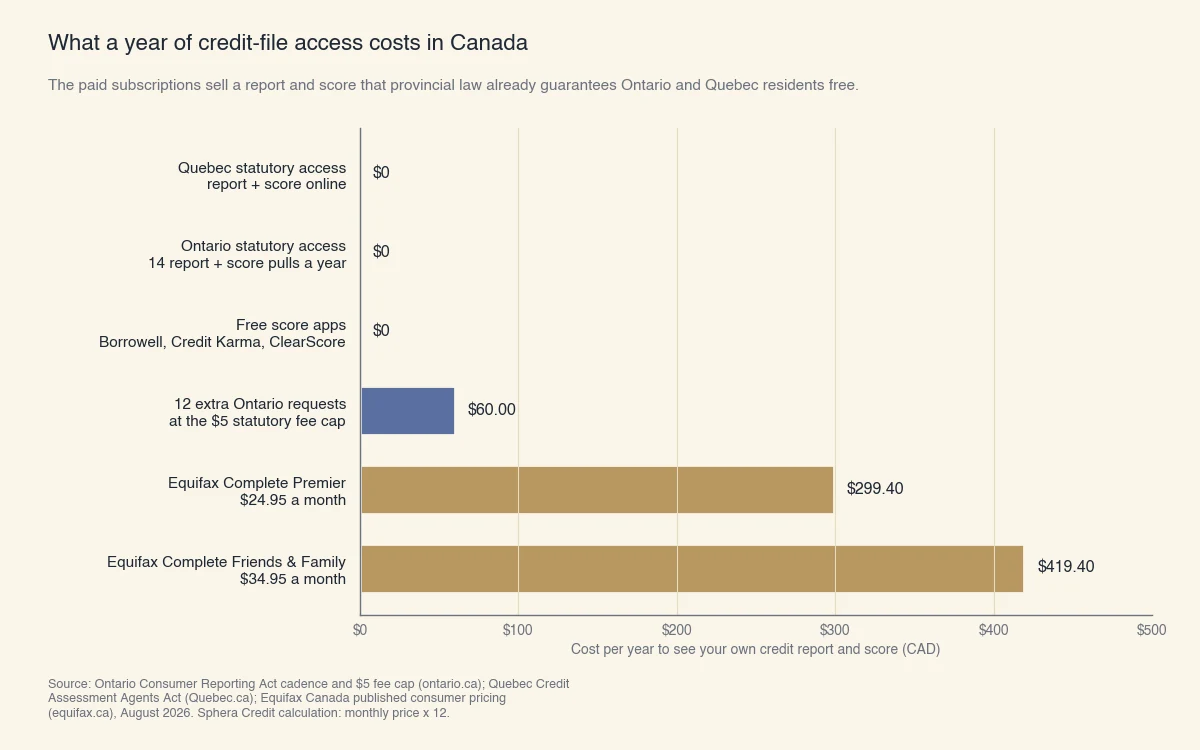
Source: Ontario Consumer Reporting Act cadence and $5 fee cap (ontario.ca); Quebec Credit Assessment Agents Act (Quebec.ca); Equifax Canada published consumer pricing (equifax.ca), August 2026. Sphera Credit calculation: monthly price x 12.
Equifax Canada publishes Equifax Complete Premier at $24.95 a month and Equifax Complete Friends & Family at $34.95 a month (Equifax Canada). Annualised, that is $299.40 and $419.40.
This does not make the paid plans a scam. It makes them a different product. What you buy at $24.95 a month is daily refreshes, credit alerts, dark web monitoring, identity restoration support and up to $1 million in identity theft insurance. What you do not buy is access, because access is already yours.
A reasonable way to decide:
- Use the free routes if you want to track your standing, check for errors before an application, or confirm nothing unexpected has landed on your file.
- Consider a paid plan only if you want continuous alerting after an identity theft incident or a data breach, and you have compared it against your bank's or credit card's existing monitoring benefit, which many Canadians already have without knowing it.
Even the statutory worst case undercuts the subscription. Twelve extra Ontario requests at the $5 legal cap total $60 a year, roughly a fifth of the Premier price, for the same underlying document.
What if the bureau cannot verify you online?
Switch to the mail or phone disclosure route, which verifies you with copies of your identity documents instead of knowledge questions about your credit history. A rejected online request is the most common place this process breaks down, and it is the one scenario almost every competing article leaves out.
Online verification works by asking questions only you should be able to answer, drawn from your existing file: a former address, a lender you once borrowed from, an approximate balance. That method fails predictably for certain people:
- Newcomers to Canada, whose file is too thin to generate questions.
- Young adults with one or two accounts and no history to draw on.
- Anyone who recently moved, where the address on file lags reality.
- Anyone who changed their name, where the identity match breaks.
- People rebuilding after insolvency, whose file was reorganised.
None of that means you have no file or no rights. It means the automated identity check cannot confirm you are you, which is a security feature working as intended. The mail-in disclosure form exists for exactly this case. You send the completed form with copies of two pieces of identification, and the bureau mails the report back. Allow several weeks for delivery.
Two things make that route worth the wait rather than a consolation prize. It returns the most complete version of the report, payment-profile tables included. And in Ontario it is one of the two free phone-or-mail requests the Consumer Reporting Act already guarantees you every year, so using it costs you nothing.
Once the report arrives, read it in this order:
- Identity section. Confirm the name, addresses and employers are yours. A wrong address is often the first sign of a mixed file.
- Account list. Confirm every account is one you opened. Check limits and balances.
- R-ratings. Read the code on each account. An unexpected R2 or worse is the thing to investigate.
- Collections and public records. These carry the most weight and are the most worth disputing if wrong.
- Inquiries. Hard inquiries you do not recognise can indicate an application made in your name.
If something is wrong, dispute it with the bureau that reported it, and dispute it with both if both carry the error. If the underlying event is real but the context matters, the Ontario explanatory statement is the tool. For what moves a score after the file is clean, see why a credit score drops.
Checking your rating is not the goal. Reading it is. The document is free in every province that matters and cheap everywhere else, and the version worth reading is the one the free apps do not show you.