

Is a consumer proposal worth it?
A consumer proposal is worth it when you own something a bankruptcy would sell, or when your income is high enough that bankruptcy's surplus payments would cost you more than the offer will, and it is the wrong choice for a low-income filer with nothing worth protecting. Most pages that answer this question are published by the firms paid to file the paperwork, so the answer is almost always yes. The honest answer is that it depends on two numbers, and both are published.
A consumer proposal is a legally binding offer to repay part of your unsecured debt, filed through a Licensed Insolvency Trustee under the Bankruptcy and Insolvency Act. It is the dominant insolvency route in Canada: of 137,295 consumer insolvency filings in 2024, 79% were proposals (Office of the Superintendent of Bankruptcy).
Popularity is not the same as fit. The structural fact almost nobody states is that a proposal costs more in total dollars than a bankruptcy would, because creditors only accept an offer that pays them more than a bankruptcy would have. You are paying a premium on purpose. What that premium buys is worth listing plainly:
- Your non-exempt property. Home equity, vehicle equity above the provincial limit, investments outside registered plans and tax refunds all stay yours.
- A payment that never rises. The amount is fixed the day you file. Get a raise, get a bonus, get a second job, and the payment does not move.
- No monthly income reporting. A bankrupt with surplus income files income and expense statements every month for 21 months. A proposal has no such obligation.
If none of those three things applies to you, the premium buys nothing, and the answer to the title question is no. For the mechanics of how a proposal is filed and how the payment is built, see what is a consumer proposal.
What does a consumer proposal cost compared with bankruptcy?
Bankruptcy is not free and its price is not a mystery: it is half of every dollar your monthly income exceeds a published federal standard, paid for 21 months. For 2026 the Superintendent's standard for a one-person family unit is $2,716 a month. Where monthly surplus reaches $200, the bankrupt pays 50% of it to the estate (Directive No. 11R2-2026), and owing surplus income stretches a first bankruptcy from nine months to 21 before automatic discharge (Bankruptcy and Insolvency Act, s. 168.1).
Run that formula across a range of incomes and the shape of the decision appears.
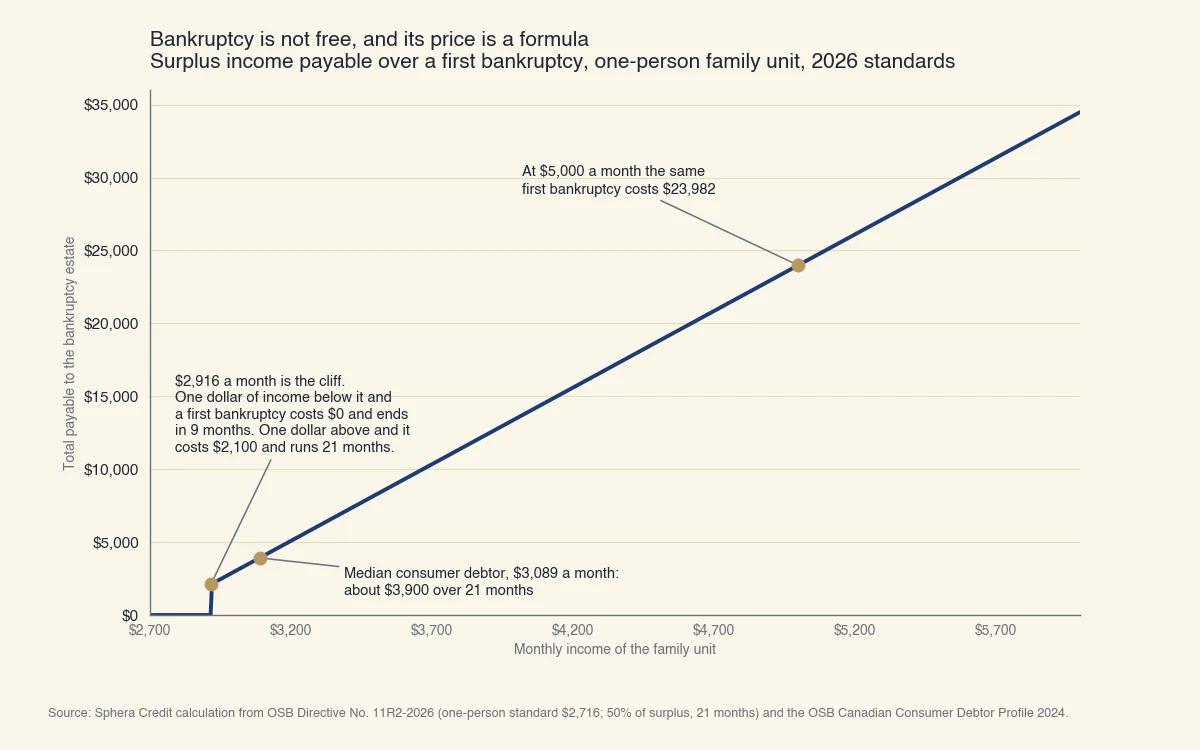
Source: Sphera Credit calculation from OSB Directive No. 11R2-2026 (one-person standard $2,716; 50% of surplus, 21 months) and the OSB Canadian Consumer Debtor Profile 2024.
Two features of that curve decide most cases. The first is the step at $2,916 a month. One dollar of income below it and a first bankruptcy costs nothing in surplus payments and ends in nine months. One dollar above it and the same bankruptcy costs $2,100 and runs 21 months. The second is that the line never flattens. Surplus payments have no ceiling, so bankruptcy gets steadily more expensive as income rises, while a proposal payment is agreed once and stays put.
That same curve is also the floor your proposal has to clear. Creditors vote on the offer, and where nobody calls a meeting inside 45 days the proposal is deemed accepted (BIA, s. 66.18). Nobody objects when the offer beats a bankruptcy and almost everybody objects when it does not, so the trustee builds the number upward from the bankruptcy recovery.
Take the median Canadian consumer debtor as the Office of the Superintendent of Bankruptcy measures them: $53,997 of liabilities, $15,142 of assets, and household income of $3,089 a month against $3,264 of expenses. Living alone, that person has $373 of surplus, pays $186.50 a month, and hands the estate about $3,900 across a 21-month bankruptcy. A proposal for the same person has to beat $3,900 plus whatever equity their province leaves unprotected. It will always be the larger number.
Is a consumer proposal the same as bankruptcy?
No. Both are filed under the same statute through the same Licensed Insolvency Trustee, and both stop collection the day they are filed, but a proposal is an offer your creditors vote on while bankruptcy is an assignment of your non-exempt property.
| Consumer proposal | First bankruptcy | |
|---|---|---|
| What you give up | An agreed sum, paid over up to 60 months | Non-exempt property, plus surplus income |
| What it costs | Fixed at filing, never rises with income | 50% of monthly surplus above $2,716 (one person), no ceiling |
| How long it runs | Up to 5 years | 9 months, or 21 months with surplus income |
| Income reporting | None after filing | Monthly, for the full 21 months |
| Credit rating | R7, clearing 6 years from filing at the latest | R9, clearing 6 years after discharge |
| How it can fail | Creditors vote no, or 3 payments in arrears | Discharge opposed by a creditor or the trustee |
Sources: Directive No. 11R2-2026, BIA s. 168.1, BIA s. 66.31 and Equifax Canada.
When is a consumer proposal worth it, and when is it not?
The answer turns on two numbers: how far your monthly income sits above the Superintendent's standard, and how much equity you hold in property your province does not protect. Four profiles cover most real cases.
The renter with low income and no assets
Income under $2,916 a month for a single person means no surplus payments at all, and a first bankruptcy ends automatically in nine months. There is no property to lose because there is none. Filing a proposal here means paying real money over as much as five years to buy protection you do not need. This is the group the search results consistently fail, and it is not small: the median consumer debtor's income sits only $373 above the standard.
The homeowner with equity
This is the case where a proposal earns its premium, and Ontario shows why most sharply. The prescribed exemption for a principal residence is $12,997 (O. Reg. 657/05), and the exemption is all or nothing: where equity exceeds the prescribed amount, the residence itself becomes subject to seizure and sale (Execution Act, s. 2(3)). A homeowner with $60,000 of equity does not risk $47,003 in an Ontario bankruptcy. They risk the house.
The same regulation exempts one vehicle to $8,578, household furnishings to $17,091, and tools of the trade to $17,362. Equity above any of those lines is money your creditors can reach, and every dollar of it lifts the proposal your trustee has to file. Other provinces set very different limits and revise them on their own schedule, so check yours before assuming the Ontario figures travel.
The higher earner
At $5,000 a month a single filer owes $23,982 in surplus payments across a 21-month bankruptcy, and files an income and expense statement every one of those months. A proposal replaces that with one number agreed on day one. If your income is rising, or seasonal, or includes bonuses, the fixed payment is the whole point, and the premium is usually worth paying.
The filer whose income is real but unstable
A fixed payment cuts both ways. It does not rise when you earn more, and it does not fall when you earn less. A consumer proposal is deemed annulled the day you are in default by an amount equal to three payments (BIA, s. 66.31(1)(a)). When that happens the stay of proceedings ends, your original debt comes back less what you paid, and the money already handed over does not come with it. Committing to 60 months of a payment you can only just afford is the most common way this goes wrong.
How bad is a consumer proposal for your credit?
Your accounts are rated R7 while the proposal runs, and Equifax Canada removes the record three years after you pay off the debts under the proposal or six years from the date it was filed, whichever comes first. That last clause is the part the search results skip, and skipping it produces a badly wrong comparison.
Read the rule against a five-year proposal. Three years after your final payment lands at eight years from filing; six years from filing is earlier, so six years from filing is what applies. The commonly repeated "three years versus six or seven for bankruptcy" describes a proposal you finish quickly, which is unusual.
Now price the alternative honestly. A first bankruptcy with no surplus income discharges at nine months, and Equifax removes it six years after the discharge date. That is roughly six years and nine months from filing (Equifax Canada).
| Path | Typical duration | Record clears | Total from filing |
|---|---|---|---|
| Consumer proposal, 5 years | 60 months | 6 years from filing | about 6 years |
| Consumer proposal, 3 years | 36 months | 3 years after last payment | about 6 years |
| First bankruptcy, no surplus | 9 months | 6 years after discharge | about 6 years 9 months |
| First bankruptcy, with surplus | 21 months | 6 years after discharge | about 7 years 9 months |
Against a nine-month first bankruptcy, a five-year proposal buys you about nine months of earlier credit recovery, and not the four years the usual framing implies. Pick your path on the money and the property. The credit file barely separates them.
What can go wrong after you file?
Two things end a consumer proposal badly: creditors voting it down, and falling three payments behind. Both are worth understanding before you sign, because the second one is entirely in your hands.
- Creditors reject the offer. A simple majority by dollar value binds every unsecured creditor, so one large creditor can decide the outcome alone. Your trustee can file an amended offer, which usually means a higher payment.
- You fall three payments behind. Annulment happens by operation of law under BIA s. 66.31(1)(a), with no hearing and no discretion. Revival is possible but not automatic.
- Some debts never go away. Secured debt, child and spousal support, court-ordered fines, and debt obtained by fraud survive the proposal in full, along with student loans if you stopped studying less than seven years ago.
If your debts are heavy but your income and payment history are still intact, an insolvency filing may not be the right tool at all. Compare it against debt consolidation first, and read how much a consumer proposal costs so you know exactly how much of each payment reaches your creditors before you commit to five years of them.