

What is debt consolidation?
Debt consolidation is borrowing once to pay off several existing debts, so that you owe one lender on one schedule instead of many lenders on many. The amount you owe does not change. What changes is the interest rate applied to it, the number of due dates you track, and the date the debt clears (FCAC).
That distinction carries most of the weight on this page. Consolidation refinances what you owe. It leaves the amount itself untouched. The morning after you consolidate $25,000 of credit card balances, you still owe $25,000. You just owe it to one place, at a different rate, over a different number of months.
Credit consolidation and debt consolidation mean the same thing in Canada. Lenders and credit counselling agencies use the two terms interchangeably, and no product difference sits behind them.
What does it mean to consolidate debt?
To consolidate debt is to replace several balances with one. The mechanics are always the same, whichever product you use:
- You total the balances you want cleared.
- You apply for one new credit facility large enough to cover that total.
- If approved, the proceeds pay off the old accounts, which drop to zero.
- You repay the new lender, usually in fixed monthly instalments.
The old accounts stay open at a zero balance unless you close them yourself. That detail matters more than it looks, and it comes back below in the section on credit scores.
Why the interest half of your payment is the part that moves
Consolidation can only act on the interest portion of a debt payment, never on the principal, and in Canada the interest portion is currently the larger of the two. Statistics Canada splits every dollar households pay on non-mortgage debt into interest and obligated principal. In 2026 Q1, Canadians paid interest at an annual rate of $70.0 billion against $67.0 billion of principal, so 51.1% of every non-mortgage debt dollar went to interest (Statistics Canada, Table 11-10-0065-01).
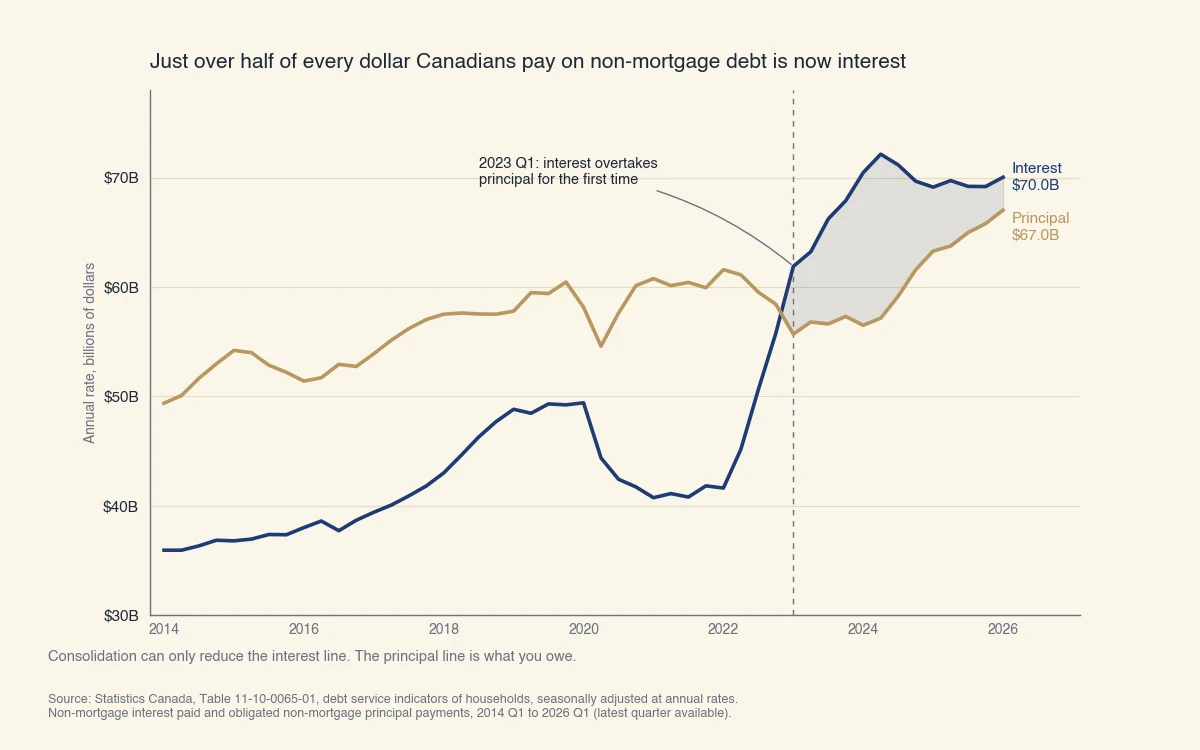
Source: Statistics Canada, Table 11-10-0065-01, debt service indicators of households, seasonally adjusted at annual rates. Non-mortgage interest paid and obligated non-mortgage principal payments, 2014 Q1 to 2026 Q1.
For the eight years before 2023, principal was always the larger half. The rate increases of 2022 and 2023 reversed it: interest overtook principal in 2023 Q1 for the first time in the series, peaked at 55.8% of the payment in 2024 Q2, and is still the larger half today despite 275 basis points of policy-rate cuts since May 2024.
This is the honest case for consolidation and its ceiling in one number. Interest is an unusually large share of what Canadians pay right now, so cutting the rate is worth more than usual. It is also all consolidation can ever cut.
What are the ways to consolidate debt in Canada?
Seven routes are available, and they split into two groups: five that require you to qualify for new credit, and two that do not. The FCAC groups the borrowing options into loans, lines of credit and balance transfers, and separately points readers toward credit counsellors and Licensed Insolvency Trustees (FCAC).
| Route | New credit required | Typical rate basis | What it does to the principal |
|---|---|---|---|
| Debt consolidation or personal loan | Yes | Fixed instalment rate | Repaid in full |
| Balance transfer credit card | Yes | Promotional rate for 6 to 18 months, then the standard card rate | Repaid in full |
| Unsecured personal line of credit | Yes | Variable, tied to prime | Repaid in full |
| Secured line of credit or HELOC | Yes, plus home equity | Variable, tied to prime | Repaid in full, secured against the home |
| Home equity loan | Yes, plus home equity | Fixed | Repaid in full, secured against the home |
| Debt management program | No | Interest often reduced or waived by agreement | Repaid in full |
| Consumer proposal | No | No interest during the proposal | Legally reduced |
The rate basis column is where the real decision sits. The first five routes give you whatever rate your credit history earns. The last two do not price you at all, which is exactly why they exist for borrowers whose credit history would produce a punishing rate.
What do these routes actually cost right now?
In the Bank of Canada's June 2026 reference month, chartered banks charged an average of 21.34% on outstanding credit card balances and 7.80% on funds advanced under personal loan plans (Bank of Canada). That 13.5 point gap is the entire economic case for consolidating card debt into an instalment loan.
| Product, June 2026 | Average rate | Basis |
|---|---|---|
| Credit card balances | 21.34% | Outstanding balances |
| Unsecured personal line of credit | 8.38% | Outstanding balances |
| Personal loan plan (new borrowing) | 7.80% | Funds advanced |
| Secured line of credit or HELOC | 4.05% | Funds advanced |
Two things about this table are worth stating plainly, because most articles on this topic quote rates with no date and no publisher at all.
First, these are averages across all borrowers at chartered banks. The rate you are offered depends on your own credit history, and a weaker file will land above the average, sometimes far above.
Second, the rate cuts of 2024 and 2025 did not reach card debt. The Bank of Canada's policy rate fell 275 basis points between May 2024 and May 2026, while the average rate on outstanding card balances went up. Card debt is priced almost independently of the policy rate, which is why the consolidation gap survived the easing cycle.
For context on the outer boundary, section 347 of the Criminal Code sets the criminal rate of interest at an annual percentage rate above 35% (Department of Justice). Every mainstream bank product sits well beneath it, so "is this rate legal" is rarely the useful question. "Is this rate below what I already pay" is.
How do debt consolidation loans work in practice?
A consolidation loan is an ordinary amortizing instalment loan: a fixed rate, a fixed term, and a fixed monthly payment that retires the balance on a set date. The arithmetic is fully determined by three inputs, so the outcome can be checked before you sign anything.
Take $25,000 of credit card balances at the June 2026 average card rate of 21.34%, refinanced into a personal loan plan at the June 2026 average of 7.80%. The rate is the same in all three rows below. Only the term changes.
| Plan | Monthly payment | Months to clear | Total interest |
|---|---|---|---|
| Consolidation loan, 3-year term | $781 | 36 | $3,120 |
| Consolidation loan, 5-year term | $505 | 60 | $5,271 |
| Consolidation loan, 7-year term | $387 | 84 | $7,522 |
| Card at 21.34%, paying $781 a month | $781 | 48 | $12,314 |
| Card at 21.34%, paying $505 a month | $505 | 121 | $35,974 |
| Card at 21.34%, paying $387 a month | $387 | never clears | unbounded |
Sphera Credit calculation using the standard amortization formula on a $25,000 balance, at Bank of Canada June 2026 average rates.
Three readings come out of that table, and the second and third are the ones missing from most coverage.
The rate cut is real. At the same $781 monthly payment, the three-year loan costs $3,120 in interest where the card costs $12,314. That is $9,194 saved and a year off the schedule, for the same money out of your account each month.
The term quietly spends the saving. The seven-year loan and the three-year loan carry the identical 7.80% rate, yet the seven-year version costs $7,522 in interest against $3,120. Stretching the term to make the payment affordable hands back $4,402 of what the lower rate won you. The lower monthly payment is not a discount. It is a longer loan.
Below a certain payment, the card never clears at all. At 21.34%, one month of interest on $25,000 is $445. A $387 monthly payment does not cover it, so the balance grows no matter how long you pay. This is the situation consolidation is actually built for, and it is why "I am paying every month and the balance will not move" is a signal rather than a complaint.
When does consolidation stop saving money?
Every term length has a break-even rate, above which consolidating costs more in total interest than simply clearing the card over three years. Against a baseline of retiring the same $25,000 card balance in 36 months at 21.34%, which costs $9,065 in interest:
| Consolidation term | Break-even rate |
|---|---|
| 3 years | 21.34% |
| 5 years | 12.92% |
| 7 years | 9.26% |
| 10 years | 6.50% |
Read it as a rule you can apply to your own offer. The longer the term, the lower the rate has to be to leave you ahead. A ten-year consolidation at 7% is worse in total interest than paying the card off in three years, even though 7% looks like an enormous improvement on 21%. To run the same arithmetic on your own balance, rate and term, the loan repayment calculator returns the payment, the total interest and a full amortization schedule.
One cost sits outside this arithmetic. Balance transfer cards charge a transfer fee, usually a percentage of the amount moved, and the promotional rate applies only for 6 to 18 months before the standard card rate returns; missing a payment can end the promotional rate early (FCAC). A balance transfer is a genuine saving only if you clear the balance inside the promotional window.
Does debt consolidation hurt your credit score?
Consolidation pushes a credit score in both directions at once, and for most borrowers the upward force is the stronger one. Equifax Canada weighs payment history, credit utilization, account age and credit mix among the main scoring factors (Equifax Canada).
Downward, for a few months:
- The application produces a hard inquiry.
- A brand new account with no repayment history lowers the average age of your credit.
Upward, and usually by more:
- Credit utilization, the share of your available revolving credit that you are using, drops sharply when several card balances go to zero. Instalment loan balances are not counted in card utilization.
- Replacing revolving balances with a fixed instalment loan improves credit mix.
- One payment is easier to make on time than five, and payment history is the heaviest factor of all.
The mechanism behind the utilization gain is also its weak point. Utilization improves because the cards now read zero, so it survives only as long as they stay near zero. If the cleared cards fill back up, you hold the consolidation loan and the card balances at the same time, and the score gain reverses along with the finances. The FCAC states the same risk plainly: keeping the spending habits that created the debt means accumulating more of it.
This is also the reason to think twice before closing the cleared cards. Closing them removes available credit, which pushes utilization back up on whatever balance remains, and eventually shortens your credit history. Leaving them open at zero is usually better for the score, and worse for temptation. If you are rebuilding, it is worth understanding how a credit rating is calculated and how to read a credit report before you decide.
Debt consolidation versus a consumer proposal
Consolidation is new borrowing in which you repay every dollar, while a consumer proposal is a legal insolvency filing in which creditors accept a percentage and forgive the rest. They are frequently presented as two flavours of the same thing. They are not.
A consumer proposal is available when your total debts, excluding your mortgage, are under $250,000. It is administered by a Licensed Insolvency Trustee, the only professional authorized to administer insolvency proceedings in Canada, and governed by the Bankruptcy and Insolvency Act. You offer creditors a percentage of what is owed, more time to pay, or both. Creditors have 45 days to accept or reject. Payments cannot run longer than five years, you keep your assets while you make them, and wage garnishments and lawsuits stop once the proposal is filed. The proposal stays on your credit record for the term of the proposal plus another three years (Office of the Superintendent of Bankruptcy).
| Debt consolidation | Consumer proposal | |
|---|---|---|
| Legal status | An ordinary credit agreement | An insolvency filing under the Bankruptcy and Insolvency Act |
| Who administers it | Your lender | A Licensed Insolvency Trustee |
| Do you need to qualify for credit | Yes | No |
| Amount repaid | 100% of the principal, plus interest | A negotiated percentage, interest stops |
| Creditor approval needed | No, only lender approval | Yes, creditors vote within 45 days |
| Maximum length | Set by the loan term | Five years by statute |
| Effect on the credit report | A new account, reported normally | An insolvency, reported for the term plus three years |
| Debt limit | Set by what you can qualify for | Under $250,000 excluding the mortgage |
The choice usually resolves on one question: can you qualify for a rate below what you already pay? If yes, consolidation keeps your credit record clean and costs you interest. If no, more borrowing makes things worse, and the routes that do not price you become the relevant ones. Our page on what a consumer proposal is covers the filing itself in detail, and the first consultation with a Licensed Insolvency Trustee is normally free.
A debt management program through a non-profit credit counselling agency sits between the two. Creditors are asked to reduce or waive interest while you repay the full principal through the agency. It requires no new credit and no insolvency filing, though it is recorded on your credit report while it runs.
What to check before you sign
The regulation of debt consolidation companies varies across provinces and territories, so the FCAC advises confirming a company's reputation, for example with the Better Business Bureau, before dealing with it. Two practical checks before committing:
- Compare the offered rate against your current blended rate. The highest single rate you carry is the wrong benchmark: one 24% card among four at 12% does not make your average 24%.
- Apply within a short window if you shop several lenders. Applying to many lenders over a long period lowers your score more than clustering the applications does.
If your existing debts have already reached collections, the rules change again, and our page on dealing with a collection agency in Canada covers what a collector can and cannot require.
Sphera Credit builds AI agents that work inside lenders' credit decisions on applications that fall outside a standard credit box, which is where a file carrying several revolving balances often lands. The value there is reading the file accurately and being able to explain the decision, not reaching it with less care. For a borrower, the equivalent discipline is smaller: get the offered rate in writing, put it in the table above, and see whether the number moves in your favour.