

A consumer proposal is a formal offer to pay your unsecured creditors a portion of what you owe, filed for you by a Licensed Insolvency Trustee under the federal Bankruptcy and Insolvency Act, and legally binding on every unsecured creditor once accepted. You keep your assets, interest stops, garnishments and collection calls stop, and the agreed amount replaces the original debt.
A Licensed Insolvency Trustee is the only professional in Canada licensed to file one. Trustees are federally licensed and supervised by the Office of the Superintendent of Bankruptcy, and they owe duties to the creditors as well as to you, which is why the offer they file has to satisfy a legal test rather than simply reflect what you would like to pay.
Two features distinguish a consumer proposal from an informal settlement negotiated with a collection agency:
- It binds every unsecured creditor, including the ones who voted against it and the ones who never responded at all.
- It stops interest and legal action from the day it is filed, under the automatic stay of proceedings.
Consumer proposals are no longer the alternative to bankruptcy in Canada. They are the norm, accounting for 110,168 of the 140,457 consumer insolvencies filed in 2025, or 78.4% of the total (Office of the Superintendent of Bankruptcy). Bankruptcy is now the exception, at roughly one filing in five.
The share has climbed steadily: 69.5% in 2021, 75.5% in 2022, 78.7% in 2023, 78.8% in 2024, then 78.4% in 2025.
The reason is not that proposals became more generous. It is that the population filing changed. A proposal is the better instrument when a filer has income above the surplus-income threshold, or equity in a car or a home worth protecting, because those are exactly the things a bankruptcy would take. Someone with neither of those tends to file bankruptcy, discharge in nine months and pay very little. The rise of the proposal is really a story about insolvent Canadians having more to lose.
You qualify if you are insolvent and your total debts, excluding any debt secured by your principal residence, come to $250,000 or less (Bankruptcy and Insolvency Act, s. 66.11). Insolvent means you cannot meet your obligations as they come due, which is a cash-flow test rather than a net-worth test. You can be insolvent while owning a house.
The mortgage exclusion is the detail readers most often get wrong. A homeowner with a $520,000 mortgage and $70,000 of credit card and line-of-credit debt is inside the limit, because only the $70,000 counts.
You also need a way to fund the payments. A proposal is a payment plan, so trustees look for steady income, a co-signer, or a lump sum from family before filing one. Someone whose income still covers the balances and who can qualify for new credit is usually in consolidation territory, and the debt consolidation calculator shows what a single loan would cost against the cards it would replace.
Unsecured debts are included automatically:
- Credit cards, lines of credit and overdrafts
- Personal loans and payday loans
- Income tax and GST debt owed to the Canada Revenue Agency
- Collection accounts and old utility or telecom balances
- The shortfall left after a vehicle is repossessed and sold
These survive a proposal and still have to be paid:
- Secured debt you want to keep, such as a mortgage or a car loan, since keeping the asset means keeping the payment
- Court-ordered support and alimony
- Fines and penalties imposed by a court
- Debts arising from fraud
- Student loans, if you left school less than seven years ago (see how a student loan affects your credit rating)
The process runs on a fixed statutory clock: the trustee files the offer, creditors get 45 days to respond, and if nobody calls a meeting the offer is deemed accepted and becomes binding on all of them. Most filers never see a creditors' meeting.
- Assessment. The trustee reviews your income, assets, expenses and debts, and calculates what creditors would receive in a bankruptcy. That figure sets the floor for the offer.
- Filing. The trustee files the proposal with the Official Receiver. An automatic stay of proceedings begins immediately, stopping interest, collection calls, lawsuits and wage garnishments.
- Notice to creditors. Creditors are notified and file proofs of claim.
- The 45-day window. Creditors holding at least 25% in value of proven claims can request a meeting (s. 66.15). If none does, the proposal is deemed accepted at the end of the 45 days (s. 66.18).
- The vote, if a meeting happens. Creditors vote as one class by ordinary resolution, decided by dollar value rather than by headcount (s. 66.19). One large creditor can therefore outweigh a dozen small ones.
- Performance. You make the agreed payments, complete two mandatory counselling sessions, and receive a certificate of full performance at the end.
The statute caps the term: a consumer proposal must be performed within five years (s. 66.12(5)). You can always finish early, and doing so shortens how long the filing stays on your credit report.
A proposal with monthly payments is deemed annulled on the day your arrears reach the value of three payments (s. 66.31), which is a cumulative balance rather than three consecutive missed payments. Paying half of what you owe for six months can therefore annul a proposal even though you paid something every single month, a distinction most explanations of the rule miss.
Annulment undoes the protection. The original debts return, the interest that had stopped resumes, and creditors can act again. The trustee can file an amendment before the annulment date to change the terms, which is why the useful moment to call is the month you fall behind, not the month after the proposal collapses.
The offer is not built from what you can afford. It is floored by what your creditors would have collected if you had gone bankrupt instead, and the trustee has to file something better than that number or creditors have no reason to accept it. That floor has two parts: the surplus income you would have paid during a bankruptcy, and the equity in any asset your province does not protect.
Surplus income is the amount by which your household's monthly income exceeds a national threshold published each year by the Superintendent of Bankruptcy. For 2026 the thresholds are:
| Family unit size | Monthly income threshold (2026) |
|---|---|
| 1 person | $2,716 |
| 2 persons | $3,381 |
| 3 persons | $4,157 |
| 4 persons | $5,047 |
| 5 persons | $5,724 |
| 6 persons | $6,456 |
| 7 or more persons | $7,188 |
Source: Directive No. 11R2-2026, Surplus Income. The standards come from Statistics Canada low-income cut-offs and are revised annually.
A bankrupt whose monthly surplus reaches $200 pays half of it to the estate. Owing surplus income also lengthens a first bankruptcy from nine months to 21 months before automatic discharge (Bankruptcy and Insolvency Act, s. 168.1). Those two rules together are what make bankruptcy expensive for a working filer, and what make a proposal attractive.
Take a single filer in Ontario with $58,000 of unsecured debt, take-home pay of $4,000 a month and a car worth $14,578 more than the loan against it.
| Step | Calculation | Amount |
|---|---|---|
| Monthly income | Take-home pay | $4,000 |
| Less the 2026 standard for one person | $4,000 - $2,716 | $1,284 surplus |
| Payable to the estate in bankruptcy | 50% of surplus | $642 per month |
| Length of a first bankruptcy with surplus income | 21 months | $13,482 total |
| Vehicle equity above Ontario's exemption | $14,578 - $8,578 | $6,000 |
| What creditors would collect in bankruptcy | $13,482 + $6,000 | $19,482 |
| A proposal has to beat that | Offer $22,000 over 60 months | $367 per month |
The result is 37.9 cents on the dollar. Both figures are gross to the estate, since the trustee's fees and the government levy come out of the money collected in either process, so the comparison is like for like.
Run the same person with no car equity and the floor drops to $13,482, and the offer drops with it. Run them at $2,900 a month of income instead of $4,000 and the surplus almost disappears, which is why two people with identical debts are quoted very different payments. The debt total barely enters the calculation.
The statute is federal and identical everywhere, but the exemption rules that set the floor are provincial, so the same income and the same debts produce different offers in different provinces. The effect shows up clearly in the filing data.
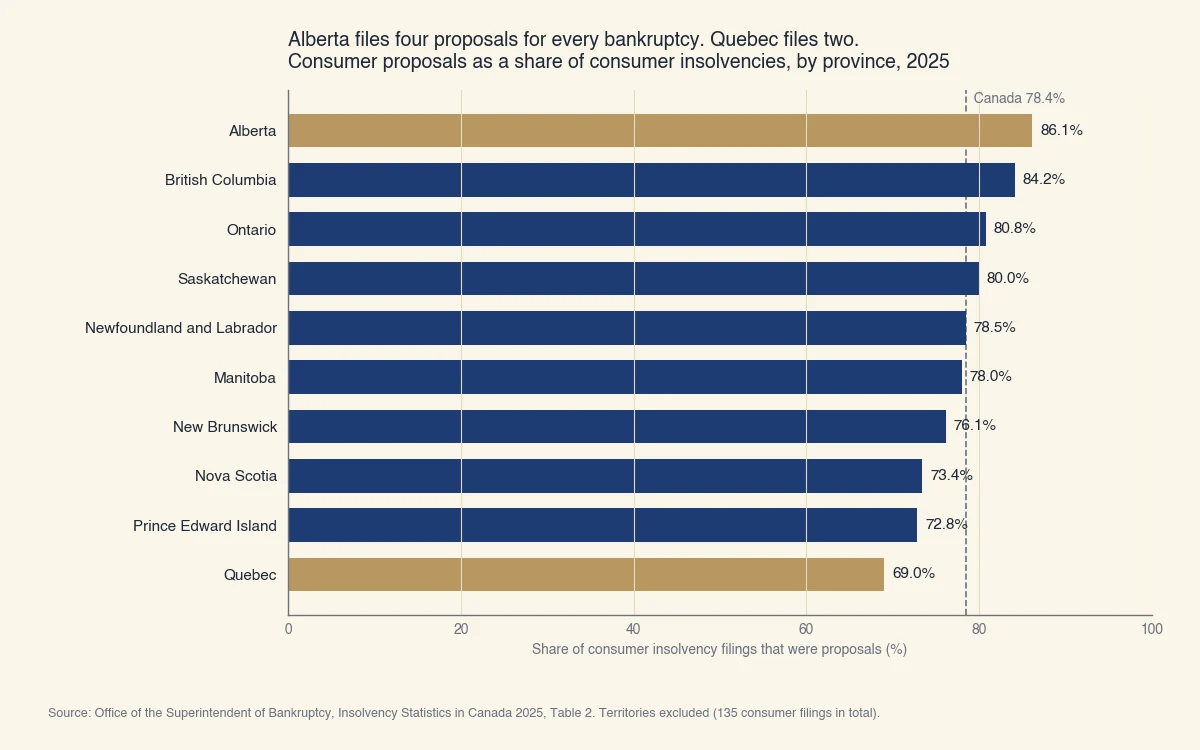
Source: Office of the Superintendent of Bankruptcy, Insolvency Statistics in Canada 2025, Table 2. Territories excluded (135 consumer filings in total).
Alberta files more than six proposals for every bankruptcy. Quebec files just over two. A 17-point spread inside one federal statute is not a difference in the law, it is a difference in what bankruptcy would cost a filer locally, plus long-standing differences in how insolvency advice is delivered in each province.
| Province | Consumer insolvencies, 2025 | Of which proposals | Share |
|---|---|---|---|
| Alberta | 18,876 | 16,261 | 86.1% |
| British Columbia | 15,331 | 12,904 | 84.2% |
| Ontario | 52,838 | 42,694 | 80.8% |
| Quebec | 34,946 | 24,113 | 69.0% |
| Canada | 140,457 | 110,168 | 78.4% |
Source: Office of the Superintendent of Bankruptcy, Insolvency Statistics in Canada 2025.
In Ontario the process is the federal one, but the province's own exemption limits under the Execution Act decide how much of your property creditors could have reached, and therefore how large your offer has to be. The current prescribed amounts, last raised by O. Reg. 393/25, are:
- Household furnishings and appliances: $17,091
- One motor vehicle: $8,578 of equity
- Tools and other property used to earn income: $17,362 in the general case
- Principal residence: $12,997 of equity
The residence rule contains a trap worth knowing. It is a cliff rather than a deduction. If your equity exceeds $12,997, the exemption does not shelter the first $12,997 for you, and the whole value becomes available to creditors. For an Ontario homeowner with real equity, that single rule is usually the reason a proposal costs what it costs.
Equifax Canada removes a consumer proposal three years after your final payment, or six years after the filing date, whichever comes first (Equifax Canada). The Financial Consumer Agency of Canada publishes the same framework and notes that retention periods can differ by province and by bureau (FCAC).
The practical consequence: a five-year proposal is reported for the full six years from filing, while a three-year proposal clears at year six as well. Finishing a five-year proposal in three years, which the statute allows, moves the removal date to three years after that final payment. Accounts included in the proposal are also flagged individually, usually with an R7 rating, and those flags follow the same clock.
Lenders treat a proposal on your credit report as an insolvency event, but a completed proposal and an annulled one say very different things about a borrower, and a rule that reads only the bureau flag cannot tell them apart. A completed proposal is evidence that someone met a five-year obligation. An annulment is evidence that they did not.
That distinction matters again once the file ages off. Because the entry clears three years after the final payment or six years after filing, borrowers routinely apply while the flag is still visible, and the accounts inside the proposal carry their own R7 markers on the same clock. If you are rebuilding, it helps to know how a credit rating is calculated and how to read a credit report so you can check that every included account was reported correctly and closed on time.
Sphera Credit builds AI agents that work inside lenders' credit decisions for the applications that fall outside a standard credit box, which is exactly where a past insolvency puts a file. The value is in reading the file accurately and being able to explain the decision, not in reaching it with less care.
If you are the borrower rather than the lender, the right first call is a Licensed Insolvency Trustee. The consultation is free, and only a trustee can run the floor calculation on your own numbers.