

How much does a consumer proposal cost?
A consumer proposal costs nothing beyond the payments you offer your creditors, because every fee is drawn out of that money rather than billed to you separately. The fee schedule is federal, it sits in section 129 of the Bankruptcy and Insolvency General Rules, and no Licensed Insolvency Trustee in Canada may charge above it or below it.
A Licensed Insolvency Trustee is the only professional the federal government licenses to file a consumer proposal. When one administers a proposal, the legislation calls them the administrator, and the tariff below is what the administrator recovers for the whole file: the filing, the creditor negotiation, five years of payment processing, the two counselling sessions, and the final certificate of full performance.
The tariff has two halves that behave very differently:
- A fixed half of $1,820 comes off the top of everything you pay in, whether your proposal totals $6,000 or $60,000.
- A variable half takes 20% of the money that reaches your creditors, plus a 5% levy the administrator remits to the Office of the Superintendent of Bankruptcy.
Because the schedule is identical at every firm, a quote is never a price. If two trustees put different monthly payments in front of you, the difference is in the offer each would take to your creditors, which is driven by your surplus income and your unprotected asset equity. The mechanics of that calculation are covered in what is a consumer proposal.
What does the federal fee tariff actually set?
Section 129 lists seven items an administrator may recover, and every dollar figure in that list has stood unchanged since April 30, 1998. Each line has its own provision, which means you can check any number a firm quotes you against the regulation itself.
| What it covers | Amount | Where it is set |
|---|---|---|
| Administrator's fee on filing | $750 | Rule 129(1)(a) |
| Administrator's fee on approval by the court | $750 | Rule 129(1)(b) |
| Administrator's fee on distributions | 20% of money distributed to creditors | Rule 129(1)(c) |
| Two mandatory counselling sessions | $85 each, so $170 | Rule 129(1)(d) and 131(1) |
| Filing fee to the Superintendent | $100 | Rule 129(1)(e) and 132(1)(c) |
| Court registrar's fee | $50 | Rule 129(1)(f) and the schedule, Part II, paragraph 3(b) |
| Federal and provincial sales tax | Applicable rate on the administrator's fees | Rule 129(1)(g) |
One more charge sits outside section 129. The Superintendent's levy takes 5% of the first $1,000,000 paid to creditors under a proposal (Rule 123(2), made under section 147 of the Bankruptcy and Insolvency Act). It funds the regulator that supervises the trustee handling your file.
Add the fixed lines together and you get $1,820: $750 plus $750 plus $170 plus $100 plus $50. That figure is the same on the smallest proposal a trustee will file and on the largest, which turns out to matter a great deal.
Two things the tariff does not include:
- Interest. A proposal stops interest on the included debts, so the amount you offer is the amount you pay.
- A retainer, consultation fee, or setup charge. You pay nothing before the proposal is filed, and the first consultation with a trustee is free.
Where does each dollar you pay actually go?
On a $250 monthly payment over 60 months, your creditors receive about $10,544 of the $15,000 you pay in, and about $4,456 goes to the tariff and the levy. That is roughly 70 cents of every dollar reaching the people you owe.
The arithmetic runs in two stages. First the fixed $1,820 comes off, leaving $13,180. Then that remainder has to cover three things at once: the money creditors actually receive, the administrator's 20% of that money, and the Superintendent's 5% of the same money. Because both percentages are charged on the distribution rather than on the pool, every dollar that reaches a creditor costs the estate $1.25.
| Step | Calculation | Amount |
|---|---|---|
| Total paid into the proposal | $250 x 60 months | $15,000 |
| Less the fixed tariff | $750 + $750 + $170 + $100 + $50 | $1,820 |
| Pool available to distribute | $15,000 - $1,820 | $13,180 |
| Divided at $1.25 per creditor dollar | $13,180 / 1.25 | $10,544 to creditors |
| Administrator's share of the distribution | 20% of $10,544 | $2,108.80 |
| Superintendent's levy | 5% of $10,544 | $527.20 |
| Share of your payments reaching creditors | $10,544 / $15,000 | 70.3% |
You can rerun this on your own offer with two numbers: subtract $1,820 from the total you would pay in, then divide by 1.25.
Why smaller proposals lose more of every dollar
The fixed $1,820 does not shrink with the file. On a $60,000 proposal it is 3% of the money; on a $6,000 proposal it is more than 30% of it. The share of your payments that survives to reach a creditor therefore climbs with the size of the proposal, and it can never pass 80 cents, because the 20% and the 5% consume the rest no matter how large the file gets.
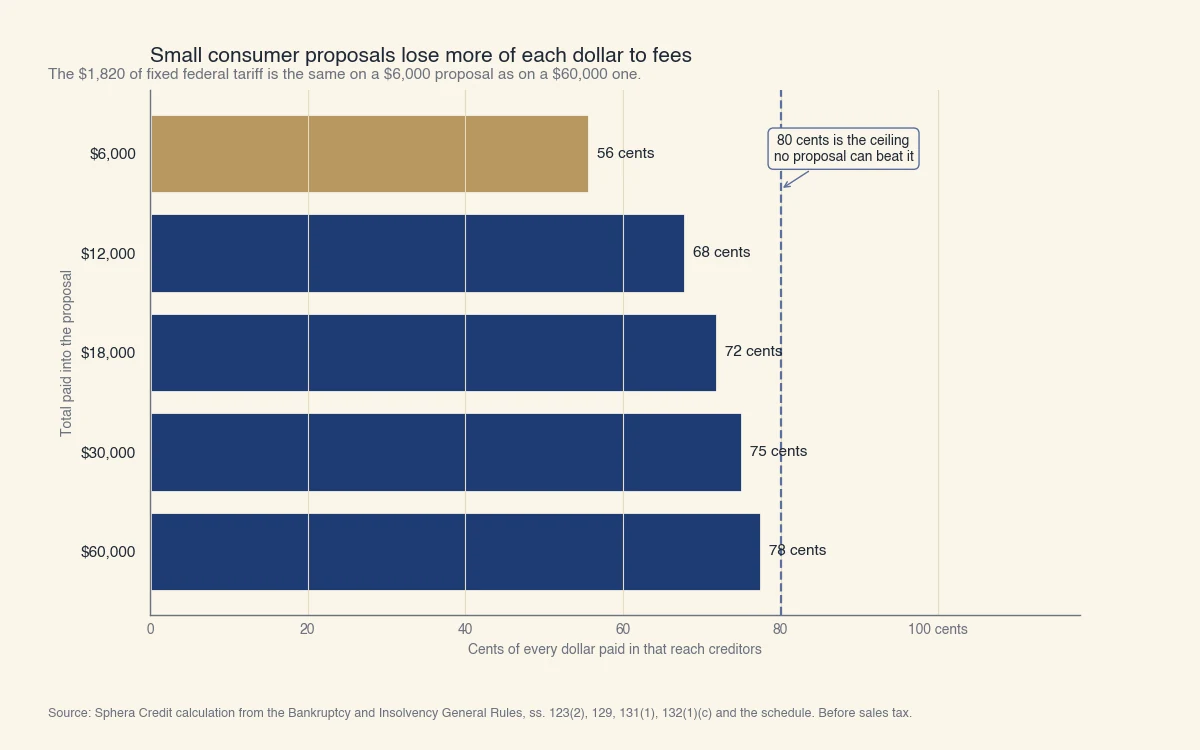
Source: Sphera Credit calculation from the Bankruptcy and Insolvency General Rules, ss. 123(2), 129, 131(1), 132(1)(c) and the schedule. Before sales tax.
The practical reading is a question worth putting to your trustee at the free consultation: on a small unsecured balance, does the concession your creditors would grant exceed the administration cost of getting it? A proposal that settles $9,000 of debt for $6,000 of payments hands $2,656 of those payments to the tariff and the levy. Repaying the balance directly, or restructuring it through debt consolidation, sometimes leaves you further ahead. On larger balances the arithmetic reverses quickly, which is why proposals are the dominant form of consumer insolvency in Canada.
What sales tax does to the number
Rule 129(1)(g) draws federal and provincial sales tax on the administrator's fees from the same pool. Applying 13% Ontario HST to the $1,500 of fixed administrator fees, the $170 of counselling, and the 20% distribution fee, the $15,000 example above delivers roughly $10,159 to creditors instead of $10,544. Sales tax costs about 2.6 percentage points of the total, and the exact figure moves with your province.
What changes the cost after you file?
Almost nothing, because both percentage fees are charged on the money your creditors receive, and that amount was fixed when they accepted your offer. The events below change your timeline or your risk far more than they change your bill.
Can you pay a consumer proposal off early?
You can pay the balance of the offer at any time, and there is no prepayment penalty, because no interest is accruing to save. The total cost is identical whether you finish in 18 months or 60: the same amount reaches your creditors, so the same 20% and 5% come off it.
What you buy with early completion is time on your credit file. A consumer proposal clears the bureau three years after your final payment or six years after filing, whichever comes first (Equifax Canada). Finishing a five-year proposal in year three starts that three-year clock two years early, which is worth more to a future borrower than any fee saving would have been. If rebuilding is the goal, how a credit rating is calculated is the next thing to read.
Can you add a debt to a consumer proposal?
A debt you owed on the filing date but left off the creditor list can usually be added. Your administrator amends the records, notifies the creditor, and that creditor becomes entitled to a pro-rata share of the same pool. If the omitted balance is small and your proposal already offered a fixed sum, your payment often does not move at all, since the existing pool simply spreads across one more claim. A large omission is different, and your creditors may need to vote on revised terms.
A debt you take on after the filing date cannot be added. A proposal binds the claims that existed when it was filed, and new borrowing sits outside it entirely. Leaving a creditor off on purpose is a misrepresentation that can put the whole proposal at risk, so an omission is worth reporting to your administrator the day you notice it.
What missed payments cost you
Falling behind is the one event that genuinely destroys the value of everything you have paid. Where payments are due monthly or more often, the proposal is deemed annulled the day you are in default by an amount equal to three payments (Bankruptcy and Insolvency Act, s. 66.31). Where they are due less often than monthly, annulment lands three months after any missed payment.
Annulment ends the protection from creditors, revives the original debts less whatever was distributed, and refunds none of the fees already drawn. On the $15,000 example, a filer who annuls in month 30 has paid $7,500 and put roughly $4,000 in front of creditors, while the tariff has already taken its two fixed draws in full.
What is changing about consumer proposal fees in 2026?
The tariff is under active amendment. A proposal published in the Canada Gazette on November 29, 2025 would raise the administrator's two fixed draws from $750 to $850 each and individual counselling from $85 to $120 a session. Consultation closed on January 16, 2026 (Canada Gazette, Part I).
| Line item | In force today | Proposed |
|---|---|---|
| Administrator's fee on filing | $750 | $850 |
| Administrator's fee on approval | $750 | $850 |
| Individual counselling, per session | $85 | $120 |
| Group counselling, per person per session | $25 | $35 |
| Fixed tariff total | $1,820 | $2,090 |
Three things a filer should take from this. The amendment is not yet registered, so the 1998 figures above are what governs a proposal filed today. The amendments would come into force one year after registration, which leaves a long runway. And the package adds a cost-of-living mechanism that indexes these amounts annually from April 1, 2027, ending the 28-year freeze that produced the regressive shape in the chart above.
For anyone comparing options, the fee tariff is only one input. The offer your creditors would accept, the assets your province protects, and what a collection file already on your record is doing to you all matter more. Why paying a collection agency can work against you covers the last of those.
Sphera Credit builds AI agents that work inside lenders' credit decisions on the applications that fall outside a standard credit box, which is exactly where a past or current insolvency puts a file. The value there is reading the file accurately and being able to explain the decision. If you are the borrower rather than the lender, the right first call is a Licensed Insolvency Trustee: the consultation is free, and only a trustee can run the offer calculation on your own numbers.