

What happens if your mortgage renewal is denied?
Your mortgage does not disappear and the bank does not take your house on the maturity date. The balance simply becomes due in full, and you are left with a fixed and fairly short window to replace the financing before the loan slips into default. The sequence is governed by federal disclosure rules first and by provincial enforcement law second, and both give you more room than the panic suggests.
Here is the order events actually run in:
- At least 21 days before your term ends. If your lender is a federally regulated bank, it must send you a renewal statement at least 21 days before the end of the term. It must also tell you 21 days before the term ends if it will not renew you at all (FCAC). That notice is your starting gun.
- The maturity date. Your term ends and the outstanding principal becomes payable in full. Nothing is automatic unless the renewal statement said the lender would auto-renew you.
- The holdover period. Most lenders do not demand the balance the next morning. The loan typically converts to an open or demand arrangement at a materially higher rate while you sort out replacement financing. You keep paying, at a worse price.
- Default. If payments stop, the lender issues a demand and then begins the statutory enforcement process for your province.
The gap between step 2 and step 4 is where every workable option lives, and it is measured in months rather than days.
How long before the lender can force a sale?
Enforcement is provincial, and the statutory clocks are longer than most borrowers assume. These are minimum floors written into legislation, not the typical duration of a real file, which is usually far longer because lenders prefer a paying borrower to a sale.
| Province | Primary remedy | Statutory minimum before a sale |
|---|---|---|
| Ontario | Power of sale | Notice cannot be given until default has continued 15 days, and no sale for at least 35 days after the notice |
| Quebec | Hypothecary recourse (judicial) | 60 days from registration of the prior notice, for immovable property |
| British Columbia, Alberta | Judicial foreclosure | Court supervised, with a redemption period set by the court |
| Manitoba, Saskatchewan | Judicial process with statutory protections | Court supervised |
Sources: Mortgages Act, R.S.O. 1990, c. M.40, s. 32 and Civil Code of Quebec, art. 2758.
Power of sale lets a lender sell the property privately, without a court order, once the notice periods run out. Judicial foreclosure requires the lender to go to court, which is slower and gives the borrower a formal redemption period. Which one applies is decided by where the property sits, not by your lender.
Who actually denied you: your current lender, or a new one?
These are two completely different events, and the fix for each is different. Borrowers use "my renewal was denied" for both, which is why the advice they find rarely fits.
| Renewing with your current lender | Switching to a new lender | |
|---|---|---|
| Is it a new credit decision? | No. The lender already holds the loan and is offering new terms on the same debt | Yes. The new lender underwrites it as a fresh origination |
| Do they pull credit and re-verify income? | Usually not | Yes, in full |
| Stress test | Not applied | Prescribed minimum qualifying rate is waived on a straight switch, but the lender still stress-tests its own way |
| How common is a decline? | Rare | The realistic risk |
Your existing lender is not required to renew you, and it will refuse if your payment record has deteriorated badly or it wants off the risk. But renewing you where you already are does not require it to prove you would qualify today, so most lenders take the payment and move on.
The switch is the harder path. Since November 21, 2024, OSFI no longer prescribes the minimum qualifying rate for an uninsured straight switch, meaning a stand-alone uninsured mortgage moving from one federally regulated institution to another with no increase in the loan amount or the remaining amortization. Two details matter and are widely missed: the balance may be increased by $3,000 to cover transaction costs such as penalties and fees, and equity take-out is not permitted. The new lender must still "assess the loan like any other new origination" under Guideline B-20, calculating debt service ratios "conservatively and appropriately stressed" (OSFI).
So the exemption removes one hurdle. It does not make the switch automatic, and it gives you no room to roll arrears or penalties beyond $3,000 into the new loan.
Why do lenders decline a renewal?
Almost every decline traces back to one of five changes since you last qualified. The property has not moved; your file has.
- Payment history has deteriorated. Missed mortgage payments are the strongest single signal, and a pattern of late payments on other credit reads nearly as badly. See how a low credit rating affects mortgage approval.
- Income has fallen or changed shape. Job loss, reduced hours, or a move from salaried employment to self-employment all force a fresh look at whether payments are supportable.
- Debt load has climbed. New car loans, lines of credit and card balances push your gross and total debt service ratios past the roughly 39% and 44% thresholds lenders work to.
- Credit score has dropped below the lender's floor. Our page on the credit rating you need for a mortgage sets out the usual bands.
- The property has lost value or no longer supports the loan-to-value the lender wants, which turns a routine switch into a declined one.
What if you are self-employed, retired, or recently separated?
The reason for a decline is usually the same across borrower types, but the evidence that fixes it is not. This is where generic advice stops being useful.
- Self-employed. The problem is rarely the money, it is the documentation. Lenders want two years of T1 Generals and Notices of Assessment, and they underwrite net income after write-offs rather than gross revenue. Credit unions and B-lenders are more willing to work from bank statements, at a rate premium.
- Retired or on fixed income. Pension, RRIF and investment income all qualify, but a lender needs it documented and durable. The usual gap is that income fell at retirement while the payment stayed the same. Extending amortization is the standard lever, and the section below prices it.
- Recently separated or divorced. A spousal buyout usually adds to the loan amount, which disqualifies it as a straight switch and puts you back inside the full qualifying test. Handle the separation agreement and the renewal as one plan, not two.
- In or recently out of a consumer proposal. Most prime lenders want the proposal completed and two years of clean re-established credit. Until then this is B-lender or private territory. See what a consumer proposal is.
What are your options after a denied renewal?
Work the list in order of cost, because every step down the ladder is more expensive than the one above it.
- Go back to your current lender and ask what it would take. Federally regulated institutions are expected to consider relief for borrowers at risk, including waiving prepayment penalties and internal fees, not charging interest on interest, and extending amortization (FCAC).
- Use a mortgage broker. A broker sees which lenders are currently taking your profile, which saves you from collecting hard inquiries by applying one at a time.
- Try credit unions. They are provincially regulated, sit outside OSFI's rules, and often set their own qualifying rate.
- Move to a B-lender. Monoline lenders, trust companies and mortgage finance companies price risk rather than refusing it. Expect a rate premium and a lender fee.
- Private lenders and mortgage investment corporations. Short-term, interest-heavy, and appropriate only as a bridge with a written exit plan.
- Sell on your own terms. Selling while you still control the timing preserves your equity. A forced sale does not.
Adding a co-signer or a co-applicant works alongside any of these, and paying down a card or line of credit before you apply can move your debt service ratios more than any negotiation will.
What does extending your amortization actually cost?
A longer amortization is the first thing a lender will offer, and FCAC opens its own renewal guidance by warning that the interest cost "may add up to thousands or tens of thousands of dollars". Here is that warning with numbers on it.
Take a $400,000 balance with 20 years left, renewing at 5.25% with Canadian semi-annual compounding:
| Remaining amortization | Monthly payment | Total remaining interest | Extra interest vs 20 years |
|---|---|---|---|
| 20 years | $2,683 | $243,863 | baseline |
| 25 years | $2,384 | $315,102 | $71,238 |
| 30 years | $2,195 | $390,140 | $146,277 |
Source: Sphera Credit calculation using the standard amortization formula, $400,000 at 5.25% with semi-annual compounding.
Stretching from 20 years to 25 buys you $299 a month and costs $71,238. Going to 30 years buys $488 a month and costs $146,277. For a borrower bridging a temporary income gap that is a reasonable trade, especially if they shorten the amortization again at the next renewal. As a permanent arrangement it is expensive. You can test your own numbers with the mortgage amortization calculator.
For reference, the Bank of Canada published a conventional five-year mortgage rate of 6.09% in late August 2026, which is a posted benchmark and sits above the discounted rates most borrowers sign (Bank of Canada). Our page on interest rates in Canada explains the gap between posted and contract rates.
How often do Canadian mortgages actually end in default?
Rarely. In June 2026, 14,021 of 4,924,612 bank mortgages in Canada were three or more months past due, a rate of 0.28% (Canadian Bankers Association). That is roughly three mortgages in every thousand, in the middle of the largest renewal wave the country has seen.
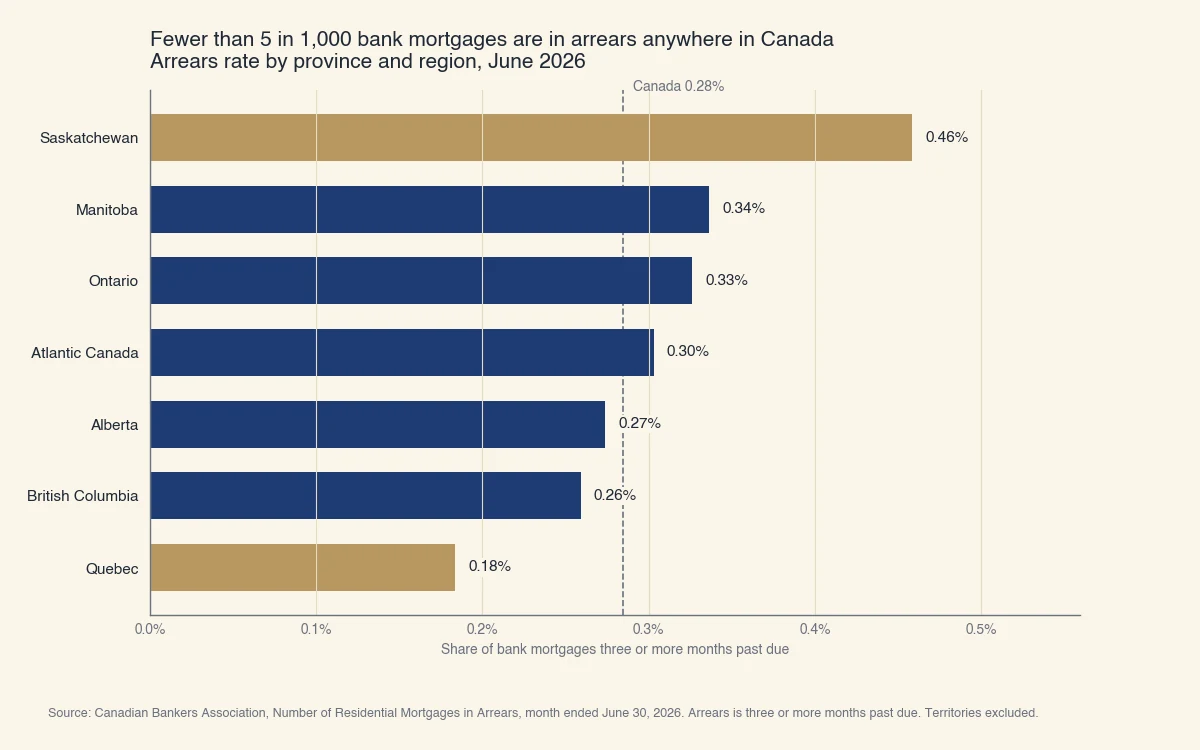
Source: Canadian Bankers Association, Number of Residential Mortgages in Arrears, month ended June 30, 2026. Arrears is three or more months past due. Territories excluded.
Two things are true at once, and most coverage picks only one.
The rate is small, and it has doubled. Arrears bottomed at 0.14% in mid-2022 and have climbed every year since. Saskatchewan now runs at 0.46%, about two and a half times Quebec's 0.18%, so where you live changes the odds meaningfully.
The pressure behind that trend is visible in the renewal pipeline. CMHC counts roughly one and a half million Canadians renewing in 2026, against national unemployment of 6.7% in February 2026 (CMHC). More borrowers are renewing into higher payments with less job security behind them.
Read together, the numbers say something useful: a declined renewal is a financing problem with a deadline, and the overwhelming majority of them get solved before they become anything worse. Treat the 21-day notice as the day the clock starts, not the day the outcome is decided.
Sphera Credit builds AI agents that work inside lenders' credit decisions for the applications that fall outside a standard credit box, which is exactly where a renewal that misses a ratio test by a point lands. The value is in reading the file accurately and being able to explain the decision, not in reaching it with less care.
If you are the borrower rather than the lender, the right first call is your existing lender, before the maturity date and before you miss a payment. A broker is the second call, because they can canvass several lenders on one application instead of leaving a hard inquiry at each.