

Never paying a collection agency is not a rule, and treating it as one is how people get sued. The advice circulates because one narrow fact behind it is true: making a payment on an old debt can hand the creditor a fresh limitation period. That is a reason to check when you last paid or acknowledged the debt before you pay. It is not a reason to ignore a debt you owe and can be sued over.
The advice also spreads because of who publishes it. Search this question and the results are almost entirely firms with a financial position on your answer. Four of the five pages ranking at the top are Licensed Insolvency Trustee practices, whose revenue comes from filing consumer proposals and bankruptcies, and the fifth is a collection agency arguing the opposite. Both sides are describing real mechanics. Neither is a neutral party.
Sphera Credit is a technology and advertising company. We do not collect debts, we do not buy them, we do not file insolvencies, and we have nothing to sell you attached to this decision. What follows is the law, the dates, and the arithmetic.
A term worth defining first. The limitation period is the window during which a creditor can start a lawsuit over a debt. When it expires, the debt is statute-barred, meaning the money is still owed but a court will not enforce it if you raise the expiry as a defence. Statute-barred is not the same as erased, and it is not automatic. You have to show up to court and say so.
Between two and six years, depending entirely on which province or territory you live in, counted from your last payment or last written acknowledgment of the debt. The two-year figure repeated across most Canadian debt advice is Ontario's rule, set by section 4 of the Limitations Act, 2002. It is not a national rule, and in five provinces and territories it is wrong by a factor of three.
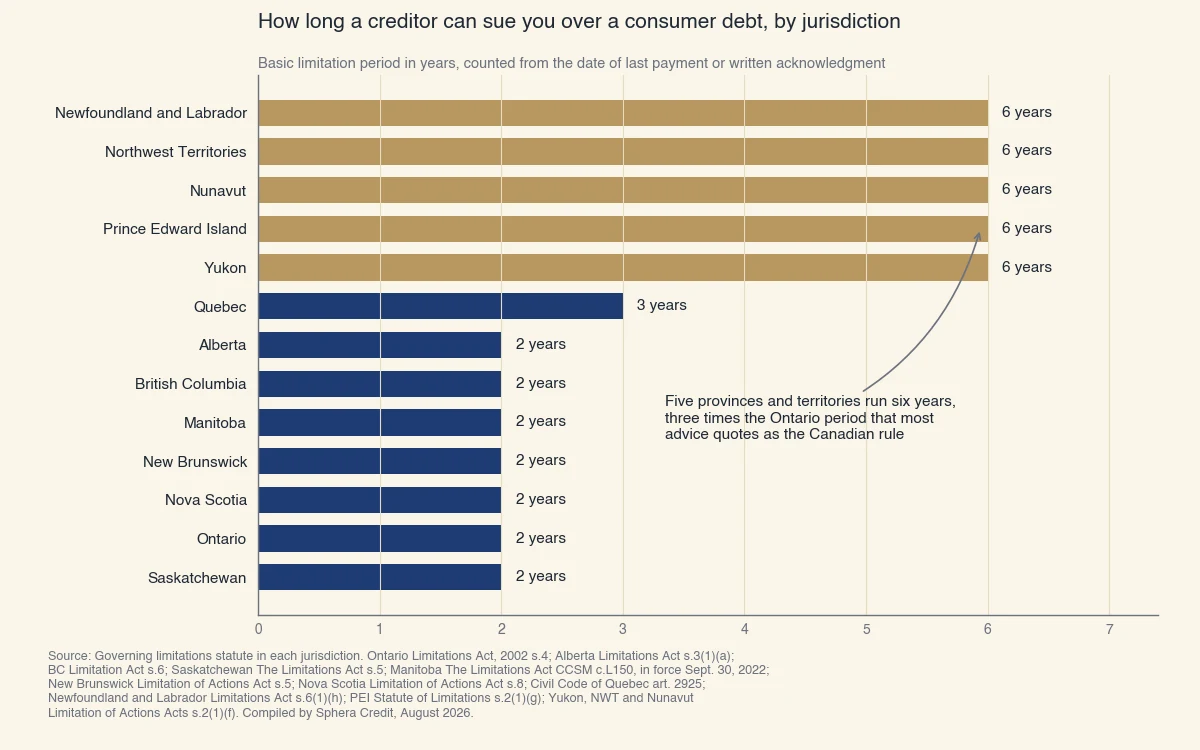
Source: Governing limitations statute in each jurisdiction. Ontario Limitations Act, 2002 s.4; Alberta Limitations Act s.3(1)(a); BC Limitation Act s.6; Saskatchewan The Limitations Act s.5; Manitoba The Limitations Act CCSM c.L150, in force Sept. 30, 2022; New Brunswick Limitation of Actions Act s.5; Nova Scotia Limitation of Actions Act s.8; Civil Code of Quebec art. 2925; Newfoundland and Labrador Limitations Act s.6(1)(h); PEI Statute of Limitations s.2(1)(g); Yukon, NWT and Nunavut Limitation of Actions Acts s.2(1)(f). Compiled by Sphera Credit, August 2026.
Here is the same information with the governing statute for each jurisdiction, so you can check your own:
| Province or territory | Limitation period | Governing statute |
|---|---|---|
| Alberta | 2 years | Limitations Act, R.S.A. 2000, c. L-12, s. 3(1)(a) |
| British Columbia | 2 years | Limitation Act, S.B.C. 2012, c. 13, s. 6 |
| Manitoba | 2 years | The Limitations Act, C.C.S.M. c. L150, in force Sept. 30, 2022 |
| New Brunswick | 2 years | Limitation of Actions Act, S.N.B. 2009, c. L-8.5, s. 5 |
| Newfoundland and Labrador | 6 years | Limitations Act, S.N.L. 1995, c. L-16.1, s. 6(1)(h) |
| Northwest Territories | 6 years | Limitation of Actions Act, R.S.N.W.T. 1988, c. L-8, s. 2(1)(f) |
| Nova Scotia | 2 years | Limitation of Actions Act, S.N.S. 2014, c. 35, s. 8 |
| Nunavut | 6 years | Limitation of Actions Act, R.S.N.W.T. (Nu) 1988, c. L-8, s. 2(1)(f) |
| Ontario | 2 years | Limitations Act, 2002, S.O. 2002, c. 24, Sched. B, s. 4 |
| Prince Edward Island | 6 years | Statute of Limitations, R.S.P.E.I. 1988, c. S-7, s. 2(1)(g) |
| Quebec | 3 years | Civil Code of Quebec, art. 2925 |
| Saskatchewan | 2 years | The Limitations Act, S.S. 2004, c. L-16.1, s. 5 |
| Yukon | 6 years | Limitation of Actions Act, R.S.Y. 2002, c. 139, s. 2(1)(f) |
Two entries in that table catch people out.
- Manitoba changed. Manitoba ran a six-year period for generations. The Limitations Act, C.C.S.M. c. L150 came into force on September 30, 2022 and moved the province to a two-year basic period, with a transitional window that closed on September 30, 2024. Advice published before 2022, which includes a good deal of what still ranks, tells Manitobans six years.
- Newfoundland and Labrador is not a two-year province. Most summaries file it with the two-year group. Its Limitations Act puts an action "to recover a debt" under section 6, at six years, not under the two-year list in section 5.
The limitation period ends the right to sue, not the right to ask. Nothing in any provincial statute requires a collector to stop contacting you once a debt is statute-barred, and some agencies keep calling for years on files they could never enforce in court. What changes at expiry is that you gain a complete defence if they do sue.
In practice, three things tend to end the contact. The account becomes statute-barred and stops being worth staff time. The credit-report entry falls off and the file loses what pressure it had. Or the agency concludes you have no income or assets a judgment could reach, which collectors call being judgment-proof.
A payment restarts the creditor's deadline to sue and leaves your credit-report deadline where it was. This is the mechanic the myth is built on, and no amount of describing it in words lands the way a calendar does. So here it is with dates.
Take a $4,200 credit-card balance in Ontario. The last payment was March 2023, and the account went to a collection agency later that year. Two clocks have been running since then:
- The limitation clock under section 4 of the Limitations Act, 2002, which gives the creditor two years to sue.
- The credit-report clock, which runs six years from the account's first delinquency, typically when it went to collection, before Equifax Canada removes the entry (Equifax Canada).
Now suppose a collector calls in August 2026 and asks for "just $50 today, as a good-faith gesture." Here is what that $50 does:
| Before the $50 payment | After the $50 payment | |
|---|---|---|
| Date of last activity | March 2023 | August 2026 |
| Creditor can sue until | March 2025, already expired | August 2028 |
| Falls off your credit report | 2029 | 2029, unchanged |
| Balance still owed | $4,200 | $4,150 |
The $50 bought a $50 reduction on a debt that could no longer be enforced in court, and paid for it with two more years of exposure to a lawsuit. The removal date did not move: the entry still comes off in 2029, paid or unpaid (Equifax Canada). That is the entire kernel of truth inside "never pay a collection agency," and it applies to exactly one situation: a debt that is already statute-barred.
The restart is not a quirk of practice, it is written into the statutes. The Northwest Territories Limitation of Actions Act states the rule in the plainest terms of any Canadian limitations statute: where a debtor promises in writing to pay, gives a signed written acknowledgment, or "makes a part payment on account of the principal debt or interest," an action may be brought within the full limitation period "after the date of the promise, acknowledgment or part payment, as the case may be, notwithstanding that the action would otherwise be barred under this Act" (section 6(1)).
Read that carefully, because two things follow that people miss. A written acknowledgment restarts the clock even with no money attached, so an email agreeing that you owe the balance does the same work as a payment. And the restart applies to a debt that was already barred, which means a payment can revive a lawsuit that was dead the day before.
One thing a payment does not do is reset your credit score to where it stood before the account went to collections. The entry stays until its original removal date, now showing a zero balance. If you are trying to understand what a collections entry is doing to your file, why a credit score drops covers how the bureaus weigh it, and how to read a credit report shows where the date of last activity appears.
A collection agency can call you, report the account to the bureaus, and sue you within the limitation period, but it cannot touch your wages or your bank account without first winning a judgment in court. Collection agencies are licensed and regulated province by province, not federally, and the Office of Consumer Affairs maintains the national summary of the conduct rules (Office of Consumer Affairs).
An agency cannot:
- Try to collect without first notifying you in writing, or making a reasonable effort to do so.
- Start or recommend legal action without notifying you first.
- Communicate with you or your family in a harassing manner.
- Call at times prohibited in your province or territory.
- Imply or give false or misleading information.
- Contact you without identifying itself, saying who is owed the money, and stating the amount.
- Keep demanding payment from someone who says they do not owe it, unless the agency first takes all reasonable steps to confirm that they do.
- Contact your friends, family or neighbours for anything beyond your phone number or address.
- Ask your employer for anything beyond your employment status, job title and work address.
That last item answers a question the search results are full of. A collector may call your workplace only to confirm those limited employment details, never to discuss the balance with your employer or with a colleague. Repeated calls to your work about the debt itself are exactly what your provincial or territorial consumer affairs office exists to handle, and the FCAC points complaints there.
Not directly, and not quickly. Wage garnishment takes three steps in sequence, and a collection agency controls only the first one:
- The agency sues you and serves a Statement of Claim.
- A court grants a judgment, either because the agency proves the debt or because you did not respond.
- The agency registers that judgment with the provincial enforcement office, which then orders your employer to redirect part of your pay.
Provincial rules then cap the amount and exempt a portion meant to cover basic needs. A collector who describes garnishment as something that happens next week, with no judgment in hand, is describing something it has no power to do.
Never ignore a Statement of Claim, even on a debt you believe is statute-barred. Step 2 does not require the agency to be right. If you do not file a defence, the court can grant a default judgment, and the expiry you were relying on is worth nothing because nobody raised it. A judgment also carries its own, much longer enforcement window, ten years in the Northwest Territories for example, so waiting out the clock stops being available the moment one is granted.
A $10,000 balance sits comfortably inside the range agencies sue over. It fits the small-claims limit in every province, so the filing cost is small next to the amount at stake, and no lawyer is strictly required. The size of the balance is rarely what decides it. Two other things usually do: whether the limitation period is still open, and whether you have income or assets a judgment could actually reach. An open limitation period on a $10,000 debt owed by someone with steady employment is the profile that gets sued.
The answer turns on four facts about your situation, not on a slogan. Work out which row you are in before you send anyone money.
| Your situation | What paying does | Reasonable next step |
|---|---|---|
| Debt is yours, limitation period still open, you have income or assets | Reduces or clears a balance that is genuinely enforceable | Pay or negotiate a settlement, get the terms in writing before you send anything |
| Debt is yours, limitation period expired | Revives a lawsuit that was no longer available | Do not pay to be polite. Get advice specific to your province before responding in writing |
| You are already served with a Statement of Claim | Nothing about paying stops the clock on your deadline to file a defence | File a defence within the deadline. Raise the limitation period if it applies |
| Debt is not yours, or the amount is wrong | Confirms a debt you may not owe | Dispute it in writing. The agency must take reasonable steps to verify before demanding again |
The first row is the one where money changes hands, and the number you offer should come from what you can actually fund. The budget calculator sets your monthly income against your expenses and Canadian category averages, which is the figure a settlement or a payment plan has to fit inside.
Three practical rules apply across every row.
- Confirm the debt is yours before anything else. Ask for written confirmation of who is owed the money and how much. You are entitled to it, and an agency cannot keep demanding payment from someone who denies the debt without first verifying it.
- Get any settlement in writing first. A verbal agreement to accept less than the full balance is difficult to enforce later. Written terms should state the amount, that it settles the account in full, and how the account will be reported.
- Say nothing in writing that acknowledges the debt while you are still working out whether it is enforceable. A signed acknowledgment restarts the limitation clock as effectively as a payment does.
If the debt is genuinely owed and you cannot pay it, the routes that exist are a negotiated settlement, a debt management plan through a credit counselling agency, a consumer proposal, or bankruptcy. The last two are filed only through a Licensed Insolvency Trustee, and the Office of the Superintendent of Bankruptcy publishes the neutral comparison of those options along with the register of licensed trustees. Which of those routes is right depends on what you would actually repay under each one, and our guide on whether a consumer proposal is worth it works that comparison through with numbers.
The honest version of the advice is narrower than the headline, and more useful. Find out which province's rule applies to you, find your date of last activity, and work out which of the four rows above you are in. Then decide. A blanket rule cannot know any of that, which is why following one costs people money in both directions: some pay debts they could never have been sued over, and others ignore claims that end in a default judgment and a garnishment.