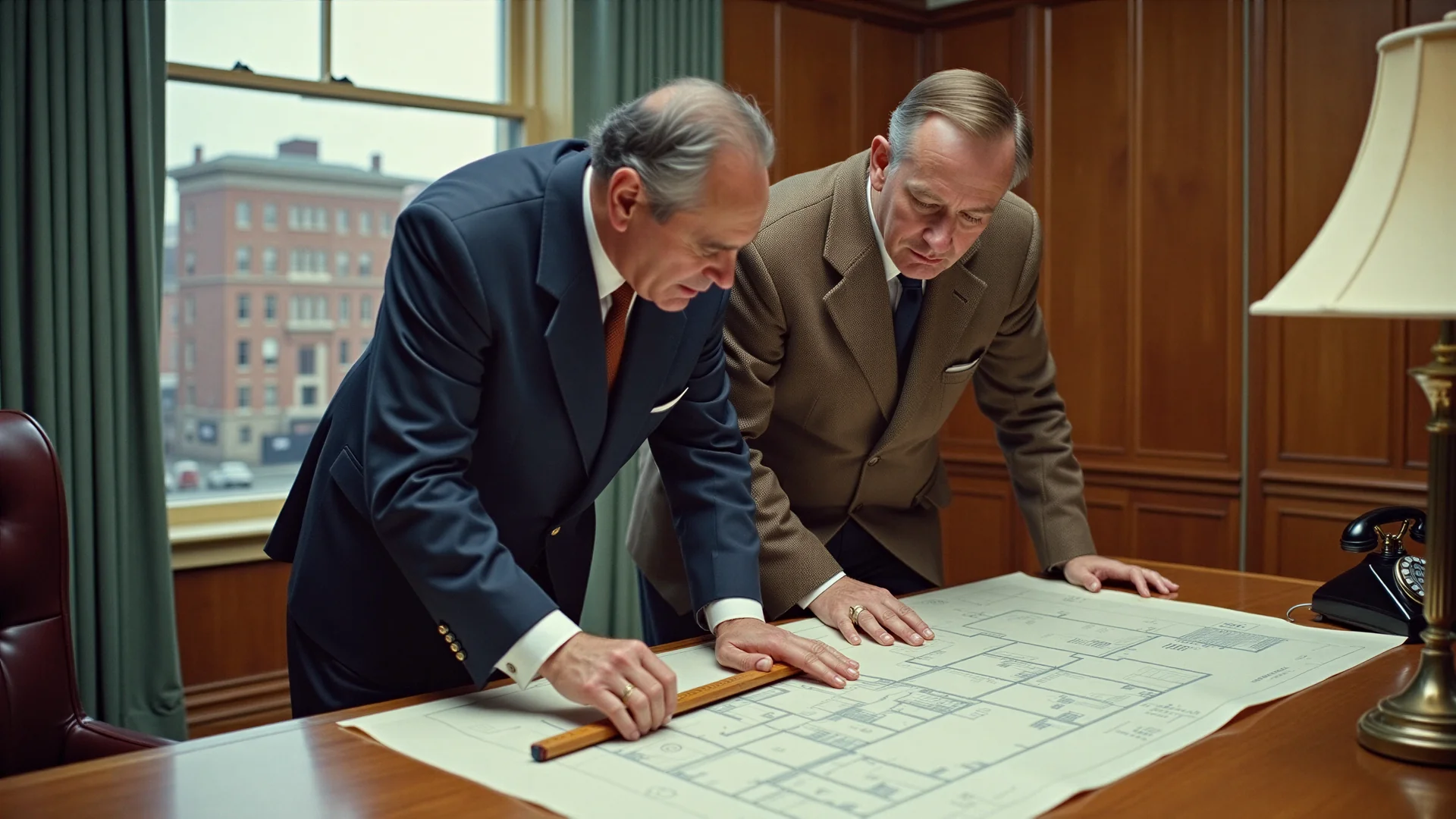

You lease commercial real estate in five steps: define the space and budget you need, tour properties with a broker, sign a letter of intent, negotiate the lease with a lawyer, and build out the space before you move in. Commercial real estate leasing is the business of renting offices, shops, warehouses and other income property to the companies that work in them.
A commercial lease is a contract between two businesses. The landlord and the tenant negotiate almost every term, and the signed document governs the relationship for years. The steps run in this order:
- Define the need. Set the size, the location, the move-in date and the full yearly budget, operating costs included.
- Search with a broker. A tenant's broker lists the available spaces and the rents recently agreed nearby. Our brokerage guide explains who a commercial real estate broker represents.
- Sign a letter of intent. The two sides agree on the business terms in a short document.
- Negotiate the lease. The landlord's lawyer drafts the lease from the letter of intent, and the tenant's lawyer reviews it.
- Build out and move in. The tenant or the landlord completes the interior work, and rent starts on the date the lease sets.
Lease length follows the property type. The pillar guide lists typical lease terms for each type of commercial real estate.
A letter of intent (LOI) is a short document in which a landlord and a tenant set out the main business terms before anyone drafts the lease. It names the premises, the term, the rent and its increases, the operating costs the tenant pays, the improvement allowance, the renewal options and the deposit.
Most of an LOI is non-binding by its own wording. The parties often make a few clauses binding, such as confidentiality or a period during which the landlord stops marketing the space. An LOI still carries weight: a term conceded there is hard to win back in the lease. Canadian brokers often use an offer to lease for the same purpose.
The main types of commercial leases are the gross lease, the modified gross lease, the net lease in its single, double and triple forms, and the percentage lease. They differ in who pays the building's property taxes, insurance and maintenance.
| Lease type | Tenant pays | Landlord pays |
|---|---|---|
| Gross, or full service | One rent figure | Taxes, insurance and maintenance |
| Modified gross | Rent plus an agreed share of some costs | The remaining costs |
| Single net (N) | Rent plus one cost, usually property taxes | The other costs |
| Double net (NN) | Rent plus two costs, usually taxes and insurance | Maintenance and structure |
| Triple net (NNN) | Rent plus taxes, insurance and maintenance | Structural repairs |
| Percentage | Base rent plus a share of sales above a threshold | Varies with the lease |
Each property type has its usual structure. The US Office of the Comptroller of the Currency (OCC), which supervises national banks, describes them for bank examiners. "Office buildings are usually leased on a gross basis" and retail leases "are commonly written on a net basis" (OCC handbook). In a retail lease, an anchor tenant "may pay a flat rate plus a percentage of their annual sales (percentage rent)".
A gross lease is one "under which you pay a single amount to the landlord that covers base rent and all incidental expenses", in the words of the Business Development Bank of Canada (BDC, leasing terms). The same structure is called a full service lease or full service gross (FSG) in office buildings. Gross rent means that all-in figure.
The landlord carries the risk that costs rise during the term, and prices that risk into the rent. Many gross leases limit it with an expense stop: the landlord pays costs up to a set level, and the tenant pays its share above it.
NNN stands for triple net. Under a triple net lease, the tenant pays base rent plus the three "nets": property taxes, building insurance and maintenance. BDC's definition leaves the landlord with "no costs, other than those for structural repairs". Net rent is the base figure before those costs.
The label alone does not settle who pays for a new roof. The OCC warns examiners that the terms net, double net, triple net and absolute net "lack universally agreed-upon definitions", and that "the lease itself should always be analyzed" (OCC, net lease definition). Two leases marked NNN can divide the cost of a parking lot or a heating system in opposite ways. Read the expense clauses and treat the label as a summary.
Commercial real estate rent equals the rentable square feet multiplied by the yearly rate per square foot, plus the tenant's share of operating costs when the lease is net. The area, the rate and the costs each need a definition before two quotes can be compared.
Rentable square feet (RSF) is the area the rent is charged on. It is larger than the area the tenant occupies. Under a US federal regulation, rentable square footage "generally includes square footage of areas occupied by customers plus a prorated share of floor common areas such as elevator lobbies, building corridors, public restrooms" (41 CFR 102-85.35). The gap between the two areas is the common area factor, also called the load factor.
Take a tenant comparing two quotes for the same office suite. Every figure is an assumption for the arithmetic:
| Step | Gross quote | Triple net quote |
|---|---|---|
| Usable area | 4,000 sq ft | 4,000 sq ft |
| Rentable area at a 15% common area factor | 4,600 sq ft | 4,600 sq ft |
| Base rent per rentable square foot | $42.00 | $30.00 |
| Operating costs per rentable square foot | Included | $11.00 |
| First-year cost | $193,200 | $188,600 |
| Cost if operating costs rise 10% | $193,200 | $193,660 |
The triple net quote costs $4,600 less in the first year. A 10% rise in operating costs reverses the order, because the net tenant carries that rise and the gross tenant leaves it with the landlord. The gross quote also works out to $48.30 for each square foot the tenant can use, well above the $42.00 on the proposal.
CAM stands for common area maintenance: the cost of running the parts of a property that all tenants share. BDC lists "fees for snow removal, janitorial services, landscaping, grass cutting and property management" as examples. A CAM charge, or CAM fee, is one tenant's share of that cost.
The share is usually pro rata by area. A tenant with 4,600 of a building's 46,000 rentable square feet pays 10%. On a CAM budget of $230,000, that share is $23,000 a year, or $5.00 per square foot.
The landlord bills CAM from a budget and settles it after year-end. In a CAM reconciliation, the landlord compares the estimates the tenant paid with the actual costs. If the actual costs reached $253,000, this tenant owes another $2,300. A tenant can negotiate the right to audit the statement and a cap on yearly increases.
Operating expenses, shortened to opex, are the recurring costs of running a building: property taxes, insurance, utilities, repairs, cleaning and management. Loan payments, income taxes and depreciation stay outside them. So do major capital projects, although a lease can let the landlord recover part of one over time.
Operating expenses matter to both sides. A net tenant pays a share of them as additional rent. For the owner, rent less operating expenses equals net operating income, the figure a building's value rests on. Our valuation guide shows how cap rates and NOI turn income into value.
Most commercial leases raise the base rent every year, through a fixed step or through an index. A fixed step adds a set percentage or dollar amount. An indexed step follows inflation, most often the Consumer Price Index (CPI).
The US Bureau of Labor Statistics (BLS), which publishes the CPI, lists rental contracts among "the most frequently used escalation applications". It "recommends that users adopt the U.S. City Average CPI for use in escalator clauses", and it states that "the use of seasonally adjusted data in escalation agreements is inappropriate" (BLS, CPI escalation). Those figures are revised after release, so a clause should name the unadjusted index.
An indexed rent can cost a tenant more than a fixed step. Take a lease that began in August 2016 and stepped up each August. The unadjusted CPI rose from 240.849 in August 2016 to 334.980 in August 2026 (FRED).

Source: U.S. Bureau of Labor Statistics, Consumer Price Index for All Urban Consumers, U.S. city average, all items, not seasonally adjusted, via FRED (series CPIAUCNS), August 2016 to August 2026; Sphera Credit calculation of the two rent paths.
For five years the indexed tenant paid less. One step in 2022 put the indexed rent ahead, and it has stayed there. On a starting rent of $30.00 per square foot, the fixed lease reaches $40.32 and the indexed lease $41.72. BLS suggests the remedy for both sides: a "cap" that limits the increase, or a "floor" that promises a minimum one.
Lenders and buyers check who the tenants are, how much rent each pays, when each lease expires, and whether each lease survives a sale or a foreclosure. A leased building is worth the rent its leases promise, so the leases are the asset.
The OCC lists what a bank's loan file should hold. It includes "copies of all leases and executed tenant estoppels" (OCC, loan documentation). The lender reads them to judge how reliable the building's income is, and sizes the loan from that income.
A rent roll is a table of a property's leases: each tenant, its suite and area, its rent, its start and end dates, and its options. An owner keeps it current, and a buyer checks it against the signed leases during due diligence. Our investing guide walks through how to buy a commercial property.
WALT means weighted average lease term: the average time left on a property's leases, weighted by each tenant's area or rent. Take three tenants:
- Tenant A leases 6,000 square feet with 8 years left.
- Tenant B leases 3,000 square feet with 2 years left.
- Tenant C leases 1,000 square feet with 1 year left.
The simple average is 3.7 years. Weighted by area, the WALT is 5.5 years, because the largest tenant stays longest. A longer WALT means steadier income. The OCC notes that properties with shorter lease terms "are vulnerable to declining market values as rents decline and leases are renewed at lower rental rates".
An estoppel certificate is a signed statement in which a tenant confirms the facts of its lease to a lender or a buyer. The tenant then cannot claim otherwise later, which is what "estoppel" means.
The US General Services Administration (GSA), the federal government's landlord and tenant agency, prints its own version in its lease rules. On request, GSA confirms that "the lease is in full force and effect", "the date to which the rent and other charges have been paid in advance", and "whether any notice of default has been issued" (GSAM 552.270-24). A private certificate covers the same ground and adds the rent, the term, the deposit and any side agreements.
An SNDA is a subordination, nondisturbance and attornment agreement between a tenant and the landlord's lender. It makes three promises, and GSA's standard clause states them (GSAM 552.270-23):
- Subordination. The lease ranks behind the mortgage: it "is subject and subordinate to any and all recorded mortgages".
- Nondisturbance. The lender leaves a paying tenant in place. The subordination cannot "affect adversely any right" of the tenant while the tenant "is not in default under this lease".
- Attornment. After a foreclosure, the tenant accepts the new owner as its landlord: the tenant "will be deemed to have attorned to any purchaser".
A tenant that signs a subordination clause with no nondisturbance promise risks losing its lease if the landlord defaults on the loan. A tenant about to spend heavily on a space should ask for the nondisturbance promise in writing.
The commercial real estate learning centre collects the rest of this series.