

What is commercial real estate?
Commercial real estate is property held to produce income, and its defining feature is that its value comes from the income it earns rather than from what similar buildings sold for. That single difference drives almost everything else: how it is appraised, how it is financed, who buys it, and why the same physical building can be residential one year and commercial the next.
Most explanations start with a list of building types: office, retail, warehouses, hotels. The list is useful and you will find it below, but it does not actually define anything. It leaves you unable to classify a self-storage facility, a parcel of raw land, a cell tower, or a six-unit walk-up. Each of those is commercial real estate, and none of them looks like the others.
What makes a property commercial rather than residential?
The test is how a buyer or an appraiser arrives at the price.
A house is priced by sales comparison: an appraiser finds recent sales of similar houses nearby, adjusts for differences, and lands on a number. The house produces no income, so there is nothing else to measure.
A commercial property is priced by the income approach: the appraiser estimates the annual income the property will produce, then converts that income into a value using a market yield. The building is treated as a stream of payments with a roof attached.
This is why a four-unit building and a five-unit building sit on opposite sides of a line that has nothing to do with bricks. It is also why development land counts as commercial even though it produces nothing today. The buyer is paying for income that does not exist yet.
What are the main types of commercial real estate?
Commercial property is grouped into asset classes by the kind of tenant it serves, because tenant type drives lease length, vacancy risk, and the cost of re-letting space. A lender and an appraiser will both ask which class a building falls into before asking anything else about it.
| Asset class | What it holds | Typical lease term |
|---|---|---|
| Office | Professional tenants, from single-tenant towers to suburban parks | 5 to 10 years |
| Retail | Storefronts, strip plazas, enclosed malls, single-tenant stores | 5 to 10 years, often with percentage rent |
| Industrial | Warehouses, distribution, light manufacturing, cold storage | 3 to 10 years |
| Multifamily | Rental residential buildings of five or more units | 1 year, renewed |
| Hospitality | Hotels and motels, where the "lease" is a nightly stay | Nightly |
| Special purpose | Self-storage, data centres, medical clinics, seniors housing | Varies widely |
| Land | Parcels held for development or held raw | No lease |
Multifamily is the one that surprises people. A 60-unit apartment building houses families in exactly the way a house does, and it is still commercial property, because the owner holds it for rent and every lender prices it on its rent roll.
What do Class A, B and C mean?
Inside an asset class, buildings are graded on quality. Class A buildings are the newest and best located, with current mechanical systems and the highest rents in their market. Class B buildings are older or less well located, command average rents, and are the most common thing actually traded. Class C buildings are functional space at below-market rents, often 30 or more years old and due for capital work.
The grades are conventions rather than definitions. There is no body that certifies them, and a Class A building in a small city would often be a Class B building downtown in a larger one.
How is commercial space measured and quoted?
Commercial rent is quoted per square foot per year in most of the United States and Canada, so a 3,000 square foot suite at $22 per square foot costs $66,000 a year, or $5,500 a month. Some Canadian markets and most US apartment listings quote a monthly figure instead, which is worth confirming before comparing two spaces.
The square footage itself has two definitions. Usable square feet is the space a tenant occupies alone. Rentable square feet adds that tenant's share of lobbies, corridors, and washrooms. The ratio between them is the load factor, commonly 10% to 20% in office buildings, and rent is charged on the rentable figure. Two suites advertised at the same rate and the same rentable area can hand over noticeably different amounts of actual room.
How do commercial leases split the operating costs?
Every commercial lease answers one question: which side pays the property taxes, the insurance, and the upkeep. Three structures cover most of the market.
- Gross lease. The tenant pays one rent figure and the landlord absorbs the operating costs out of it. Common in office towers and in small suites where the tenant wants a predictable monthly number.
- Net lease. The tenant pays base rent plus a share of the operating costs. Single net adds property tax, double net adds insurance, and triple net adds maintenance on top. Triple net is the usual structure for retail and industrial space.
- Percentage lease. The tenant pays a base rent plus a percentage of sales above an agreed threshold. Standard in enclosed malls, where the landlord's marketing and foot traffic are part of what the tenant is buying.
The structure changes what the same headline rent means. A $20 per square foot gross rent and a $20 per square foot triple net rent are different deals, because the second one adds the operating costs on top. Comparing two spaces means converting both to the same basis first.
Where is the line between residential and commercial property?
In both the United States and Canada the practical dividing line for rental residential buildings sits at five units: one to four units is financed as residential, five or more is financed as commercial. The building does not change. The financing available to it changes completely.
On the US side, Fannie Mae "purchases or securitizes first-lien mortgages that are secured by residential properties when the dwelling consists of one to four units" (Fannie Mae Selling Guide B2-3-01). A fifth unit puts the property outside that programme and into commercial multifamily lending.
On the Canadian side the same threshold appears in CMHC's multi-unit insurance rules, where a project "must have a minimum of 5 units" to qualify for MLI Select (CMHC).
What sits on either side of that line matters more than the line itself:
- Four units or fewer. The loan is underwritten mainly on the borrower's personal income and credit. Amortization typically runs 25 to 30 years. The rate is quoted off residential mortgage benchmarks.
- Five units or more. The loan is underwritten mainly on the property's own income. The borrower's covenant still matters, but the building has to service its own debt. Terms are shorter than the amortization, so the loan matures with a balance still outstanding.
That second point is the part newcomers most often miss. A commercial mortgage with a 25-year amortization and a 5-year term does not disappear in year five. It has to be refinanced, and if values or rates have moved against the owner in the meantime, refinancing is where the loss shows up.
How does a lender value and finance a commercial property?
A lender works through four numbers in order: net operating income, then value, then the debt the income can service, then the debt the collateral can support. The smaller of the last two is the loan. Working through one property makes the sequence concrete.
Take a small retail strip collecting $240,000 of annual rent, with a 5% vacancy allowance and $54,000 of annual operating costs (property taxes, insurance, common area maintenance, management).
- Effective gross income. $240,000 less 5% vacancy equals $228,000.
- Net operating income. $228,000 less $54,000 of operating costs equals an NOI of $174,000. NOI excludes mortgage payments and income tax on purpose, so that two buyers with different financing measure the same building identically.
- Value. Divide NOI by the market capitalization rate, the yield an unleveraged buyer would accept. At a 6.5% cap rate, $174,000 divided by 0.065 gives a value of about $2,677,000.
- The loan. Two separate tests apply.
The first is debt service coverage ratio (DSCR), the NOI divided by the annual mortgage payment. Lenders commonly want at least 1.25, meaning the building earns 25% more than the payment. At a 1.25 minimum, annual debt service can be at most $174,000 divided by 1.25, which is $139,200. At a 6% interest rate on a 25-year amortization, that payment supports roughly $1.8 million of debt.
The second is loan-to-value (LTV), the loan divided by the appraised value. For improved income-producing property, US bank regulators set a supervisory LTV limit of 85%, alongside 65% for raw land, 75% for land development, and 80% for commercial and multifamily construction (Interagency Guidelines for Real Estate Lending). Most lenders sit well below the ceiling. At 70% LTV the collateral supports about $1,874,000.
The loan is the lesser of the two, so this building borrows roughly $1.8 million, constrained by coverage rather than by collateral. That is the usual case, and it is why an owner who raises NOI raises both the value and the borrowing capacity of the same building.
Who actually lends on commercial property?
Commercial and multifamily mortgage debt outstanding in the United States passed $5.02 trillion in the first quarter of 2026, and it is held by four main groups plus a long tail.
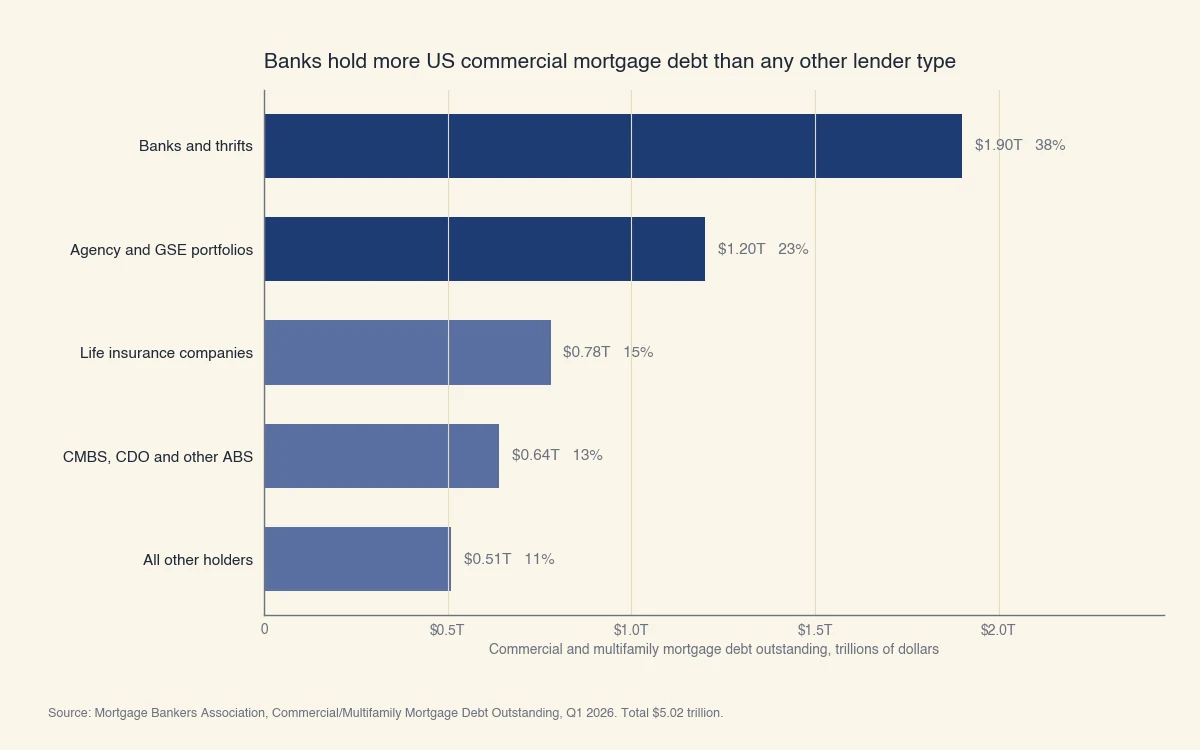
Source: Mortgage Bankers Association, Commercial/Multifamily Mortgage Debt Outstanding, Q1 2026. Compiled from the Federal Reserve Financial Accounts of the United States, the FDIC Quarterly Banking Profile, and Trepp LLC.
Each group lends differently. Banks hold the largest share at 38% and are the most flexible on structure and the quickest to reprice. Agency and government sponsored enterprise programmes concentrate in multifamily, where they hold half of all debt outstanding, and they offer the longest terms. Life insurance companies want stabilised, well-located assets and quote fixed rates for long periods. Securitised lenders package loans into bonds, which makes their pricing competitive and their loan terms rigid after closing.
If the underwriting vocabulary here is unfamiliar, our explainers on what underwriting is and how underwriting works in real estate cover the process in more detail.
How does commercial real estate differ in Canada and the United States?
The asset classes and the five-unit threshold are the same on both sides of the border, while the lease vocabulary, the insured financing programmes, and the transfer taxes are not. Practitioners who work in both markets get caught by the vocabulary first.
| Canada | United States | |
|---|---|---|
| Recoverable operating costs | TMI, for taxes, maintenance, and insurance | NNN or triple net, for the same three categories |
| Insured multifamily financing | CMHC MLI Select, up to 95% loan-to-value and up to 50-year amortization | Fannie Mae and Freddie Mac multifamily programmes |
| Transfer tax on purchase | Provincial land transfer tax, plus municipal tax in some cities | State and county transfer taxes, rates set locally |
| Policy rate reference | Bank of Canada | Federal Reserve |
TMI and NNN describe the same arrangement in different words: the tenant pays a proportionate share of property taxes, building maintenance, and insurance on top of base rent. A Canadian listing quotes base rent plus TMI; a US listing for the identical deal quotes a triple net rent. Landlords in both markets estimate the annual figure, bill it monthly, then reconcile against actual costs after year end and refund or invoice the difference.
The financing difference is larger than the vocabulary difference. CMHC's MLI Select programme insures multi-unit residential loans at up to 95% of value with amortization as long as 50 years for projects that score enough points on affordability, energy efficiency, and accessibility (CMHC). Because the loan carries government insurance, the lender prices it well below an uninsured commercial loan. Nothing in the US market combines that loan-to-value with that amortization for the same asset.
Rate expectations differ too, because the two central banks move independently. Our pages on the current prime rate and how rate increases pass through to US mortgages track each side.
What are the main risks in commercial real estate?
The three risks that distinguish commercial property from residential property are vacancy, tenant concentration, and the gap between a loan's term and its amortization. All three trace back to the same fact: the value is the income, so anything that interrupts the income hits the value directly.
Vacancy costs more and lasts longer. A vacant apartment re-lets in weeks at a known market rent. A vacant 20,000 square foot industrial bay can sit for a year, and the landlord usually pays for tenant improvements and broker commissions to fill it. Those costs arrive precisely when the income has stopped.
Tenant concentration turns one credit decision into the whole investment. A single-tenant building has a 100% occupancy rate right up until it has a 0% occupancy rate. Owners and lenders read the tenant's own financial strength and the weighted average remaining lease term across the building, because a strong tenant with 11 months left is a different risk from a weaker tenant with nine years left.
The refinance gap is the risk most specific to commercial debt. A commercial mortgage is commonly written with a 25-year amortization and a 5 or 10 year term, so a large balance is still outstanding when the term ends. The owner has to refinance it. If cap rates have risen or NOI has fallen since origination, the property appraises lower, the new loan is smaller, and the owner has to put in cash to close the gap or sell. Roughly a fifth of US commercial mortgage balances comes due in any given year, which is why loan maturities get watched as closely as rents do.
None of this makes commercial property a worse asset than residential property. It makes it a different one, priced and financed on the strength of a contract stream rather than on the borrower's paycheque.
For the rest of this vertical, including valuation, leasing, brokerage, and careers, start at the commercial real estate learning centre.