The AI operating system for consumer lenders
Flag risk signals no one else can see, and approve borrowers you used to decline.

Generate data no other lender has
Interview borrowers, by voice
Run the interview on every file
The verification a branch manager used to do in person, on every application, at any loan size.
It follows up on the answer it just got
A vague answer gets a follow-up question there and then, not a flag for someone to chase next week. That is the part a form cannot do.
Turn the conversation into data and a score
Structured fields, with their source
Every answer becomes a field with a provenance, not a note buried in a file. The same fields on every borrower.
Signals a form never captures
A second household income, commission-heavy pay, a stated use of funds that matches the bank data. Scored against your policy, not ours.
Build the conversation flows
Flows your team designs
What gets asked, where it branches, and what a given answer triggers. Built by the people who own the credit policy.
Change it without an engineer
A new question or a new branch is a change to the flow, not a release you wait on.
Get the same benefits as running a physical branch, digitally
Collect documents and standardized credit data
It does the chasing
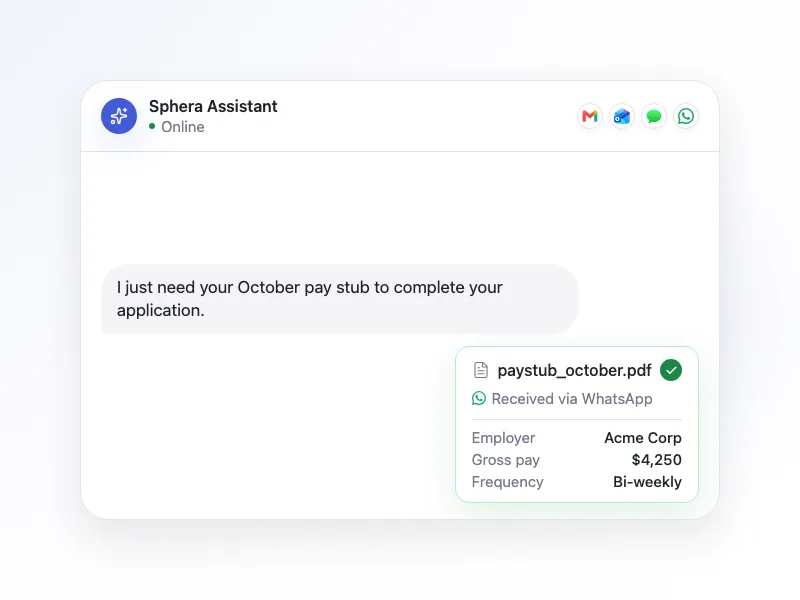
Requests, reads and verifies what the file needs, over email, text and WhatsApp.
Structured the same way every time
Every file arrives with the same fields, filled the same way. That is a credit dataset, not a folder of PDFs.
Connected to your data sources
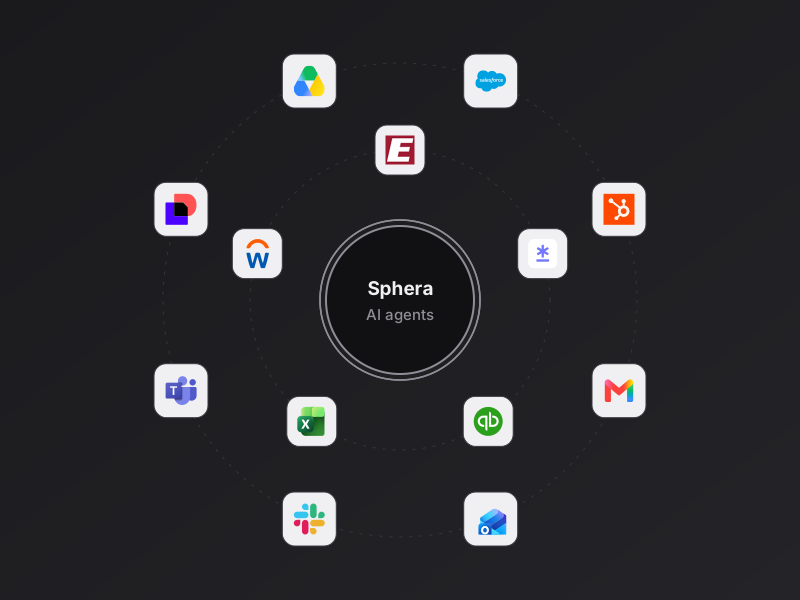
Your existing providers
Bureau, banking and transaction data, identity and income verification, read through the contracts you already hold.
Inside the tools you use
Agents do the manual work between your systems.
Your credit policy, running as decision flows
Written by your credit team
Deterministic flows your team can change, test and prove out before they touch a live application.
The decision stays yours
Sphera processes and recommends. Approval stays with your team.
Agents for the files that do not fit
Edge cases get worked, not queued
The file that falls outside policy is the one that costs the most to touch. Agents work it instead of parking it.
Every step is on the record
What the agent asked, what came back, and why it landed where it did.
Frequently asked questions from consumer lenders
Sphera Credit is an AI operating system for consumer lenders: credit unions, banks and non-bank lenders that make unsecured personal loans. It covers origination, underwriting, credit risk and servicing. AI agents interview applicants by voice, turn the conversation into structured data and risk signals, verify income and employment, analyze bank statements, and handle servicing requests after funding. The lender's credit policy and its underwriters make every credit decision.
Sphera Credit is built for unsecured personal loans. With no collateral and often a thin credit file, the bureau report and the application form give an underwriter little to decide on. Sphera Credit adds the information that is missing: a voice interview with the applicant, verified income and employment, and an analysis of bank transactions. Products that are already fully automated, such as credit cards, are a weaker fit.
No. Sphera Credit can run origination end to end as the lender's loan origination system, or its AI agents can work on top of the loan origination system, core banking system and data providers a consumer lender already uses, reading from those systems and writing updates back to the same records. Sphera Credit supports both paths and recommends the first to lenders who are ready to redesign how the work gets done, because systems built before agentic AI were never designed for AI agents to work in them.
On an unsecured personal loan, a conversation with the applicant is often the best source of information a lender has, because there is little collateral, credit history or financial data to rely on. A branch manager used to have that conversation in person, and it is hard to justify staff time for it on every small loan. Sphera Credit's voice agent runs the interview on the applications the lender chooses, asks a follow-up question when an answer is vague, and records every answer as data.
Sphera Credit turns every answer into a structured field with its source in the conversation, in the same format for every applicant. It also extracts risk signals that an application form does not capture, such as a second household income, commission-heavy pay or a stated use of funds that matches the bank data, and scores them against the lender's own credit policy. The underwriter receives the fields, the signals and the transcript.
Yes. The lender's credit team builds the conversation flows in Sphera Credit: what is asked, where the conversation branches and what a given answer triggers. Adding a question or a branch is a change to the flow that the team makes itself, with no engineering release to wait for.
Yes. Sphera Credit's AI assistant requests the documents the file needs, such as pay stubs, T4s and notices of assessment in Canada or W-2s in the United States, reads them and verifies income and employment against the application. It follows up with the applicant until each condition to fund, or stipulation, is cleared.
Yes. Sphera Credit's loan processing reads bank statements and open banking feeds as transactions. It categorizes deposits, returned payments and recurring obligations, ties them to the applicant, and flags what does not match the application, such as deposits that differ from the declared income. Each flag links to the transaction behind it.
For applicants with a thin credit file, including newcomers and people a bureau cannot score, Sphera Credit gives the underwriter more to decide on than the bureau report alone: the interview, verified income and employment, and bank transaction analysis, all structured the same way on every file. The lender's credit policy decides how that information is used.
Sphera Credit ties every figure an agent extracts to the page it came from and records every agent run step by step: what the agent read, what it did and why. Before an agent works on live files, the lender's team replays it in AI Agent Studio on cases the team has already handled and scores how it behaves. The lender also sets a level of autonomy for each action an agent can take: run automatically, require human approval every time, or be blocked completely.
No. The lender's credit policy runs as decision flows that its own credit team writes, tests and versions, so an application inside the credit box gets the same decision every time. Applications that fall outside the box are routed to the lender's underwriters or to AI agents that gather and analyze more information. Sphera Credit prepares the file and the recommendation, and approval stays with the lender's team.
Yes. Because the credit policy runs as rules, each decision traces to the rule behind it. For a declined application, Sphera Credit's agents draft the specific reasons from the rules and the file, and the lender reviews them before they go to the applicant, for example in an adverse action notice in the United States.
Yes. After funding, Sphera Credit's agents answer account calls and handle requests such as a payment date change or a hardship request. They take the request, check it against the lender's rules and prepare the change. The lender sets which changes an agent can apply on its own and which need a person's approval.
Sphera Credit pricing is tailored to each consumer lender and has two parts: an implementation fee and an ongoing platform fee. The implementation fee depends on the scope of the rollout, because Sphera Credit's team works alongside the lender on both the technical setup and change management. The platform fee is outcome-based: it follows the loan volume processed on the platform, so it scales with the size of the lender's operations.
Sphera Credit encrypts client data in transit and at rest, and limits access with role-based permissions, single sign-on and multi-factor authentication. Client data is never used to train AI models. For Canadian lenders, Sphera Credit stores data in data centres in Montreal and runs AI inference in Montreal as well, so documents, prompts and AI responses stay in Canada. For US lenders, Sphera Credit stores data in data centres in the United States and runs AI inference there as well, so documents, prompts and AI responses stay in the United States. Every lender can choose the region where its AI inference runs.
Run one live file with us
Pick a file your team would normally verify by hand. We will run it and show our work.