The AI operating system for mortgage brokerages
File processing from intake to lender-ready submission, without adding headcount.

What Sphera Credit does for mortgage brokerages
Re-engage the borrowers who went quiet
Follow-up that actually happens
Most files do not die on rate. They die because nobody followed up on the fourth day.
Before the file goes cold
A borrower who stops answering gets reached before the deal is gone.
Collect the documents
It does the chasing
Requests, reads and verifies every document, and follows up over email, text and WhatsApp.
Wherever the borrower actually replies
Email, phone, text and WhatsApp. The assistant follows up on the channel that gets an answer, not the one that suits us.
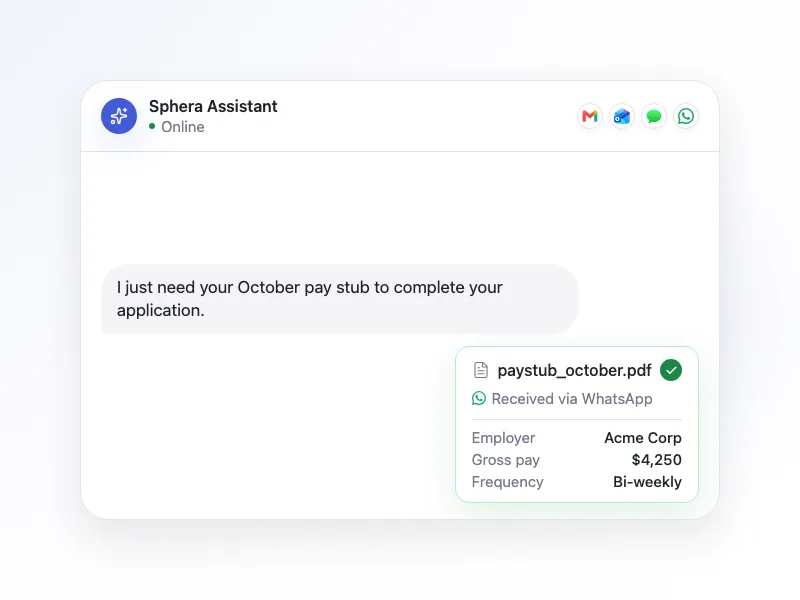
Read every document, not just collect it
Fields pulled and cross-checked
Every document is read and its figures checked against what the application already claims.
Contradictions surface on your side
An address that does not match, or income that disagrees with the T4, is caught before the lender ever sees the file.
Submit a package the lender can ingest
MISMO 3.4 or the lender's own format
Application data and documents assembled the way each lender actually wants to receive them.
Validated before it goes
Nothing missing, nothing that fails schema validation, and no second request for a document you already sent.
Upload the lender's conditions and Sphera clears them
Every condition tracked to cleared
Drop in the commitment letter. Each condition becomes a tracked item that gets worked until nothing is outstanding.
Faster to funding
Conditions are the last mile, and clearing them quickly is what your borrower actually experiences.
Frequently asked questions from mortgage brokerages
Sphera Credit is an AI operating system for mortgage brokerages. It covers application intake, document collection and review, lender submission and conditions. AI agents collect each borrower's documents, read them and check them against the application, assemble the submission package for the lender and work the lender's conditions until none is outstanding. Brokers keep the borrower relationship, the choice of lender and the recommendation.
Sphera Credit handles purchase, refinance, renewal and switch files, for salaried, self-employed and non-prime borrowers. It prepares submissions to prime (A), alternative (B) and private lenders, including mortgage investment corporations, in Canada, and to wholesale lenders in the United States. It is built for mortgage brokers and brokerages in both countries that process a high volume of files.
No. Sphera Credit's AI agents can work on top of the origination platform, CRM and document tools a brokerage already uses, reading from those systems and writing updates back to the same records. Sphera Credit can also run the file itself, from application to submission package, with its own borrower portal, document collection and file review. On either path, the submission is assembled in the format each lender asks for.
Sphera Credit's AI assistant requests each document the file needs, one at a time, and explains what qualifies. In Canada that is typically pay stubs, an employment letter, T4s, notices of assessment (NOAs), T1 Generals and bank statements for the down payment. In the United States it is typically pay stubs, W-2s, 1040 tax returns and bank statements. The assistant follows up by email, text message, WhatsApp and phone, reads each document when it arrives and asks for a clean copy when a page is missing or unreadable.
Sphera Credit records what each borrower still owes and why the file stalled. The AI assistant then follows up on the channel the borrower answers, names the exact document that is missing, and places a phone call when messages get no reply. The broker sees which files are stalled, and for what reason, in one view.
Sphera Credit's loan processing reads every document and checks its figures against the application and against the other documents in the file. It flags, for example, an address that does not match, income that disagrees with the T4 or the notice of assessment, or a bank deposit that does not match the declared income. It also calculates the ratios the lender will look at: gross and total debt service ratios (GDS and TDS) in Canada, debt-to-income (DTI) in the United States, and loan-to-value (LTV). Each flag links to the page behind it, so the broker resolves it before the lender sees the file.
Yes. For self-employed, commissioned and gig-income borrowers, Sphera Credit reads the documents that establish income, such as T1 Generals and notices of assessment in Canada, 1040 returns in the United States, business financial statements and bank statements for the past twelve months. It calculates the income with the method the brokerage sets for the lender or program, shows the calculation and ties each figure to its source page for the broker to review.
Yes. A brokerage gives its AI agents the guidelines of the lenders it works with. Before submission, an AI agent compares the file with the guidelines of the lender the broker has in mind and lists the criteria the file meets and the ones it misses, each with the passage it relied on. The broker chooses the lender.
Sphera Credit assembles the application data and the documents in the format each lender asks for, such as MISMO 3.4 in the United States or the lender's own format. It validates the package before it goes out: every required document is present and the data passes the format's checks. An AI agent also drafts the submission note that presents the borrower's situation, for the broker to edit and approve.
The broker uploads the lender's commitment letter, or the conditional approval in the United States. Sphera Credit turns each condition into a tracked item, requests what the borrower still owes, reads each document when it arrives and keeps the list current until no condition is outstanding. The broker sees every file's open conditions on one board.
Sphera Credit's AI agents work inside the mortgage file itself. They request and read the borrower's documents, cross-check the data, calculate the ratios and assemble the submission package, each within permissions the brokerage sets, and every run is recorded step by step. Brokerages also choose where AI processing happens: Canadian brokerages can keep documents, prompts and AI responses in Montreal, while a general-purpose assistant may process a prompt in a data centre outside Canada.
Sphera Credit ties every figure an AI agent extracts to the page it came from and records every agent run step by step: what the agent read, what it did and why. Before an AI agent works on live files, the brokerage's team replays it in AI Agent Studio on files the team has already handled and scores how it behaves. The brokerage also sets a level of autonomy for each action an AI agent can take: run automatically, require human approval every time, or be blocked completely.
No. Sphera Credit's AI agents prepare the file: they collect, read, check and assemble. The broker advises the borrower and recommends the product and the lender, and the lender makes the credit decision. The brokerage sets which actions an AI agent can take on its own and which need a person's approval.
Sphera Credit pricing is tailored to each brokerage and has two parts: an implementation fee and an ongoing platform fee. The implementation fee depends on the scope of the rollout, because Sphera Credit's team works alongside the brokerage on both the technical setup and change management. The platform fee is outcome-based: it follows the mortgage volume processed on the platform, so it scales with the size of the brokerage's operations.
Sphera Credit encrypts client data in transit and at rest, and limits access with role-based permissions, single sign-on and multi-factor authentication. Client data is never used to train AI models. For Canadian brokerages, Sphera Credit stores data in data centres in Montreal and runs AI inference in Montreal as well, so documents, prompts and AI responses stay in Canada. For US brokerages, Sphera Credit stores data in data centres in the United States and runs AI inference there as well, so documents, prompts and AI responses stay in the United States. Every brokerage can choose the region where its AI inference runs.
Run one live file with us
Hand us one file after the first client call. You get back a submission-ready package.