

Commercial real estate is valued with three approaches: the income approach, which converts the property's net operating income into a price; the sales comparison approach, which adjusts recent sales of similar buildings; and the cost approach, which adds land value to the depreciated cost of rebuilding. An appraiser runs every approach that applies, then reconciles the results into one opinion of value. US banking regulators write this into their guidance: "the appraisal must include any approach to value (that is, the cost, income, and sales comparison approaches) that is applicable and necessary to the assignment" (Interagency Appraisal and Evaluation Guidelines).
The income approach carries most of the weight for property held to earn rent, because a buyer of a leased building is paying for its rent. The sales comparison approach checks that number against what buyers actually paid. The cost approach sets a ceiling: a buyer will rarely pay more for an existing building than it would cost to build a new one on similar land.
| Approach | What it measures | Strongest for | Weakest for |
|---|---|---|---|
| Income | Net operating income divided by a market cap rate, or a multi-year cash flow model | Leased office, retail, industrial and apartment buildings | Vacant buildings and owner-occupied space with no rent |
| Sales comparison | Price per square foot, per unit or per door from adjusted recent sales | Markets with frequent sales of similar buildings | Special-purpose property and thin markets |
| Cost | Land value plus replacement cost, minus depreciation | New construction and special-purpose buildings | Older buildings, where depreciation is hard to measure |
Take a 40,000 square foot industrial building leased on triple net terms at $11.50 per square foot, so the tenant covers property tax, insurance and maintenance.
- Income approach. Rent of $460,000, less a 5% allowance for vacancy and credit loss ($23,000), gives effective gross income of $437,000. The landlord still pays $32,000 of costs the lease does not pass through, such as management and a structural reserve, which leaves net operating income (NOI) of $405,000. Similar buildings trade at a 6.75% capitalization rate, so the indicated value is $405,000 divided by 0.0675, or $6,000,000.
- Sales comparison approach. Three recent sales of similar buildings, adjusted for size, age and location, point to $146, $148 and $150 per square foot. At $148 the building indicates $5,920,000.
- Cost approach. The land is worth $1,200,000. Rebuilding the structure would cost $140 per square foot, or $5,600,000, less 20% depreciation for age and wear ($1,120,000). That gives $4,480,000 for the building and $5,680,000 in total.
| Approach | Indicated value | Weight in this case |
|---|---|---|
| Income | $6,000,000 | 60% |
| Sales comparison | $5,920,000 | 30% |
| Cost | $5,680,000 | 10% |
| Reconciled value | about $5,944,000 |
The building is leased and trades in an active market, so the appraiser leans on income and sales and gives the cost approach little weight. The weights express that judgment; they are not a formula. A lender then sizes the loan from this value and from the income, as our walkthrough of how a lender values and finances a commercial property shows.
Value equals net operating income divided by the capitalization rate, so a property's value moves up with its income and down as the cap rate rises. The cap rate is the first-year yield an all-cash buyer accepts, which makes it the market's price for one dollar of a building's income.
Net operating income is rent and other revenue minus the costs of running the property: property tax, insurance, utilities, repairs and management. It excludes mortgage payments, income tax and depreciation, so two buyers with different loans reach the same NOI for the same building.
The capitalization rate comes from the market, not from the owner. An appraiser derives it from recent sales: each comparable sale's NOI divided by its price gives that sale's cap rate, and the range across several sales sets the rate for the subject property.
Because value is income divided by the cap rate, each step up in the rate removes a smaller share of value than the step before. Holding the industrial building's $405,000 of NOI constant, a move from a 5% to a 6% cap rate cuts its value from $8.10 million to $6.75 million, a 16.7% loss. The same one-point move from 7% to 8% cuts value from $5.79 million to $5.06 million, a 12.5% loss.
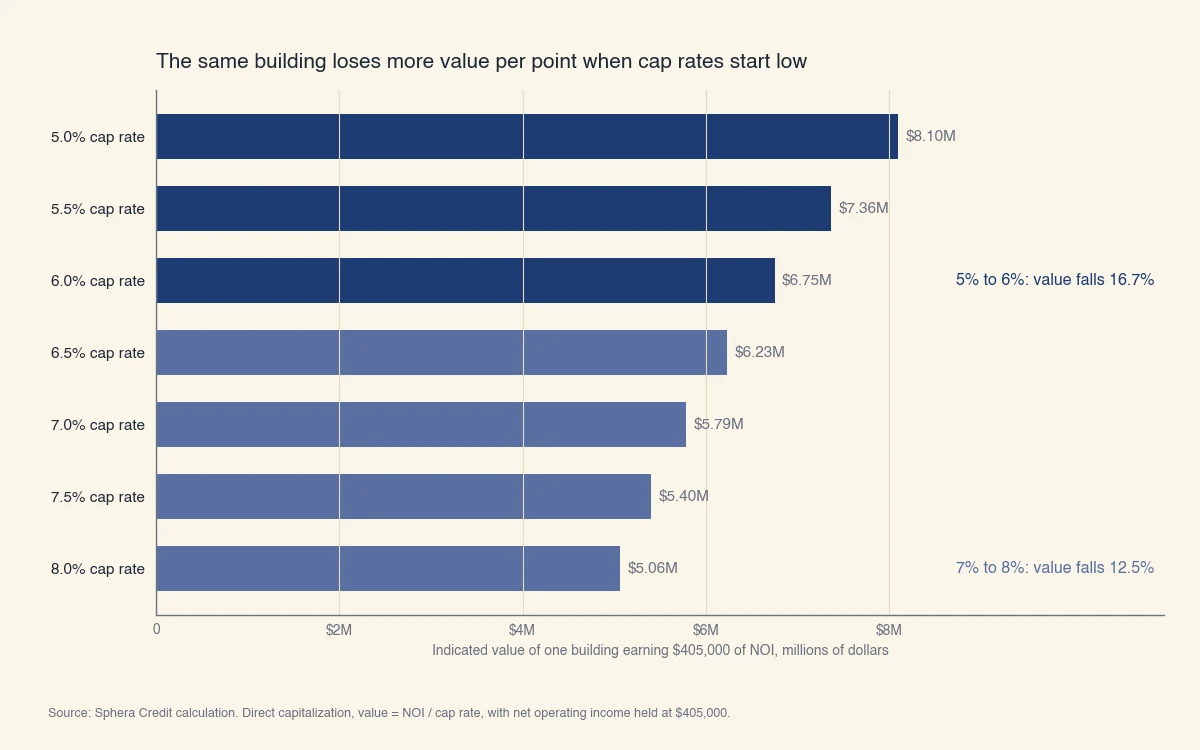
Source: Sphera Credit calculation. Direct capitalization, value = NOI / cap rate, with net operating income held at $405,000.
Owners who bought at low cap rates in 2021 met this effect directly. The 10-year Treasury yield averaged 1.53% in the fourth quarter of 2021 and 4.45% in the fourth quarter of 2023 (FRED, DGS10). Over the same stretch, US commercial property prices went from rising 15.6% year over year to falling 10.7% year over year by the second quarter of 2024, according to the Bank for International Settlements series (FRED, COMREPUSQ159N). Higher borrowing costs pushed buyers to demand higher cap rates, and a building's income bought less value than before.
A single cap rate assumes next year's income is representative of every year after it. That fails when a major lease expires mid-hold, when rents are far below market, or when the building needs a new roof in year three. In those cases analysts build a pro forma, a year-by-year projection of income, expenses and capital spending, and run a discounted cash flow (DCF) analysis that converts each year's cash flow and the eventual sale price into today's dollars.
The discount rate that makes those future cash flows equal the purchase price is the internal rate of return (IRR). A cap rate describes one year of income; an IRR describes the whole investment, including the exit.
Investors screen many buildings before valuing one. Three ratios do most of the screening:
- Price per square foot for office, retail and industrial space, compared against recent sales of similar buildings.
- Price per unit or per door for apartment buildings, which normalizes buildings with different unit counts.
- Gross rent multiplier, the price divided by annual gross rent, which ignores expenses and vacancy and so flatters buildings with high operating costs.
None of these replaces the three approaches. They tell you which buildings deserve one.
A lender needs a formal appraisal by a state-certified or licensed appraiser for most US commercial real estate transactions above $500,000, while a broker opinion of value is a sales estimate that regulators do not accept as a lender's valuation. Below the threshold a regulated lender still has to obtain an "appropriate evaluation of real property collateral," so the property is valued either way (12 CFR 34.43).
| Transaction | Appraisal by a certified or licensed appraiser | Rule |
|---|---|---|
| Commercial real estate, $500,000 or less | Not required; an evaluation is required | 12 CFR 34.43(a)(13) |
| Residential real estate, $400,000 or less | Not required; an evaluation is required | 12 CFR 34.43(a)(1) |
| Business loan of $1 million or less, not repaid mainly from real estate income or sale | Not required; an evaluation is required | 12 CFR 34.43(a)(5) |
| Commercial real estate above $500,000 | Required, unless another exemption applies | 12 CFR 34.43 |
The thresholds apply to institutions supervised by the Office of the Comptroller of the Currency; the Federal Reserve and the FDIC use parallel rules. A private buyer paying cash is not bound by them, but will often order an appraisal anyway to support the price.
No. A broker opinion of value (BOV) is a commercial broker's estimate of the price a property would sell for, usually prepared to win a listing. An appraiser who follows USPAP must stay independent of the outcome; a broker is paid when the property sells. The Interagency Guidelines draw the line in one sentence: "a valuation method that provides a sales or list price, such as a broker price opinion, cannot be used as an evaluation because, among other things, it does not provide a property's market value" (Interagency Appraisal and Evaluation Guidelines).
A BOV is still useful. It is quick, it reflects what buyers in the broker's pipeline are paying, and it often includes a marketing plan. Treat it as a pricing opinion, not as the number a lender will lend against.
In Canada, the Appraisal Institute of Canada grants two designations, and only one of them covers commercial property. An AACI is "qualified to undertake any valuation and consulting assignment on residential, commercial, industrial, institutional, agricultural, land and special use property types," while a CRA is limited to "dwellings containing not more than four self-contained family housing units" (Appraisal Institute of Canada). Members follow the Canadian Uniform Standards of Professional Appraisal Practice (CUSPAP) (AIC).
The four-unit limit is the same line that separates residential from commercial financing. A six-unit apartment building needs an AACI appraiser for the same reason it needs a commercial mortgage: it is valued on its rent.
No regulator publishes a fee schedule, so the price comes from the scope of work. Four things move it:
- Property type and complexity. A single-tenant building with one lease takes less time than a shopping centre with dozens of leases to read.
- Approaches required. A cost approach on a special-purpose building adds a replacement-cost estimate.
- Report format. A full narrative report costs more than a restricted report for the client's own use.
- Deadline and location. Rush work and remote sites cost more.
Ask two or three appraisers to quote the same written scope, so the quotes compare the same job.
Comparable sales come from public deed and transfer records, which confirm the price and date, and from the brokers and appraisers who know the terms behind them. The record shows that a building sold for $5.9 million; it does not show that the buyer received six months of free rent from the seller or took over a below-market lease. Appraisers confirm each comp with a party to the deal before adjusting it, and they prefer sales from the last six to twelve months.
The most common mistakes are averaging the three approaches, capitalizing the seller's income instead of the income a buyer will actually receive, and treating an asking price or a single value as the answer. Each one can move the number by hundreds of thousands of dollars on a mid-size building.
No. A reconciled value weights each approach by how reliable it is for this building. In the industrial example the cost approach gets 10% because an old building's depreciation is hard to measure. For a new build-to-suit facility with no sales in the market, the weights flip, and the cost approach can carry the most weight.
Not without checking it. Sellers often present trailing NOI, the last twelve months, sometimes with expenses trimmed. Appraisers and lenders capitalize a stabilized, forward-looking NOI: market vacancy, a management fee even when the owner self-manages, and a reserve for replacements. On the industrial building, leaving out the $32,000 of non-recoverable costs would add about $474,000 of value at a 6.75% cap rate.
No. A listing's cap rate is the seller's NOI divided by the seller's asking price, which makes it a marketing figure. The market cap rate comes from closed sales. The two can differ by half a point, and at the industrial building's income, a half-point move from 6.75% to 7.25% changes the value by about $414,000.
No. Market value is the price between a typical informed buyer and seller. Investment value is what the property is worth to one specific buyer with its own financing, tax position and plans. Appraisers also report an as-is value for the building today and an as-stabilized value once a lease-up or renovation is done. Many lenders size the first loan on the as-is value of an unfinished project, which is why a value-add buyer's plan rarely shows up in the first loan amount.
For how a lender reads the rest of a commercial file, see how real estate underwriting differs between residential and commercial loans. The commercial real estate learning centre collects the rest of this series.