The AI operating system for private mortgage lenders
Take the manual work out of the file.

What you originate
Fix and flip
Purchase and rehab in one loan, sized on cost and after-repair value.
Key ratios- LTC
- ARV
Bridge
Short-term first and second mortgages with a defined exit.
Key ratios- LTV
- CLTV
Rental and DSCR
Qualified on the property's rent against its debt service.
Key ratios- DSCR
- LTV
Ground-up construction
Budgets, draw schedules and completed value.
Key ratios- LTC
- Loan-to-completed-value
Alt and B-type mortgages
Self-employed, stated-income and bruised-credit files.
Key ratios- GDS
- TDS
- LTV
First mortgages
First-position purchases, refinances and renewals.
Key ratios- LTV
- DTI
Every application in one view
Stage and status on one board
Every live file, what stage it sits at, and the one thing it is waiting on. No status meeting required.
Stalled files surface themselves
A file that has stopped moving rises to the top before the borrower goes quiet on you.
Your team works the same file at once
No passing it down the line
Processor, analyst and underwriter work the same file at the same time instead of waiting their turn.
Every change lands immediately
No file locks, no stale copy, and no version of the file that only one person can see.
A broker portal that answers in seconds
AI-assisted prequalification
A broker drops the deal in and gets an indicative answer against your box in under a minute, before they package anything.
Reasoned against your policy
Not a calculator. The answer names the LTV, the exit and the exceptions, so the broker knows what to fix before submitting.
A borrower portal in your brand
Your name on it, not ours
White-labeled end to end. Borrowers never meet a third party in the middle of your application.
It adapts to the product
A DSCR file asks for rent rolls. A construction file asks for the draw schedule. Same portal, different questions.
An assistant that collects the documents
It does the chasing
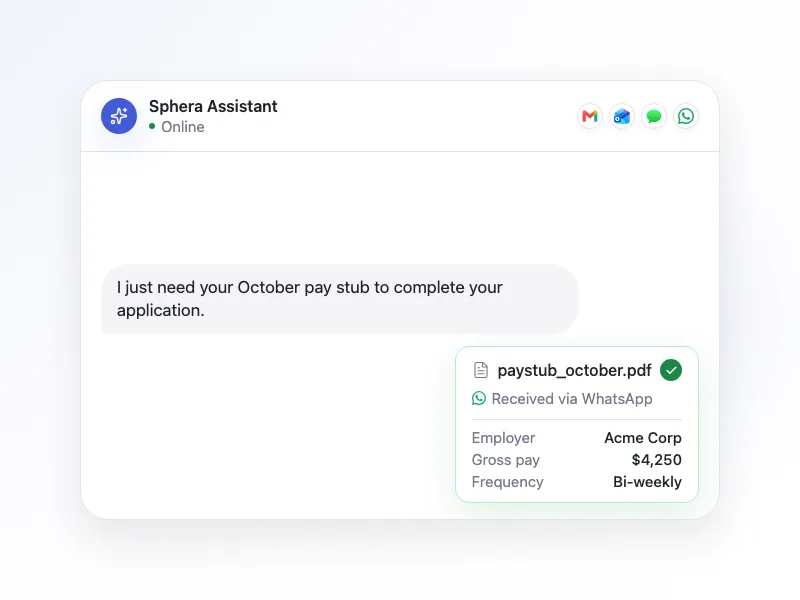
Requests, reads and verifies every document a file needs, and follows up over email, text and WhatsApp until nothing is outstanding.
Nothing sits waiting on a reply
Follow-up happens on its own schedule, not when someone remembers. A file only reaches your team once it can actually be worked.
Connected to the data you already pay for
Your existing providers
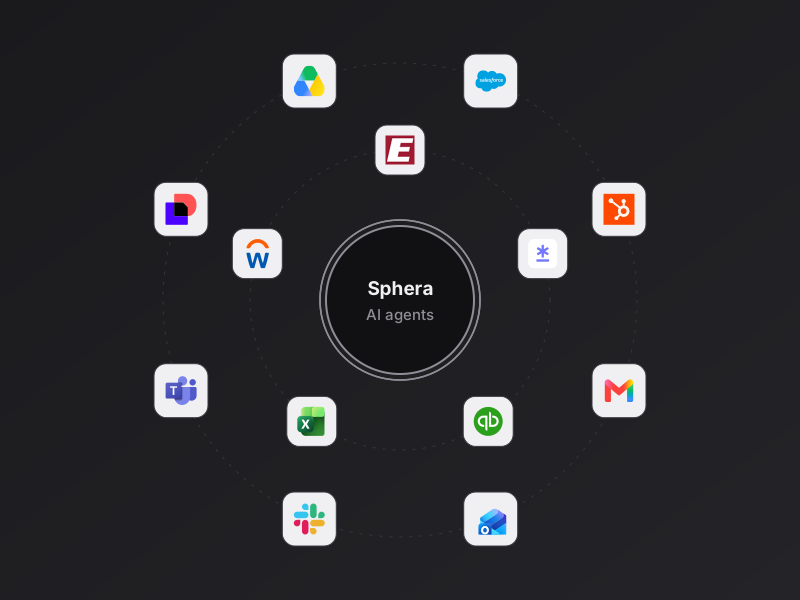
Credit bureau, banking data, identity, valuation. Sphera reads them through the contracts you already hold.
Inside the tools you use
Agents do the manual work between your systems. Your team keeps its CRM, its inbox, its spreadsheets and its LOS.
Your credit policy, running as decision flows
Written by your credit team
Rules your underwriters can change, test against past files and prove out before they go anywhere near a live application.
The decision stays yours
Sphera does the processing and the recommendation. Approval never leaves your desk.
Frequently asked questions from private mortgage lenders
Sphera Credit is an AI operating system for private mortgage lenders, known as hard money lenders in the United States. It covers origination, underwriting, credit risk and servicing: AI agents screen the deals brokers submit, collect borrower, entity and property documents, review the appraisal and the scope of work, size the loan, review construction draws, monitor each live loan against the terms of its promissory note through to maturity and prepare investor reporting. The lender's underwriters review the work and make every credit decision.
Sphera Credit supports private mortgage loans that need hands-on underwriting. That covers fix-and-flip and bridge loans, rental and DSCR loans, ground-up construction, alternative and B-type mortgages for self-employed or bruised-credit borrowers, and first and second mortgages. It serves private lenders and mortgage investment corporations (MICs) in Canada, and hard money and bridge lenders in the United States.
No. Sphera Credit can run origination end to end as the lender's loan origination system, or its AI agents can work on top of the loan origination system, CRM and spreadsheets a private lender already uses, reading from those systems and writing updates back to the same records. Sphera Credit supports both paths and recommends the first to lenders who are ready to redesign how the work gets done, because systems built before agentic AI were never designed for AI agents to work in them.
Yes. A broker submits a deal in the broker portal, and Sphera Credit's AI agents read it against the lender's credit box. Sphera Credit can also connect to the email inboxes of the lender's originators, so the deals brokers send by email are screened the same way. Either way, the screening returns an indicative answer that names the loan-to-value (LTV), the exit and any exceptions, so the file can be corrected before it is packaged. The answer is indicative, and every deal stays subject to the lender's full underwriting.
Sphera Credit's AI assistant requests each document the file needs from the borrower or the broker, such as identification, the purchase agreement, proof of funds, the appraisal, and the scope of work and budget. It also collects and checks entity documents, including the articles and the operating agreement, along with title and insurance. It reads each document on arrival, flags what is missing or unreadable, and follows up by email, text and WhatsApp until the file is complete.
Yes. Sphera Credit's agents read the appraisal and the borrower's scope of work and budget, and check the after-repair value (ARV) against them. They flag what the underwriter should look at, for example an ARV that sits above the appraisal's comparable sales or a budget that leaves out part of the planned work. Each flag points to the page it came from, and the underwriter decides what value to lend on.
Sphera Credit calculates the ratios the lender's credit policy calls for, to the lender's own definitions. For private mortgages that includes loan-to-value (LTV) and combined loan-to-value (CLTV), loan-to-cost (LTC), loan-to-after-repair-value (ARV) and DSCR on rental loans, plus GDS and TDS on alternative and B-type mortgages in Canada. Agents can work in the lender's own Excel sizing model and draft the term sheet or quote for the lender's team to review and send.
Yes. When a borrower requests a draw, Sphera Credit's agents read the invoices and the inspection report and reconcile them against the approved budget. They prepare the draw for the lender's review with each discrepancy flagged. The lender's team approves every draw before funds are released.
Yes. Sphera Credit's AI agents read the promissory note and the mortgage or deed of trust of every live loan and record its terms: interest rate, payment schedule, maturity date, late charges, default interest, prepayment terms, extension options and the borrower's covenants. They then monitor each loan against those terms for its whole life, as a loan servicer does today. They check each payment against the note, track the interest reserve, confirm that property insurance is in force and property taxes are paid, check that no new lien has been registered on the property and follow the maturity date. Ahead of maturity, they contact the borrower about the exit and follow up on extension and payoff requests. Any term that is no longer respected is flagged to the lender's team, which sets the terms of any extension and approves every payoff.
Yes. Sphera Credit's agents prepare capital partner reporting from the lender's loan data. That includes loan tapes for warehouse lenders and note buyers in the United States, and investor statements for mortgage investment corporations (MICs) in Canada. The lender's team reviews each report before it goes out.
Sphera Credit ties every figure an agent extracts to the page it came from and records every agent run step by step: what the agent read, what it did and why. Before an agent works on live files, the lender's team replays it in AI Agent Studio on cases the team has already handled and scores how it behaves. The lender also sets a level of autonomy for each action an agent can take: run automatically, require human approval every time, or be blocked completely.
No. The lender's credit policy runs as decision flows that its own credit team writes, tests and versions. Files that fall outside the credit box are routed to the lender's underwriters or to AI agents that gather and analyze more information. Sphera Credit prepares the file and the recommendation, approval stays with the lender, and every agent run is recorded step by step.
Sphera Credit pricing is tailored to each private mortgage lender and has two parts: an implementation fee and an ongoing platform fee. The implementation fee depends on the scope of the rollout, because Sphera Credit's team works alongside the lender on both the technical setup and change management. The platform fee is outcome-based: it follows the loan volume processed on the platform, so it scales with the size of the lender's operations.
Sphera Credit encrypts client data in transit and at rest, and limits access with role-based permissions, single sign-on and multi-factor authentication. Client data is never used to train AI models. For Canadian lenders, Sphera Credit stores data in data centres in Montreal and runs AI inference in Montreal as well, so documents, prompts and AI responses stay in Canada. For US lenders, Sphera Credit stores data in data centres in the United States and runs AI inference there as well, so documents, prompts and AI responses stay in the United States. Every lender can choose the region where its AI inference runs.
Run one live file with us
Give us one live application. You get back the file your underwriter would have built.