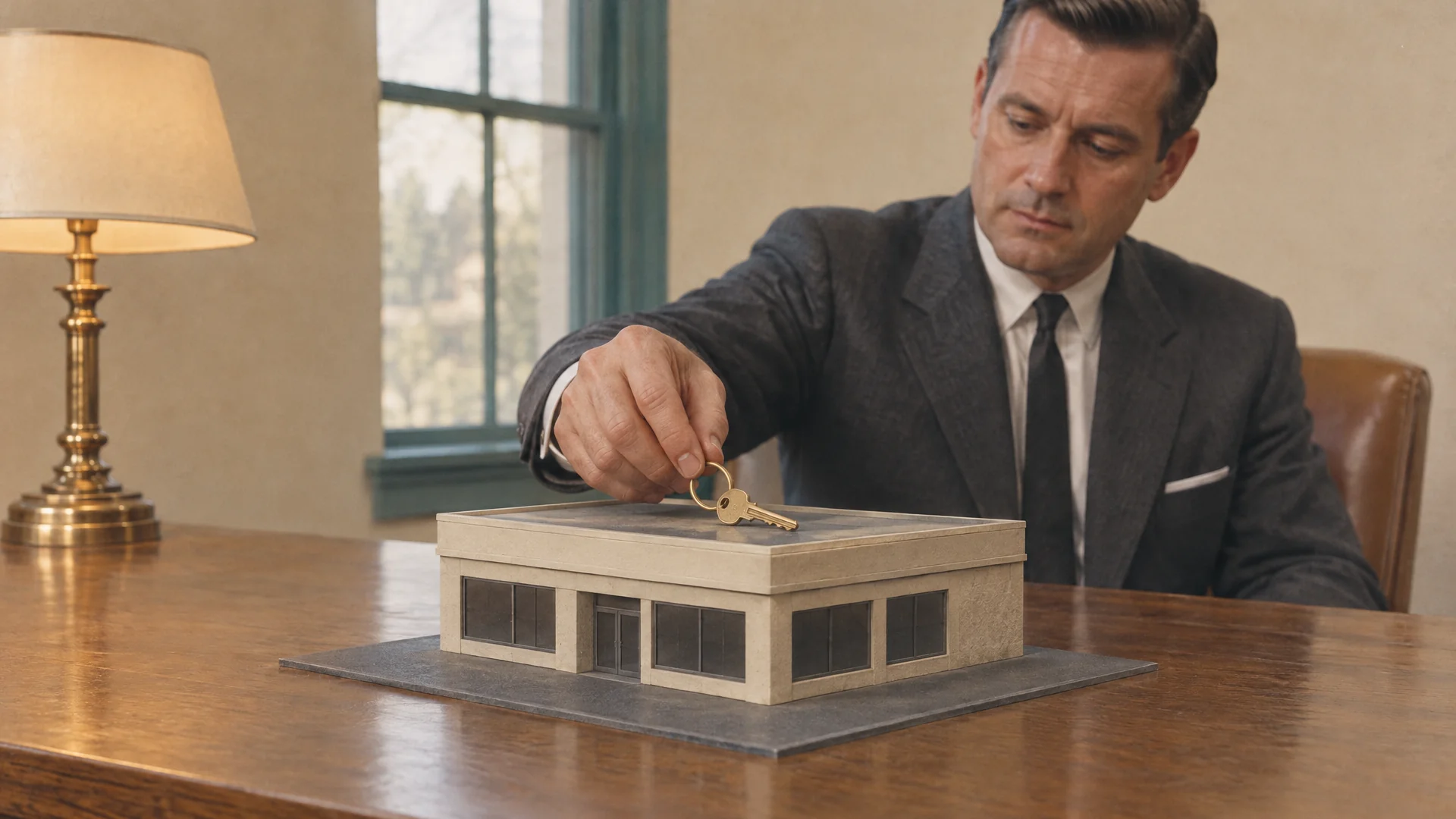

STNL stands for single-tenant net lease: a whole building leased to one tenant, who pays the rent plus the property's taxes, insurance and most of its upkeep. One lease supplies all of the income, so investors buy the lease as much as the building.
Typical STNL tenants are pharmacies, quick-service restaurants, bank branches, dollar stores, auto parts stores and distribution warehouses. Realty Income is the largest of the three listed owners in the table below. It describes its business as "freestanding commercial properties leased under long-term net lease agreements" (Realty Income 10-K). STNL is one of the lease terms in the commercial real estate glossary.
| Single-tenant net lease | Multi-tenant building | |
|---|---|---|
| Income | One lease | Many leases |
| Occupancy | 100% or 0% | Moves a few points at a time |
| Operating costs | The tenant pays most of them | The owner pays, then bills each tenant a share |
| What sets the price | Tenant credit and years left on the lease | Rents, vacancy and the market |
| Owner's work | A few decisions a year | Leasing, collections and common areas all year |
A net lease makes the tenant pay the building's operating costs. The OCC defines it as a lease "wherein the tenant must pay operating expenses such as real estate taxes, insurance, and maintenance" (OCC handbook, net lease).
STNL counts the tenants; a triple net (NNN) lease describes which costs the tenant pays. The two usually travel together. For single-tenant industrial buildings, the OCC says leases are "usually written on a net basis with the landlord responsible for maintaining only the roof and outer walls."
Buyers price an STNL property from its rent: the price is the yearly rent divided by a cap rate. A stronger tenant or a longer lease earns a lower cap rate, so a higher price. The cap rate is the yearly net income as a share of the price.
Take a drugstore leased to one tenant for $300,000 a year on an absolute net lease, with 12 years left. At a 6.0% cap rate the building sells for $5,000,000. At 7.0% it sells for about $4,285,700, or 14% less for the same rent.
Four things move the cap rate:
- Tenant credit. Who signed the lease: a rated parent company, a subsidiary or a franchisee.
- Years left on the lease. NNN REIT says its leases "provide for initial terms of 10 to 20 years and a triple-net lease structure" (NNN REIT 10-K).
- Rent increases. Fixed steps or inflation adjustments raise the income the buyer gets later.
- The real estate. The location, the lot and how easily another tenant could use the building.
An investment-grade tenant is a company whose credit rating is BBB- or higher. The SEC's investor bulletin draws the line: "a rating that is 'BBB-' or higher is investment grade" (SEC, credit ratings). The letters work like the AAA to BBB scale for companies and governments.
The rating belongs to the company that signed or guaranteed the lease. A store run by a franchisee may carry no rating at all, even under a rated brand. Agree Realty reports that about 66.8% of its annualized base rent came from tenants, or their parents, with an investment-grade rating at December 31, 2025 (Agree Realty 10-K).
In a US bankruptcy the tenant must keep paying rent until it keeps or rejects the lease. A rejected lease leaves the landlord a claim capped at one to three years of rent. With one tenant, that claim is all the building earns until a new lease is signed.
The Bankruptcy Code says the trustee "shall timely perform all the obligations of the debtor" under a nonresidential lease "until such lease is assumed or rejected" (11 U.S.C. 365). A lease neither assumed nor rejected within 120 days of the order for relief, or by plan confirmation if sooner, is deemed rejected. The court may extend that deadline once "for 90 days"; a later extension needs the landlord's written consent.
NNN REIT spells out the risk. A single tenant's failure "is likely to cause a significant or complete reduction in NNN's rental revenue from that Property" (NNN REIT 10-K).
Section 502(b)(6) caps the claim at "the rent reserved by such lease, without acceleration, for the greater of one year, or 15 percent" of the remaining term (11 U.S.C. 502). The 15% share stops at three years of rent. Unpaid rent already due at the filing comes on top.
On the drugstore lease, 12 years remain and $3,600,000 of rent is left. Fifteen percent of 12 years is 1.8 years, more than one year, so the cap is 1.8 years of rent: $540,000, or 15% of the rent left. The cap limits the claim; what the claim pays depends on the tenant's bankruptcy estate.
The example uses level rent. With scheduled increases, how the 15% is measured can change the figure, so a bankruptcy lawyer runs the number on a real lease.
Canada's Bankruptcy and Insolvency Act lets an insolvent commercial tenant that files a proposal end its lease. It may "disclaim or resiliate the lease on giving thirty days notice to the lessor" (BIA, section 65.2). The landlord then has "no claim for accelerated rent". The proposal says whether the landlord claims its actual losses or a formula amount. The formula takes the first year's rent plus "fifteen per cent of the rent for the remainder of the term", up to three years' rent.
On the same lease, that is one year plus 15% of the other 11, or 2.65 years of rent: $795,000, about 22% of the rent left.
| The $300,000 lease, 12 years left | United States | Canada, proposal |
|---|---|---|
| Formula | Greater of 1 year or 15% of the remaining term, capped at 3 years | First year plus 15% of the rest, capped at 3 years |
| Largest claim, in years of rent | 1.8 | 2.65 |
| Largest claim, in dollars | $540,000 | $795,000 |
| Share of the $3,600,000 left | 15% | 22% |
The gap depends on the years left on the lease. Canada's cap sits above the US cap whenever more than 1 and fewer than 20 years remain.

Source: Sphera Credit calculation with level rent, from the US Bankruptcy Code (11 U.S.C. 502) and Canada's Bankruptcy and Insolvency Act.
STNL buyers range from listed net lease REITs with thousands of buildings to individual investors deferring tax through a 1031 exchange. The listed owners publish their numbers every year in a Form 10-K.
| December 31, 2025 | Realty Income | NNN REIT | Agree Realty |
|---|---|---|---|
| Properties | 15,511 | 3,692 | 2,674 |
| Share leased | 98.9% | 98.3% | 99.7% |
| Average years left on leases | About 8.8 | 10.2 | About 7.8 |
Of Realty Income's 15,511 properties, 15,167, or 97.8%, were single-tenant properties (Realty Income 10-K). The last row is the weighted average remaining lease term (WALT): the years left on a portfolio's leases, with larger leases counting more.
Section 1031 lets an investor defer the tax on a sale of business or investment real property by buying like-kind real property. Form 8824 "figures the amount of gain deferred" (IRS, Form 8824 instructions). The replacement "must be identified within 45 days". It must be "received within 180 days, or by the due date of your tax return (including extensions), whichever is earlier". A leased one-tenant building suits that timeline, and the 1031 exchange on a commercial sale has its own rules.
Many STNL buildings start as a sale-leaseback: a company sells the building it uses and signs a long lease to stay. Lenders read that lease first. They measure the debt service coverage ratio: net income divided by loan payments. The OCC says a lower ratio may suit "long-term net leases to highly creditworthy tenants." The commercial mortgage calculator shows the payment on such a loan.
Three beliefs cause most surprises: a strong tenant makes the rent safe, a net lease leaves no owner costs, and a long lease fixes the value.
A rating measures the risk of default, and a rated company can still close stores or file for bankruptcy. Agree Realty tells its investors: "Bankruptcy laws will limit our remedies if a tenant becomes bankrupt and rejects its leases" (Agree Realty 10-K). The claim caps above apply to every tenant, rated or unrated.
The owner keeps whatever the lease leaves out, often the roof and the structure. When the tenant leaves, Agree Realty says, "we would be responsible for all of the operating costs of a property following a vacancy at a single tenant building."
Dark value is what the building is worth empty, with no tenant and no rent. Agree Realty notes its buildings were "built to suit a particular tenant's specific needs and desires". Making one "ready for another tenant" can bring "significant losses". For a factory built around one user, the OCC calls the building's adaptability "to meet the needs of other potential users" an "important underwriting consideration."
The lease also shortens every year. A building with 4 years left trades on its dark value and the odds of renewal, far more than one with 15 years left.