

What is a balance transfer credit card?
A balance transfer credit card is a card that lets you move an existing balance from another credit card onto it, and charges a reduced promotional interest rate, often 0%, on that moved amount for a fixed number of months. The Financial Consumer Agency of Canada describes the mechanic plainly: a balance transfer moves your balance from an old credit card to a new one, and that new card generally carries a lower rate (FCAC).
The product exists because revolving credit card debt is expensive. FCAC's own illustrative figures put a regular purchase rate near 19% and a cash advance rate near 22%. At those rates, interest on a carried balance compounds faster than most people can pay it down, and a promotional window is a way to stop the meter while the principal actually falls.
Two things about that promotional rate are worth stating up front, because they decide almost everything that follows:
- It applies only to the amount you transferred. Purchases you make on the same card are priced at the card's regular rate from the day they post.
- It expires on a date, not on a balance. Whatever is left on the promo balance when the window closes is repriced to the regular rate immediately.
A balance transfer is a repricing tool. It does not reduce what you owe, it does not settle anything with your original creditor, and it does not change your total debt. It buys you a defined stretch of months in which your payments go almost entirely to principal instead of interest.
Who it is aimed at: Bank of Canada data gives a sense of the population this product targets. As of the first quarter of 2026, 13.2% of Canadian credit card borrowers were using more than 80% of their available card limit, and 2.8% were at least 30 days late on one or more cards (Bank of Canada). Bank of Canada staff research finds that borrowers who rely more heavily on credit card debt are more likely to hit financial stress in the near term.
How does a balance transfer work in Canada?
You apply for a card carrying a transfer offer, tell the new issuer which balances to move and how much, and the new issuer pays your old creditor directly and adds that amount, plus a transfer fee, to your new card. From then on you have one balance on one card, priced at the promotional rate until a stated end date.
The steps, in order:
- Apply and get approved. Your credit limit on the new card caps what you can move, and the limit is set at approval, so you may be approved for less than you owe.
- Request the transfer. You give the account numbers and amounts. Some offers require the transfer to be requested within a short window after opening the account, often the first 30 to 90 days, or the promotional rate does not apply.
- Wait for it to settle. This takes several business days to a few weeks. Keep paying the old card during the gap.
- Confirm the old balance is zero, then decide what to do with the old card.
What does a balance transfer cost?
The fee is a one-time percentage of the amount you move, commonly 1% to 3% at Canadian issuers, and it is added to your new balance rather than billed separately. FCAC's worked example: transfer $1,000 with a 3% fee and the fee is $30 (FCAC). Move $5,000 at 3% and you start the promotional period owing $5,150, not $5,000.
That fee is easy to over-weight. Measured against the interest you avoid, it is small:
| Transfer fee | Interest avoided per month at 19.99% | Months of 0% needed to repay the fee |
|---|---|---|
| 1% | 1.67% of the balance | About 0.6 months |
| 2% | 1.67% of the balance | About 1.2 months |
| 3% | 1.67% of the balance | About 1.8 months |
A 3% fee is repaid by fewer than two months of avoided interest against a 19.99% card. Any genuine promotional window in the Canadian market, which typically runs 6 to 18 months, clears that bar with room to spare. The fee is almost never the reason a balance transfer fails.
How long does the promotional rate last?
Canadian offers commonly run from 6 to 18 months. FCAC's guidance is to read the credit agreement carefully before transferring, because the promotion applies only for a specific period and the terms vary by issuer. The regulator maintains a credit card comparison tool that lists rates and features across cards sold in Canada, which is a neutral place to check current terms.
The number that matters is not the promotional rate. It is the promo end date set against the monthly payment you can actually sustain. If your balance divided by the number of promotional months exceeds what you can pay each month, the transfer will leave a remainder that gets repriced, and you should size the transfer accordingly. Our credit card payoff calculator will run that arithmetic against a specific balance and payment.
Why does a 0% balance transfer card still charge you interest?
Because the promotional rate covers only the transferred balance, and Canadian law does not require your payments to attack your most expensive debt first. These two facts together are what turn a well-chosen balance transfer into an expensive one, and they are almost never explained on the pages that recommend these cards.
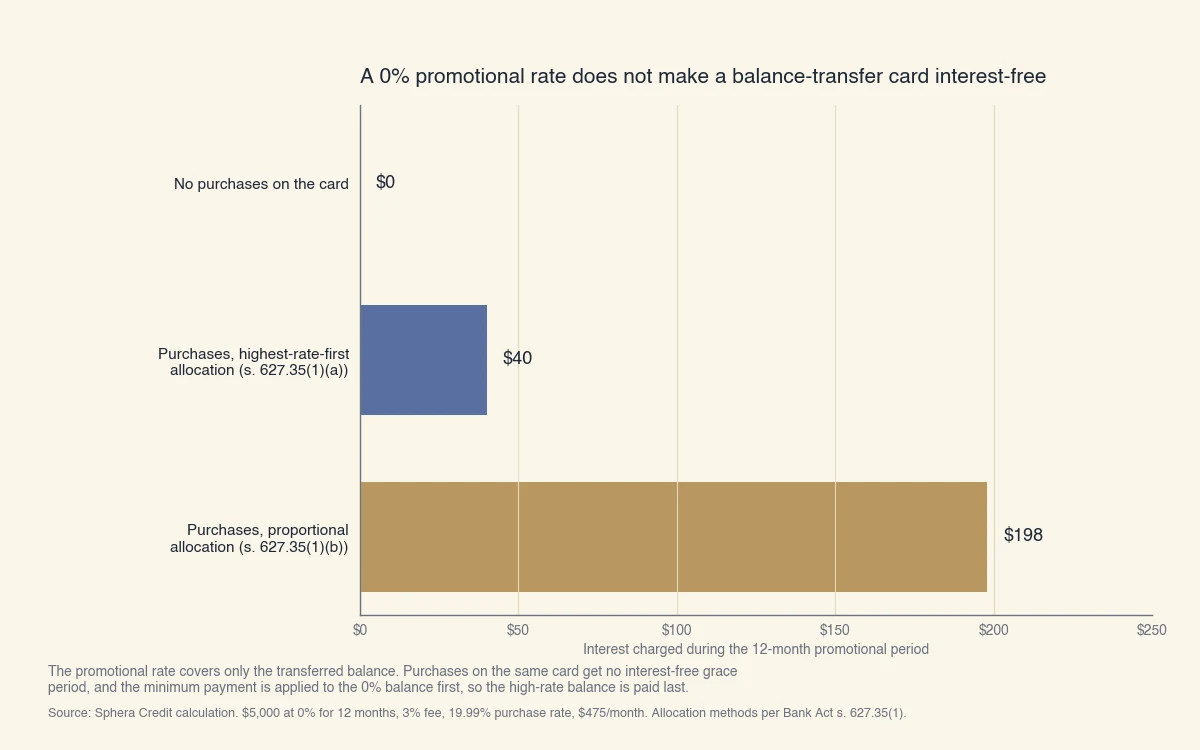
Source: Sphera Credit calculation. $5,000 at 0% for 12 months, 3% fee, 19.99% purchase rate, $475/month. Allocation methods per Bank Act s. 627.35(1).
The simulation above takes one borrower, one balance and one payment amount, and changes only two things: whether the card is used for purchases, and which of the two legal allocation methods the issuer applies. The interest charged over the same twelve months ranges from nothing to $198.
The grace period does not apply while a transferred balance sits on the card
Your interest-free grace period on new purchases survives only if you pay the entire statement balance in full each month, which is impossible while you are deliberately carrying a transferred balance. The Bank Act is explicit: an institution shall not charge interest on purchases in a billing cycle if the person pays the outstanding balance owing on the account in full on or before the due date (Bank Act, s. 627.34(4)). The same section sets the floor for that window, requiring at least 21 days between the end of a billing cycle and the minimum payment due date.
FCAC states the exclusion directly: the grace period does not apply to cash advances, cash-like transactions and balance transfers (FCAC).
The practical consequence: a $200 grocery run on your balance transfer card starts accruing interest at the regular purchase rate the day it posts. There is no interest-free month, because the condition for one cannot be met.
Your minimum payment is applied to the 0% balance first
A card carrying a promotional balance and a purchase balance has two interest rates on it, and Canadian law only governs where the portion of your payment above the minimum goes. Under Bank Act s. 627.35(1), when different interest rates apply to different amounts on a credit card account, the institution must allocate any payment greater than the required minimum by one of two methods:
- (a) Highest rate first. The above-minimum amount goes to the balance with the highest rate, then down the list in descending rate order.
- (b) Proportionally. The above-minimum amount is split across balances in the same proportion each represents of the total.
The issuer chooses which method to use. That is the difference from the United States, where the CARD Act requires highest-rate-first allocation. A Canadian cardholder does not get to assume their extra payment is attacking the expensive balance.
The required minimum itself is governed by neither method. FCAC describes standard practice: your minimum payment will typically apply to the portion of your balance with the lowest interest rate (FCAC). On a balance transfer card the lowest-rate portion is the 0% promotional balance. So the minimum payment is spent retiring the debt that costs you nothing, while the purchase balance at 19.99% waits for whatever is left over.
Put the two rules together and the mechanism is clear. Purchases on a balance transfer card accrue from day one, the minimum payment cannot touch them, and under proportional allocation only part of your extra payment reaches them. That is how a 0% card charges $198 in interest over a promotional year.
The rule that follows: treat a balance transfer card as a repayment container and put your day-to-day spending on a different card. Doing so moves you to the top bar of the chart, where the promotional rate delivers what it advertises. It also costs nothing, which is unusual for financial advice.
When does a balance transfer actually save money?
A balance transfer saves money whenever you can retire most of the transferred amount inside the promotional window and keep purchases off the card, and the size of that saving is usually several hundred dollars on a mid-sized balance. Take $5,000 owed at 19.99%, paid down at $475 a month:
| Stay on the 19.99% card | Transfer at 0% for 12 months, 3% fee | |
|---|---|---|
| Upfront cost | $0 | $150 fee |
| Interest over 12 months | $544 | $0 |
| Balance after 12 months | $0 | $0, cleared in month 11 |
| Total cost of the debt | $544 | $150 |
The transfer saves $394 and clears the balance a month earlier, because every dollar attacks principal instead of splitting between principal and interest. That is the case the product is built for.
It stops working in three situations:
- The balance is too large for the window. At $300 a month against the same $5,000, the promotional year ends with $1,550 still owing, which is then repriced to the card's regular rate. The transfer still saves money, but it postpones rather than resolves the problem.
- You keep spending on the card. Covered above. This is the failure mode that turns a good decision into a mediocre one.
- You miss a payment. FCAC warns that missing or making a late payment risks losing the benefit of any promotional rate offer you have, and can increase your interest rate. A single missed payment can end the promotion outright.
Does a balance transfer affect your credit score?
Applying costs a few points from the hard inquiry, and the new card's limit then tends to help by lowering your overall utilization rate. The net effect on a healthy file is usually mildly positive after a few months, provided you do not close the old card and shrink your available credit again. We cover the scoring mechanics in detail on how a balance transfer affects your credit rating, and the inquiry side on whether applying for a credit card affects your rating.
Leaving the old card open at a zero balance is generally the better move for your score. If you decide the temptation to spend on it outweighs that, cancelling a credit card has its own procedure worth following.
What are the alternatives to a balance transfer credit card in Canada?
A balance transfer competes with three other ways of repricing revolving debt, and the right one depends on how much you owe and how long you need. A transfer wins on cost when the balance is modest and the timeline is short. It loses when either of those stretches.
| Option | Typical use | Main limitation |
|---|---|---|
| Balance transfer card | Under roughly $10,000, repayable within the promo window | Credit limit caps the amount, and the rate is temporary |
| Personal line of credit | Larger balances needing a longer runway | Variable rate, and requires qualifying |
| Debt consolidation loan | Several balances, fixed repayment discipline needed | Fixed term with a set payment, no early exit |
| Credit counselling or a consumer proposal | Balances beyond what any new credit can solve | Recorded on your credit report for years |
A line of credit generally carries a lower rate than a credit card and no expiry date on that rate, which suits a balance you cannot clear in 12 to 18 months. A debt consolidation loan rolls several balances into one fixed payment with a defined end date, which suits borrowers who want the structure imposed rather than self-managed. If the balance is beyond what any new borrowing can fix, a consumer proposal is a different category of solution and a first consultation with a Licensed Insolvency Trustee is normally free.
Before choosing, compare against your blended rate rather than your worst rate. One card at 22% among three at 12% does not put your average anywhere near 22%, and the transfer may be worth less than it appears.
Sphera Credit builds AI agents that sit inside lenders' credit decisions on applications that fall outside a standard credit box, which is often where a file carrying several revolving balances lands. What matters there is reading the file accurately and being able to explain the decision afterwards. For a borrower weighing a balance transfer, the equivalent discipline is smaller and entirely within reach: get the fee, the promo end date, and the allocation method in writing, then check that your monthly payment clears the balance before that date arrives.