

What are current line of credit interest rates in Canada?
As of the May 2026 reference period, the average interest rate on outstanding secured personal lines of credit in Canada was 3.96%, and the average on unsecured personal lines of credit was 8.40% (Statistics Canada, Table 10-10-0006-01). Both sit against a chartered bank prime rate of 4.45%, which follows a Bank of Canada policy interest rate of 2.25% that has been held since October 2025 (Bank of Canada).
A line of credit is revolving credit: your lender approves a limit, you draw against it as you like, and you pay interest only on what you have actually taken out. That last point matters more than most rate comparisons suggest. An approved but untouched line costs nothing in interest, though some lines carry registration or administration fees (FCAC).
Here is where lines of credit sit against the rest of the consumer credit market, using the same Statistics Canada release for every figure so the comparison is like for like:
| Product | Average rate (May 2026) | Position vs prime |
|---|---|---|
| Secured personal line of credit | 3.96% | 0.49 points below prime |
| Personal loan plans | 7.54% | 3.09 points above prime |
| Unsecured personal line of credit | 8.40% | 3.95 points above prime |
| Credit card loans | 21.21% | 16.76 points above prime |
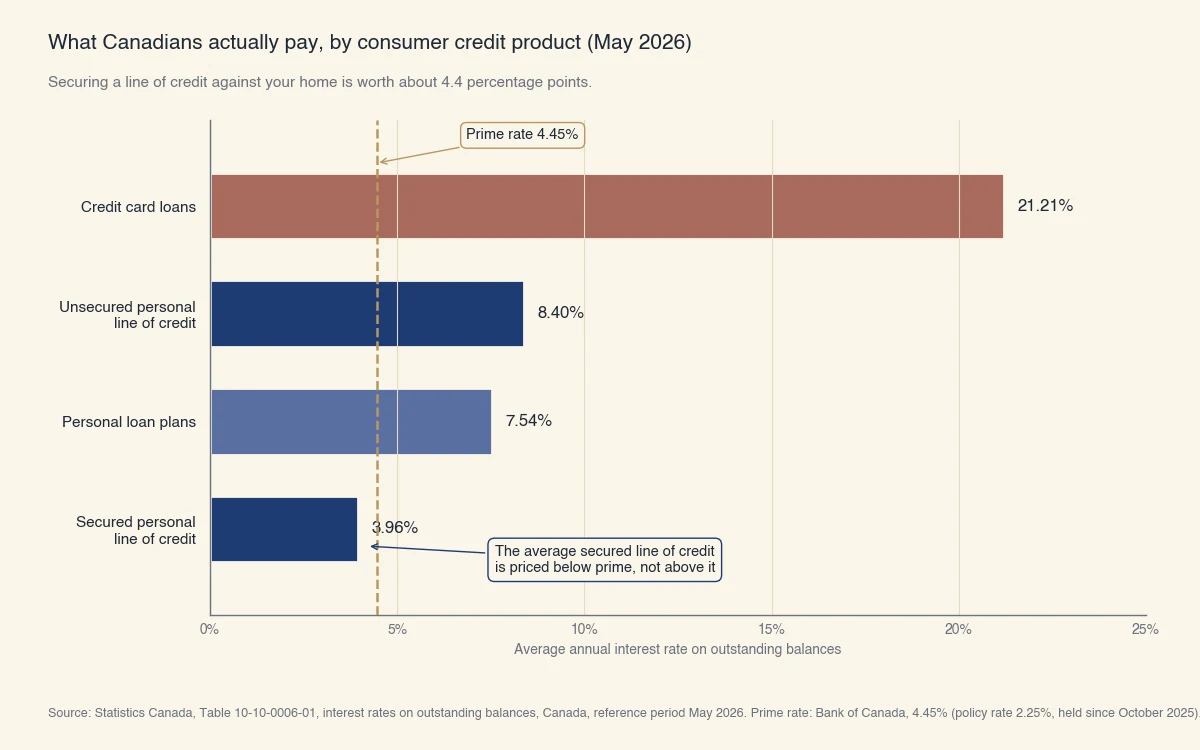
Source: Statistics Canada, Table 10-10-0006-01, interest rates on outstanding balances, Canada, reference period May 2026. Prime rate: Bank of Canada, 4.45% (policy rate 2.25%, held since October 2025).
Why do other sites say 4.07% and 7.94%?
Those two figures appear on most of the pages ranking for this question, and they come from the same Statistics Canada table. They are simply older reference periods. 4.07% was the secured reading earlier in 2026, and 7.94% is an older unsecured figure still.
The gap is worth understanding rather than ignoring, because the two series have moved in opposite directions. Secured rates have kept drifting down month after month. Unsecured rates bottomed out around 8.29% in late 2025 and have edged back up since. A page quoting 7.94% for unsecured lines is not only stale, it points the wrong way.
Whenever you read a Canadian line of credit rate, check which reference period it belongs to. Statistics Canada publishes this series monthly, and the reference period is the only thing that tells you whether a number is current.
How is a line of credit interest rate actually set?
Your rate is not a number the lender picks in isolation. It is the prime rate plus or minus a fixed spread, and the spread is the only part specific to you. Prime moves for everyone at once when the Bank of Canada changes its policy rate. Your spread is set when your line is approved.
Canadian prime has tracked the Bank of Canada's overnight rate target plus 2.20 points since 2015. With the policy rate at 2.25%, prime sits at 4.45%. So a line of credit quoted at "prime plus 3.5" charges 7.95% today, and would charge 8.20% the morning after a quarter-point hike, with no renegotiation and no notice beyond the rate-change disclosure.
This reframes the question most borrowers ask. You are not shopping for a rate, because the rate has two parts and one of them is identical at every lender in the country. You are shopping for a spread.
What determines your spread?
Lenders assess repayment risk and price the spread against it. FCAC lists the inputs a Canadian financial institution reviews when setting your limit and your rate (FCAC):
- Collateral. This is the single largest factor, worth roughly 4.4 percentage points on average between a secured and an unsecured line.
- Your credit score. The higher your score, the lower the rate, because the score tells the lender how risky the loan is. If yours is below where you want it, how to improve your credit score covers the levers that actually move it.
- Your income. Most institutions apply a minimum household income threshold before approving a line at all.
- Your existing debt with other institutions. Your total obligations, not just the ones held at the lender you are applying to.
- Your relationship with the institution. Lenders price more sharply for customers who hold a mortgage, an investment account or a payroll deposit with them.
Federally regulated banks must also sell you a product that suits your circumstances and financial needs, and must tell you if they have assessed that a product is not appropriate for you.
Why did my line of credit rate not fall as much as prime did?
Because the spread is set at approval and is sticky afterward. Between May 2024 and May 2026 the prime rate fell 2.75 percentage points, but the average secured line of credit rate fell only 1.81 points. Secured borrowers captured about two-thirds of the cutting cycle. Unsecured borrowers captured nearly all of it.
| May 2024 | May 2026 | Change | |
|---|---|---|---|
| Prime rate | 7.20% | 4.45% | -2.75 |
| Secured line of credit | 5.77% (prime -1.43) | 3.96% (prime -0.49) | -1.81 |
| Unsecured line of credit | 11.05% (prime +3.85) | 8.40% (prime +3.95) | -2.65 |
Read the middle column rather than the outer ones. The average secured line of credit was priced 1.43 points below prime in May 2024 and only 0.49 points below it two years later. The discount narrowed by almost a full percentage point while headline rates were falling, which is exactly the period a borrower is least likely to be scrutinizing their statement.
Two honest caveats. These are averages across the whole stock of outstanding balances, not quotes on new applications, so part of the move reflects product mix: promotional discounts rolling off, and older HELOCs written at deeper discounts being replaced by newer ones priced less aggressively. And an average is not your rate. Your own spread is whatever your credit agreement says it is.
The practical consequence holds anyway. Falling prime does not automatically deliver a proportional saving, and nothing about a rate cut prompts a lender to revisit your spread. If your credit profile has improved since you were approved, that improvement sits unused until you ask for it.
The related trap: a lower rate does not mean a shrinking balance
FCAC is blunt about the mechanics: your minimum payment on a line of credit is usually equal to the monthly interest, and paying only the interest means you will never pay off what you owe (FCAC).
On a $25,000 balance at 8.40%, the arithmetic is unforgiving:
| Monthly payment | Time to clear the balance | Total interest |
|---|---|---|
| $175 (interest only) | Never | Unlimited |
| $400 | 6 years 11 months | $7,993 |
| $600 | 4 years 1 month | $4,661 |
| $800 | 2 years 11 months | $3,311 |
Doubling the payment from $400 to $800 cuts the interest bill by about $4,700. That is a far larger saving than any rate negotiation is likely to produce, which is worth remembering before spending much effort chasing a quarter point. You can run your own balance and rate through our line of credit interest calculator.
What is the difference between a secured and an unsecured line of credit?
A secured line is backed by an asset you pledge as collateral, most often your home, and that collateral is worth about 4.4 percentage points off your rate. An unsecured line has no collateral, prices higher, and carries a lower limit.
With a secured line of credit you pledge an asset such as your car or your home. If you do not repay, the lender may take possession of it (FCAC). The dominant form in Canada is the home equity line of credit (HELOC), revolving credit secured against your house. Canadians hold roughly $362 billion in secured personal line of credit balances against about $74 billion unsecured, so the secured product is close to five times the size of the unsecured one.
The HELOC rules are specific and set by regulation rather than by individual lenders (FCAC):
- You may borrow up to 65% of your home's value on the HELOC itself.
- A standalone HELOC requires more than 35% equity in the home.
- A HELOC combined with a mortgage (sometimes called a readvanceable mortgage) requires 20% equity, and the available credit grows as you pay down your mortgage principal.
- You must pass a stress test to qualify at a bank, proving you could afford payments at a higher qualifying rate.
An unsecured line of credit puts no asset at risk. Personal and student lines of credit are the common types.
What the rate gap costs in dollars, on $25,000 drawn for a year:
| Product | Rate | Interest for one year |
|---|---|---|
| Secured line of credit | 3.96% | $990 |
| Personal loan plan | 7.54% | $1,885 |
| Unsecured line of credit | 8.40% | $2,100 |
| Credit card | 21.21% | $5,302 |
The $1,110 annual saving on a secured line is real, and it is also the reason to be careful. Securing a line of credit against your home converts an unsecured obligation into a claim on your house. FCAC lists the consequences directly: if you do not repay, you could lose your home, and drawing on the line reduces your equity and may limit your options if you later want to sell. A cheaper rate on the same debt is not the same thing as less risk.
How does a line of credit compare to a personal loan or a credit card?
A line of credit is cheaper than a credit card and more flexible than a personal loan, and it trades away the structure that gets an installment loan repaid.
| Line of credit | Personal loan | Credit card | |
|---|---|---|---|
| Average rate (May 2026) | 3.96% secured, 8.40% unsecured | 7.54% | 21.21% |
| Rate type | Variable, tied to prime | Usually fixed | Usually fixed, high |
| Structure | Revolving, reusable | Installment, fixed term | Revolving, reusable |
| Interest charged on | Only what you draw | The full amount advanced | Balance carried past the grace period |
| Minimum payment | Often interest only | Principal plus interest | Small percentage of balance |
| Ends on its own | No | Yes, on a set date | No |
The last row is the one that decides outcomes. A personal loan has a maturity date, so an amortizing payment is built in and the debt disappears on schedule. A line of credit has no end date and a minimum payment that can be pure interest, so the discipline has to come from you. For a borrower who will pay it down deliberately, a line of credit is usually the cheaper instrument. For a borrower who will pay the minimum, the fixed-term loan often ends up costing less despite the higher headline rate. In the credit-card column the minimum is a small percentage of the balance, and the credit card minimum payment calculator shows how many years a payoff stretches to when you pay only that.
Lines of credit also differ from credit cards in when interest starts. A credit card gives you an interest-free grace period if you pay the statement balance in full. A line of credit does not: interest accrues from the day you withdraw the money.
How can you get a lower rate on your line of credit?
Focus on the spread, since prime is outside anyone's control, and treat the published rate as an opening position rather than a fixed price.
- Ask for a spread review, especially if your credit has improved. Your spread was priced against the profile you had at approval. Nothing updates it automatically. If your score has risen or your income has grown since then, that is new information the lender has never been asked to price.
- Bring a competing written offer. A quote from another institution is the most concrete lever available, because it converts a general request into a specific decision about keeping your business.
- Offer collateral if you have it and accept the trade. Roughly 4.4 percentage points separates the average unsecured and secured line. Weigh that saving against putting your home behind the debt.
- Consolidate your banking. Lenders price more sharply for customers whose mortgage, deposits or investments they already hold.
- Improve your credit score before applying rather than after. The score is priced at approval, which makes the months before an application worth more than the months after. How to improve your credit score covers the changes with the shortest payoff.
- Compare the total cost, not the rate. Registration and administration fees, and optional balance protection insurance, can outweigh a small rate difference. Insurance is never required for approval, and a lender cannot insist you buy it.
One legal backstop is worth knowing. Since 1 January 2025 the criminal interest rate under section 347 of the Criminal Code has been an annual percentage rate above 35% (Justice Laws), lowered from the previous 60% effective annual rate. Mainstream personal lines of credit price nowhere near that ceiling, so it is not a benchmark to aim at. It matters if you are being quoted a rate in the high twenties or thirties, which signals you are in the high-cost segment of the market rather than being offered a competitive line of credit.
If your application was declined or priced far above these averages, the reason is usually visible in your credit file. Why did my credit score drop walks through the most common causes, and how to check your credit score explains how to read your own report at no cost before you apply again.