

Are interest rates going to drop?
No cut is in sight for 2026. The Federal Reserve has held its target range at 3.50% to 3.75% since December 2025, and the median projection in its own June 2026 Summary of Economic Projections puts the rate at 3.8% by the end of this year, which points to a small increase rather than a drop (Federal Reserve).
The federal funds rate is the overnight rate banks charge each other for reserves, and it is the one rate the Fed sets directly. Every other rate you meet as a consumer sits some distance away from it. The current target range has been unchanged through five consecutive meetings, and the next decision lands on September 15-16, 2026 (Federal Reserve FOMC calendar).
Inflation is the reason nothing is moving. Core PCE inflation ran at 3.3% year over year in June 2026, and headline CPI at 3.5%, both well clear of the Fed's 2% target. Goldman Sachs Research expects no cuts at all in 2026, with the first reduction pushed to June 2027 and a terminal rate of 3% to 3.25% (Goldman Sachs Research).
Where the major forecasts stood in mid-2026:
| Forecaster | View on 2026 | First cut expected |
|---|---|---|
| FOMC median projection, June 2026 | Year-end rate of 3.8%, above today's midpoint | Not in 2026 |
| Goldman Sachs Research | No cuts; a hike is more likely than previously thought | June 2027 |
| J.P. Morgan | Hold through 2026 | Next move is up, in 2027 |
| Congressional Budget Office | Some easing during 2026 | 2026 |
Are interest rates going up instead?
A rate increase is now the more likely next move, not a cut. The Fed's own June 2026 median of 3.8% sits above the current 3.625% midpoint, which is the committee's way of saying one more quarter-point rise is the base case. Futures markets have priced a meaningful chance of a hike at the September meeting. That is a full reversal from December 2025, when the same committee's median implied a cut this year.
Are home interest rates going to drop?
Mortgage rates follow the 10-year Treasury yield rather than the federal funds rate, so they can fall while the Fed holds still and rise after the Fed cuts. The 30-year fixed average was 6.66% in the week ending July 30, 2026, up from the mid-6% range earlier in the summer. If your question is specifically about home loans, our page on whether mortgage interest rates are going down works through the Treasury link and the forecaster spread in detail.
How accurate are interest rate forecasts?
The Fed's own one-year-ahead projection for its policy rate missed the realized year-end rate by at least half a percentage point in four of the last ten years, and the average miss across the decade was 0.81 percentage points. That is the number nobody quotes when they tell you rates are about to drop.
Every December, the FOMC publishes a median projection for where its policy rate should sit at the end of the following year. The realized rate is public record. Comparing the two gives a clean, decade-long scorecard of how much a rate forecast is worth.
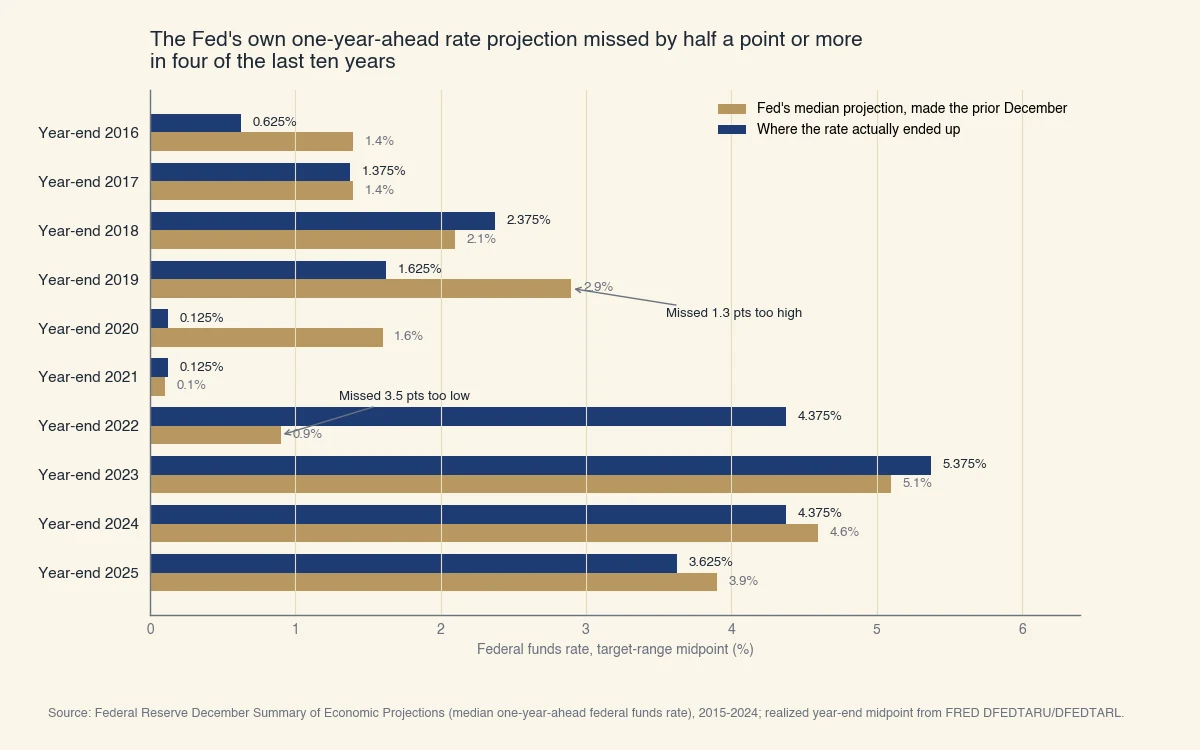
Source: Federal Reserve December Summary of Economic Projections (median one-year-ahead federal funds rate), 2015-2024; realized year-end midpoint from FRED DFEDTARU/DFEDTARL.
Three things stand out in that record:
- Most years are close. The median miss is 0.28 percentage points. In calm years the projection is a reasonable guide.
- The failures are large and two-sided. In December 2018 the committee projected 2.9% for the end of 2019 and the rate finished at 1.625%. Three years later it projected 0.9% for the end of 2022 and the rate finished at 4.375%. One miss was 1.3 points too high, the other 3.5 points too low.
- The misses arrive exactly when they matter. Both large errors happened at turning points, which is precisely when a reader is asking whether to wait for a better rate.
Strip out 2020 and 2022, the pandemic and the inflation surge, and the average miss falls to 0.39 points. That is the honest read: in an ordinary year the forecast is worth something, and the years that break the forecast are the years you most wanted it to work.
What are interest rates going to do this year?
The consensus has already changed direction once in 2026. The December 2025 and March 2026 projections both put the year-end 2026 rate at 3.4%, below the current level, which implied a cut. The June 2026 projection moved it to 3.8%, which implies a hike. That is a 0.4 point swing in the committee's own median inside six months, from the same institution, with no change in the underlying policy rate.
The practical consequence: a plan that only works if rates drop is a plan resting on a forecast that has flipped twice this year.
What is a rate drop actually worth to you in dollars?
For a typical household, a single quarter-point move is worth tens of dollars a year, not thousands, and on the deposit side it is a loss rather than a gain. Competitors on this topic almost never run the arithmetic, so here it is against the rates that actually applied in mid-2026.
Assume the full quarter point passes through to each product, which is generous for savings accounts and roughly right for cards indexed to prime:
| What you hold | Balance | Rate before | Effect of a 0.25 point drop |
|---|---|---|---|
| Credit card balance | $6,500 | 20.94% | You save about $16 a year |
| New 48-month auto loan | $30,000 | 7.47% | Payment falls $3.50 a month, $168 over the loan |
| Existing fixed-rate loan | Any | Locked | No change at all until you refinance |
| Savings account | $20,000 | 0.38% | You lose about $50 a year |
Rates as of May 2026 for the card and auto figures (FRED credit card rate, FRED 48-month auto rate) and July 20, 2026 for the FDIC national savings average (FDIC).
A household carrying all four lines nets about $8 a year from a quarter-point cut. The savings loss almost cancels the borrowing gain.
Now compare that to a decision you control today. Moving the same $20,000 from a savings account paying the 0.38% national average into a 12-month CD at the 1.68% national average is worth $260 a year. That is five times what a quarter-point Fed move does to your whole balance sheet, and it does not depend on any forecast being right.
The lesson is not that rate moves are irrelevant. On a $400,000 mortgage the arithmetic is very different, which is why the mortgage question deserves its own treatment. The lesson is that for the balances most households actually carry, waiting on a rate move is a small prize with an uncertain delivery date, while shopping the rate you can get today is a larger prize available now.
What should you do if you are a saver rather than a borrower?
A rate drop is a pay cut for savers and a discount for variable-rate borrowers, so the right move depends entirely on which side of the balance sheet you sit on. Every forecast article treats the reader as a borrower. Roughly half of them are not.
- If you hold cash: the 12-month CD rate you can lock today disappears the moment the market believes a cut is coming, and it disappears before your borrowing costs improve. Laddering CDs while the FDIC national 12-month average sits at 1.68% removes the forecast from your decision. If rates rise instead, a ladder keeps part of your money free to reprice.
- If you carry a variable-rate balance: credit cards and home equity lines track the prime rate, which is the benchmark banks quote to their strongest borrowers and which moved to 6.75% alongside the current target range. These reprice within a billing cycle or two of any Fed move, in both directions. At a 20.94% average card rate, paying the balance down beats any plausible rate move by an order of magnitude.
- If you are about to borrow at a fixed rate: you are choosing between today's known rate and an unknown future one. The scorecard above says the unknown one has a wide error band. Lock when the payment works at today's rate.
- If you already hold fixed-rate debt: nothing changes for you when the Fed moves. Your rate was set at signing. The only lever is refinancing, and that only pays when the rate improvement recovers the closing costs within a reasonable horizon.
For the mechanics of how a Fed move reaches each product and how long each one takes to reprice, our page on when interest rates will go down has the full product-by-product breakdown.
How should you follow this without checking daily?
Three primary sources cover almost everything worth knowing, and all three are free:
- The FOMC calendar and statement on the Federal Reserve site, eight scheduled dates a year.
- The Summary of Economic Projections, published four times a year, which is the committee's own median view and the same document the scorecard above audits.
- The FRED series for the target range, which shows the actual rate rather than anybody's expectation of it.
Everything else is commentary on those three.
At Sphera Credit we build credit decisioning tools for lenders, and the same discipline applies there. A model that assumes a particular rate path is a model with a hidden bet inside it. The useful work is in what you can verify today, not in what the curve says about next year.