

Is APR and interest rate the same?
No. The interest rate is the price of the money itself, and the APR is that interest plus the mandatory lender charges the law folds into your cost of borrowing, restated as a single annual rate. They land on the same number only in one situation, and Canadian law says exactly when: section 32 of the Financial Consumer Protection Framework Regulations provides that the APR for a credit agreement is the annual interest rate when the only cost of borrowing is interest (Justice Laws).
That is the whole distinction. Cost of borrowing is the legal term for everything a loan costs you, and APR, the annual percentage rate, is that cost expressed as an annual rate on the principal. If a lender charges you nothing but interest, the two figures are the same by operation of law rather than by coincidence. If the lender charges anything else that the regulations count, the APR rises and the interest rate does not move.
A worked comparison makes the gap concrete. Two lenders quote the same rate on the same $450,000 mortgage over 25 years:
| Lender A | Lender B | |
|---|---|---|
| Contract interest rate | 4.34% | 4.34% |
| Mandatory administration fee | $0 | $1,500 |
| Monthly payment | $2,450.76 | $2,450.76 |
| Cost of borrowing over 25 years | $285,228 | $286,728 |
| APR | 4.34% | Higher than 4.34% |
The payments are identical, which is why the interest rate alone tells you nothing useful here. Lender B costs $1,500 more, and the APR is the only quoted figure that shows it.
Which fees does Canadian law put inside the APR?
Canadian law works by exclusion: section 48 of the Financial Consumer Protection Framework Regulations defines the cost of borrowing, then names eight categories of charge that stay outside it, and everything else the lender requires you to pay counts. This is the part almost no explainer covers, and it is the only way to predict whether a given fee will move the APR.
The eight excluded categories, from paragraph 48(2)(a) through 48(2)(h):
| Charge | Counts toward your APR? |
|---|---|
| Optional loan insurance, or insurance where you are the beneficiary and the amount reflects an asset given as security | No, 48(2)(a) |
| Overdraft charges | No, 48(2)(b) |
| Fees to register documents or search a public registry for security interests | No, 48(2)(c) |
| Prepayment penalties | No, 48(2)(d) |
| Most lawyer or notary services and disbursements | No, 48(2)(e) |
| Title insurance you pay for directly | No, 48(2)(f) |
| Appraisal, inspection or survey services provided directly to you | No, 48(2)(g) |
| Default insurance on a high-ratio mortgage | No, 48(2)(h) |
| Lender administration, origination and processing fees | Yes |
| Broker fees the lender requires you to pay | Yes |
Read the list once and a pattern appears. The charges that stay in the APR are the ones the lender imposes for granting you credit. The charges that drop out are largely the ones paid to somebody else: a lawyer, a registry, an appraiser, an insurer.
Why a no-fee loan makes both numbers identical
Section 32 is the reason a credit card quotes one number rather than two. A card charges interest on carried balances, and its annual fee and cash-advance fees are not the kind of mandatory upfront lending charge that enters the calculation for a purchase balance. With interest as the only cost of borrowing, the APR and the interest rate collapse into the same figure. Nothing is being hidden when a card quotes a single rate. There is genuinely only one number to quote. That single figure is enough to price a carried balance from end to end, and the credit card interest calculator turns a posted rate into a month-by-month payoff schedule. A line of credit usually works the same way, which is why the posted line of credit rate is normally the whole cost of borrowing on a drawn balance.
The same logic applies to a no-fee mortgage. If the lender waives every administration charge, the APR equals the contract rate, and a lender advertising "APR equals rate" is describing an absence of fees rather than a discount.
Can the APR still understate what you pay?
Yes, and on the most common Canadian first-home purchase it does so by thousands of dollars, because mortgage default insurance is excluded from the cost of borrowing by paragraph 48(2)(h). The standard advice to just compare the APR is sound in general and wrong in this specific case.
Take a $500,000 purchase with 10% down. The mortgage is $450,000 over 25 years at 4.34%. Because the down payment is under 20%, the mortgage must be insured, and CMHC charges 3.10% of the loan at that loan-to-value band (CMHC). That is $13,950, and almost every buyer finances it by adding it to the mortgage.
Here is what that does:
- The monthly payment rises from $2,450.76 to $2,526.73, an increase of $75.97.
- Over the full 25-year amortization, financing the premium costs $22,792: the $13,950 premium itself plus $8,842 of interest charged on it.
- The disclosed APR does not move, because paragraph 48(2)(h) keeps the premium out of the cost of borrowing.
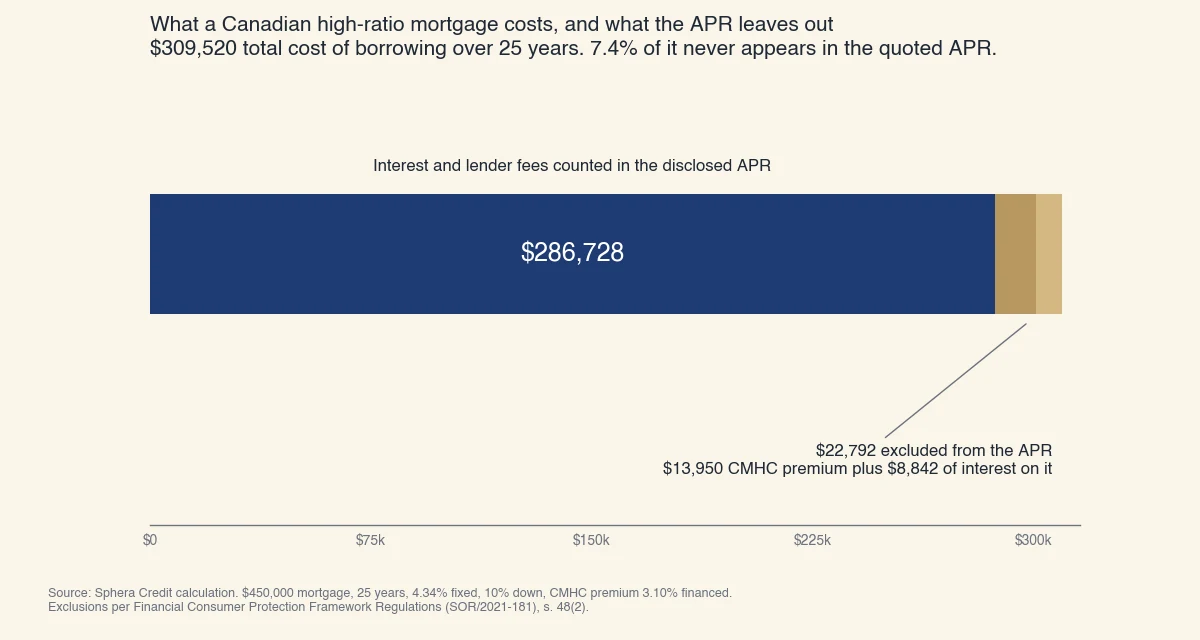
Source: Sphera Credit calculation. $450,000 mortgage, 25-year amortization, 4.34% fixed, 10% down. CMHC premium rate 3.10%. Exclusions per Financial Consumer Protection Framework Regulations, s. 48(2).
Roughly 7.4% of what this borrower actually pays sits outside the number the law requires the lender to disclose. Add the excluded legal fees, title insurance, appraisal and registration charges from the table above and the share grows.
None of this means the APR is dishonest. It means the APR answers a narrower question than most borrowers assume: it prices the lender's charges, not the transaction's charges. The fix is simple. Compare APRs to rank lenders, then ask each one for a written list of every amount you will pay at closing.
Which number should you compare when shopping for a loan?
Compare the APR to rank two offers, use the interest rate to understand your payment, and ask for the closing-cost list to catch what neither number includes. Each figure answers a different question, so using one for all three jobs is how borrowers get surprised.
- The interest rate drives your payment. Your monthly amount comes from the contract rate, the principal and the amortization. The APR never enters that arithmetic. When the Bank of Canada moves, only floating-rate debt feels it right away; a fixed contract holds its rate until renewal.
- The APR ranks offers. It is designed for exactly one purpose: making two credit agreements comparable on a single scale.
- The closing-cost list catches the rest. Everything in the eight excluded categories is real money that no rate on the term sheet reflects.
One practical caution about term length. Because the APR spreads fixed fees across the loan, the same $1,500 fee inflates the APR far more on a 2-year term than on a 25-year amortization. Comparing the APR of a short-term offer against a long-term one exaggerates the short one's cost. Compare like terms with like terms.
Two related rules are worth knowing while you compare. Section 4 of the Interest Act says that if a contract states interest at a weekly or monthly rate without also stating the equivalent yearly rate, the lender cannot recover more than 5% per year (Interest Act, s. 4). And Canadian fixed mortgages compound semi-annually rather than monthly under section 6 of the same Act, a convention that shows up in the effective annual rate rather than the APR. We cover that arithmetic and the legal ceiling on borrowing costs in what rate of interest a Canadian lender actually charges.
Has the Canadian rule changed recently?
Yes. The Cost of Borrowing (Banks) Regulations, SOR/2001-101, were repealed on 29 June 2022 and replaced by the Financial Consumer Protection Framework Regulations, SOR/2021-181. Many explainers still name the repealed instrument, so a reader checking an older article against the statute will land on a page marked "Repealed" and reasonably conclude the rules no longer exist.
The substance carried over. Lenders must still disclose the cost of borrowing and the APR before you sign a credit agreement, and the definitions still turn on the same distinction between interest and mandatory lender charges (FCAC). What changed is where the rules live and the section numbers you cite. If you are checking a claim about Canadian APR disclosure, section 32 gives the definition, section 47 gives the calculation, and section 48 gives the inclusion and exclusion list.
Separately, the ceiling on what a lender may charge moved on 1 January 2025, from 60% expressed as an effective annual rate to 35% expressed as an APR (Criminal Code, s. 347). The unit matters: because the ceiling is now written in APR, mandatory lender fees count toward it and not just the stated interest rate. If you want to solve for the rate you are actually paying on an existing loan, how to figure out an interest rate walks through the arithmetic.