

The Bank of Canada's policy rate is 2.25%, held for the sixth consecutive decision on 15 July 2026, and prime at the chartered banks is 4.45%. The next scheduled announcement is Wednesday 2 September 2026 (Bank of Canada).
Those two numbers are what almost every article about Canadian interest rates gives you. They are also the two numbers least likely to be the rate you actually pay.
The policy rate, formally the target for the overnight rate, is the rate at which financial institutions lend to each other overnight. The rate those overnight loans actually settle at is the CORRA rate. CORRA generally tracks the policy rate relatively closely over time but can deviate from it depending on funding conditions in the overnight repo market. The prime rate is the benchmark each chartered bank publishes for its best-qualified floating-rate borrowers. Your own rate is prime plus or minus a spread on a floating product, or a separately priced contract on a fixed one.
Here is where the current cycle stands:
| Rate | May 2024 | Today | Change |
|---|---|---|---|
| Bank of Canada policy rate | 5.00% | 2.25% | -2.75 pp |
| Chartered bank prime rate | 7.20% | 4.45% | -2.75 pp |
Prime absorbed the entire cut, one basis point for one basis point (Bank of Canada). If the story ended at prime, every Canadian borrower would be 275 basis points better off. It does not end at prime, and most Canadians are not.
For the current level of rates by product, see what rate of interest a lender actually charges. For where rates go next, see whether interest rates are going down in Canada.
Between May 2024 and May 2026 the Bank of Canada cut 275 basis points, and the average rate Canadians pay went down on floating-rate debt, barely moved on short fixed terms, and went up on credit cards, auto loans and long fixed mortgages. The Bank publishes the rate actually charged on outstanding balances by product, which makes the uneven pass-through measurable rather than a matter of opinion.
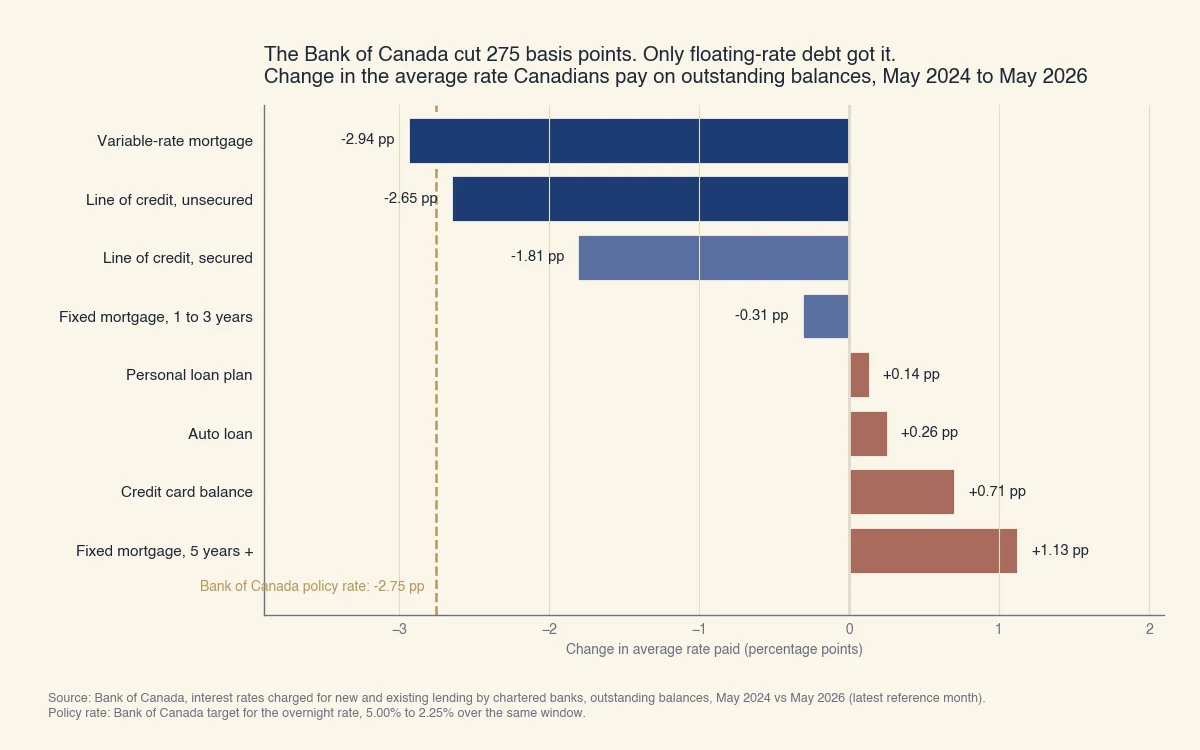
Source: Bank of Canada, interest rates charged for new and existing lending by chartered banks, outstanding balances, May 2024 vs May 2026 (latest reference month). Policy rate: Bank of Canada target for the overnight rate, 5.00% to 2.25% over the same window.
Three separate mechanisms produce that spread.
- Floating products reprice within one billing cycle. A variable mortgage or a line of credit is quoted as prime plus a spread. When prime moves, the contract moves with it automatically. Variable mortgages fell 2.94 percentage points and unsecured lines of credit fell 2.65, both slightly more than the policy rate itself, because competitive spreads narrowed at the same time.
- Fixed products reprice only at renewal, and off a different benchmark. Fixed mortgage rates are priced from Government of Canada bond yields of a similar term, which respond to inflation expectations rather than to the overnight target. The average rate on outstanding five-year-plus fixed mortgages went up 1.13 percentage points, because the pool is still shedding terms signed at 2020 and 2021 pricing and replacing them at current pricing.
- Card rates are contractual and unindexed. A credit-card agreement states a fixed annual rate, typically near 20%, that no policy decision touches. The average rate on outstanding card balances rose 0.71 percentage points over the window.
The point worth carrying away: card debt and an existing fixed mortgage are wired to something other than the policy rate, so waiting for the Bank of Canada to make them cheaper is waiting for something the mechanism cannot deliver.
On a $400,000 variable mortgage the cuts are worth about $11,760 a year in interest, and on an $8,000 credit-card balance they are worth minus $57. The arithmetic is simple enough to check yourself.
Take the variable mortgage. Interest charged in one year on a balance held constant is the balance times the rate:
- May 2024: $400,000 x 6.69% = $26,760
- May 2026: $400,000 x 3.75% = $15,000
- Difference: $11,760 less interest in a year
Run the same calculation across the debts a Canadian household typically holds, using the Bank of Canada rates behind the chart above:
| Debt you hold | Balance | Rate May 2024 | Rate May 2026 | Yearly interest change |
|---|---|---|---|---|
| Variable-rate mortgage | $400,000 | 6.69% | 3.75% | $11,760 less |
| Secured line of credit | $50,000 | 5.77% | 3.96% | $905 less |
| Unsecured line of credit | $20,000 | 11.05% | 8.40% | $530 less |
| Auto loan | $30,000 | 6.58% | 6.84% | $78 more |
| Credit card balance | $8,000 | 20.50% | 21.21% | $57 more |
| Five-year fixed mortgage at renewal | $400,000 | 3.00% | 4.13% | $4,520 more |
Two things stand out. The first is scale: the household with a variable mortgage collected roughly twenty times more benefit than the household whose largest exposure was a line of credit, from the same eight rate decisions. The second is direction: the household renewing a five-year fixed mortgage signed in 2021 is paying about $4,520 a year more interest despite a cutting cycle, because their comparison point was never the 2024 peak.
These figures hold the balance constant to isolate the rate effect. A real amortizing mortgage pays down principal over the year, so the actual interest is slightly lower. The relative sizes are unchanged.
The useful question is not where the policy rate goes next, it is which of your debts is wired to it. Four decisions cover most Canadian households.
Budget from the current rate, not from the headline direction. The +1.13 percentage-point move on outstanding long fixed mortgages is the renewal cliff showing up in national data: terms signed at roughly 3% are renewing near 4.1% to 4.3%. On $400,000 that is several hundred dollars more per month. Ask your lender for the renewal quote early, and shop it, because the spread between the offered renewal rate and the best available rate is one of the few levers still fully under your control (FCAC).
Treat the rate as fixed at roughly 21% and plan around it. Card rates did not fall during the cutting cycle and there is no mechanism by which a future cut would reach them. A balance transfer to a secured or unsecured line of credit at 3.96% or 8.40% moves the debt onto a product that does respond to policy, and it is the single largest rate reduction available to most households. The transfer only pays off if the payment you set actually clears the balance, so check the monthly figure your target date requires with the line of credit payment calculator. Moving the balance to another card under a promotional offer is the other route: a one-time transfer fee buys a low rate that expires on a set date, so the arithmetic differs from a line of credit that floats with prime. How a balance transfer credit card is priced in Canada sets out both numbers.
You received 181 basis points of the cut and you will receive the next one within a billing cycle. That cuts both ways: the same wiring passes increases through just as quickly, and HELOC balances are typically interest-only, so a rate move lands on your payment immediately (FCAC).
Decide on which risk you can absorb. Variable delivers future cuts within weeks and delivers future increases just as fast. Fixed holds your payment steady for the term and gives up any cuts that arrive during it. The 2024 to 2026 data shows what each choice was worth: variable borrowers captured the full cycle, fixed borrowers who signed in 2021 captured none of it and are renewing higher. FCAC publishes a checklist for stress-testing a payment against a higher rate before you commit (FCAC).
A borrower whose income or file does not fit a lender's standard template often gets quoted a wider spread over prime, which can matter more than the policy rate itself. That gap is the problem Sphera Credit works on. When an applicant falls outside a lender's credit box, our AI agents assemble and verify the additional evidence a human underwriter would need to price the file accurately, so the spread reflects what the borrower can actually support.
The policy rate has been flat at 2.25% since 30 October 2025, and the Bank has signalled that inflation risk, rather than growth, is what would move it next. The July 2026 decision cited higher oil prices and continuing trade-policy uncertainty as reasons to hold (Bank of Canada).
Three things to watch, in order of how directly they reach your wallet:
- The next fixed announcement dates. 2 September, 28 October and 9 December 2026. A change on any of those dates reaches floating-rate debt within a billing cycle.
- Government of Canada bond yields. These set fixed mortgage pricing and can move in the opposite direction to the policy rate. A reader shopping a fixed rate should track yields rather than the overnight target.
- Your own renewal date. For most fixed-rate borrowers this is the single date that determines their rate for the next five years, and it is knowable in advance.
Everything above is about the rate you pay on debt. For the rate you are quoted in the first place, which depends far more on your credit file than on monetary policy, see what the interest rate in Canada means for borrowers.