

How do you figure out an interest rate?
Which method you need depends on which number is missing, and there are only two cases: either you know the rate and want the dollars, or you know the dollars and want the rate. Almost every article on this question answers the first case. The people searching for it are usually in the second.
The first case is arithmetic. You have a rate on paper and you want to know what it costs. Multiply.
The second case is the one that sends people looking. You are holding a payment, a price, and a term, and nobody wrote the rate down. A dealer quoted $599 a month. A furniture store called it "easy monthly instalments." A private lender gave you a total to repay and a schedule. The rate exists, but it was never stated, and you cannot get to it by multiplying anything.
Here is the split, and the rest of this page follows it:
- You know the rate, you want the cost. Use the simple interest formula for a lump sum, or the amortization split for an instalment loan. Covered below in the section on monthly interest.
- You know the payment, you want the rate. Solve the payment equation backwards. There is no single formula for this, which is exactly why it is hard to find an answer to.
One term to fix before going further. A nominal annual rate is the monthly rate multiplied by 12, and it is the number Canadian lenders quote. An effective annual rate is what you actually pay once interest compounds on itself, calculated as (1 + monthly rate)^12 - 1. On the car loan below, the nominal rate is 10.38% and the effective rate is 10.89%. Both are correct. They answer different questions, and mixing them up is the most common reason two people calculating the same loan get two different answers. The effective figure is the closer estimate of the rate of interest you actually pay.
How do you find the interest rate when you only know the payment?
Run RATE(number of payments, -payment, amount borrowed) × 12 in any spreadsheet, because the payment equation cannot be rearranged to isolate the rate and has to be solved by search instead. That second half is the part nobody explains, and it is the reason this question has no clean formula answer.
An instalment loan follows the ordinary annuity equation:
Amount borrowed = Payment × (1 - (1 + i)^-n) ÷ i
where i is the monthly rate and n is the number of payments. Look at where i appears. It sits in the denominator and inside a negative exponent at the same time. No amount of algebra pulls it out onto its own side. Every calculator that claims to "solve for the rate" is guessing, checking, and narrowing, and so is the RATE function.
You have three practical ways to do the same thing.
Method 1: the spreadsheet RATE function
This is the fastest and it works identically in Excel, Google Sheets, LibreOffice Calc, and Numbers.
Take a real case. You financed $32,000 on a vehicle after your down payment and trade-in. The payment is $599 a month for 72 months. Nobody told you the rate.
=RATE(72, -599, 32000) * 12
That returns 10.38%. Three points on the arguments, because each one trips people up:
- The 72 is the number of payments, not the number of years.
- The -599 is negative. The function models cash flows, so money leaving you is negative and the loan arriving is positive. Enter it as 599 and you get an error.
- The 32000 is the amount actually financed, not the sticker price. Subtract your down payment and trade-in first.
Multiplying by 12 converts the monthly rate the function returns into the nominal annual rate a lender would quote.
Method 2: trial and error
No spreadsheet handy, and you want to check the dealer's arithmetic while sitting at the desk. Use the forward payment formula and bracket the answer.
The payment on $32,000 over 72 months at various rates:
| Guess | Monthly payment it produces | Versus the $599 quoted |
|---|---|---|
| 8% | $561.06 | Too low, so the real rate is higher |
| 12% | $625.61 | Too high, so the real rate is lower |
| 10% | $592.83 | Still slightly low |
| 10.4% | $599.30 | Essentially a match |
Four guesses gets you inside a tenth of a percent. This is exactly what the RATE function does internally, just slower and by hand.
Method 3: the total-cost sanity check
If you want one number in ten seconds, use the actuarial approximation:
Approximate annual rate = (2 × 12 × total interest) ÷ (amount borrowed × (number of payments + 1))
On our car loan, total interest is $43,128 minus $32,000, or $11,128. That gives (2 × 12 × 11,128) ÷ (32,000 × 73), or 11.43%.
The exact answer was 10.38%, so this runs about a point high. Treat it as a smell test, not an answer. It tells you instantly whether you are looking at a 5% loan or a 15% loan, which is usually the decision in front of you.
A lookup table for a $30,000 loan over 60 months
If you would rather read your answer off a table than compute anything:
| Monthly payment | Implied nominal annual rate | Total interest |
|---|---|---|
| $525 | 1.94% | $1,500 |
| $550 | 3.82% | $3,000 |
| $575 | 5.64% | $4,500 |
| $600 | 7.42% | $6,000 |
| $625 | 9.15% | $7,500 |
| $650 | 10.85% | $9,000 |
| $675 | 12.50% | $10,500 |
| $700 | 14.13% | $12,000 |
Note how flat the relationship is. On a five-year loan, every extra $25 of monthly payment is worth roughly 1.8 percentage points of rate. That is why a payment difference small enough to feel trivial at the desk is not trivial at all.
Why can two loans with the same payment have very different rates?
A monthly payment is produced by three inputs, so fixing only the payment tells you nothing about any of them, and a lender can hold your payment exactly where you asked while moving the term to accommodate a much higher rate. This is the single most useful thing to understand about figuring out an interest rate, and it is why the reverse-solve matters more than the arithmetic.
Say you tell a salesperson you can manage $599 a month on $32,000. Every row below satisfies that request.
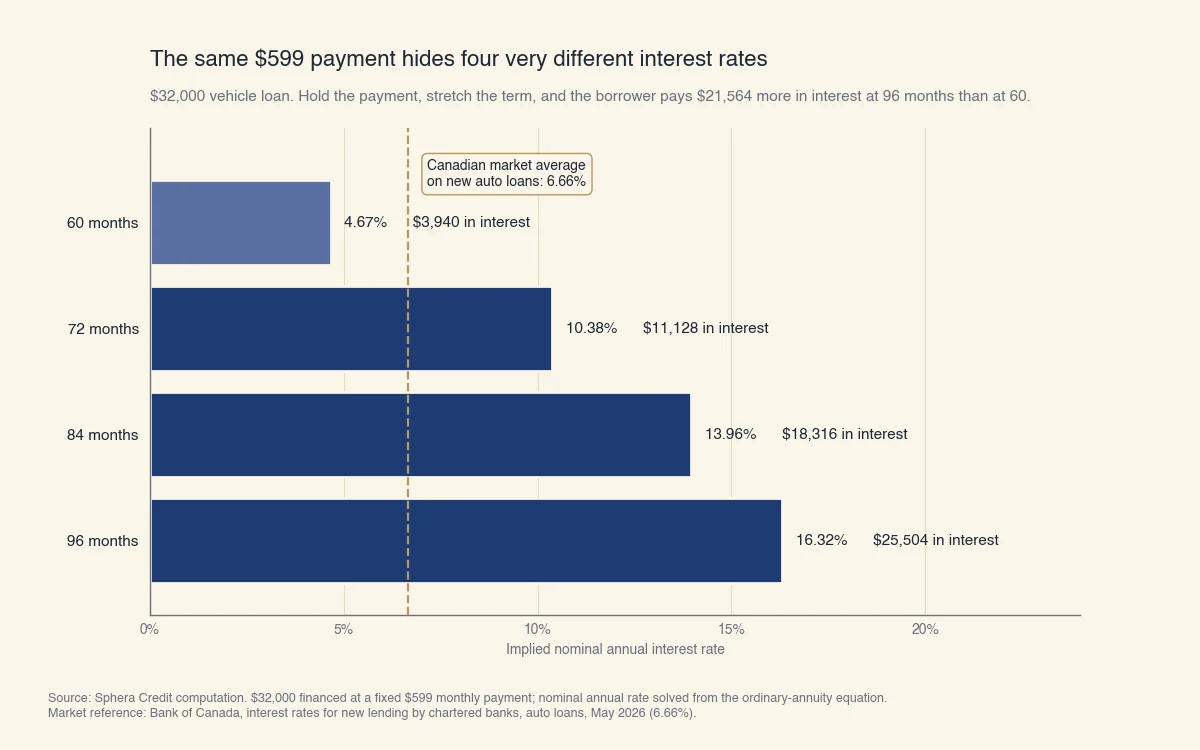
Source: Sphera Credit computation. $32,000 financed at a fixed $599 monthly payment; nominal annual rate solved from the ordinary-annuity equation. Market reference: Bank of Canada, interest rates for new lending by chartered banks, auto loans, May 2026 (6.66%).
At 60 months, $599 implies 4.67%, comfortably below the 6.66% average Canadian chartered banks charged on new auto loans in May 2026 (Bank of Canada). That benchmark tracks the interest rate in Canada, which the Bank of Canada resets on eight fixed dates a year. At 96 months, the same $599 implies 16.32%. The borrower who accepted the longer term pays $25,504 in interest instead of $3,940. The payment they were shown never moved.
Nothing here is hidden. The term is printed on the contract. But a buyer comparing offers by payment alone has no way to see it, and payment is how most vehicle and equipment financing is actually sold.
Three things follow:
- Ask for the rate and the term in the same sentence. A payment quote without both is not a price.
- Reverse-solve any quote before signing. One RATE call takes fifteen seconds.
- Compare offers on total interest, not on payment. Total interest is the number the term cannot disguise.
This gap between what a file looks like and what it actually costs is close to the problem Sphera Credit works on from the lender's side. When an applicant falls outside a lender's standard credit box, our AI agents assemble and verify the additional evidence a human underwriter would need, so the price attaches to what the borrower can genuinely support rather than to whatever the standard template captured.
How do you figure out the interest you owe this month?
For a lump-sum debt, multiply the balance by the periodic rate; for an amortizing loan, multiply the current balance by the monthly rate and treat everything left over from your payment as principal. This is the forward direction, and it is where most calculations actually start.
Simple interest applies to a debt where interest is charged on the original principal only and nothing compounds:
Interest = Principal × Rate × Time in years
Borrow $5,000 at 9% for three years and you owe $1,350 in interest. Canadian student loans and many short private loans work this way. The simple interest calculator solves that formula for whichever of the four terms you are missing.
Amortized interest applies to anything you repay in level instalments, which covers mortgages, car loans, and personal loans. Each payment splits in two:
- Multiply your current balance by the monthly rate. That is the interest portion.
- Subtract that from your payment. The remainder reduces the principal.
- The balance is now smaller, so next month's interest portion is smaller and the principal portion is larger.
This is why early payments feel like they accomplish nothing. On a $500,000 mortgage at 4.34%, the first payment carries roughly $1,792 of interest. The split is not a fee structure. It is just what happens when interest is charged on a balance that starts large.
Credit card interest is its own case. Issuers usually apply a daily periodic rate to the balance and compound it, so dividing an annual rate by 12 gets you close but not exact (FCAC). To find your card's rate from a statement, divide the interest charged by the balance it was charged on and multiply by 12.
What is different about figuring out a Canadian interest rate?
Canadian mortgage rates compound semi-annually rather than monthly, so dividing the quoted rate by 12 gives you the wrong monthly rate and a reverse-solve that ignores this returns a rate lower than the one in your contract. Most of the top-ranking guidance on this question is written for American loans, and on this specific point it produces a wrong answer for a Canadian reader.
Why semi-annual compounding changes your answer
Section 6 of the Interest Act says a mortgage cannot charge interest unless the contract states the principal and the rate "calculated yearly or half-yearly, not in advance" (Interest Act, s. 6). In practice, Canadian fixed mortgages compound twice a year while payments are made monthly. Converting between the two takes a root, not a division:
Monthly rate = (1 + annual rate ÷ 2)^(1/6) - 1
On a 4.34% mortgage:
| Method | Monthly rate | Payment on $500,000 over 25 years |
|---|---|---|
| Naive: rate ÷ 12 | 0.361667% | $2,733.95 |
| Correct: semi-annual conversion | 0.358439% | $2,723.07 |
The difference is $10.88 a month, or about $3,265 across a 25-year amortization. Small, but it runs the wrong way for you and it compounds the error when you reverse-solve.
Run the reverse-solve on that same mortgage and the point becomes sharp. Feed the correct $2,723.07 payment, $500,000, and 300 payments into RATE and multiply by 12, and you get 4.30%. The contract says 4.34%. The spreadsheet is not wrong. It returned a monthly-compounded rate, and your contract is quoted semi-annually. To recover the contract rate, convert back:
Contract rate = ((1 + monthly rate)^6 - 1) × 2
A US personal loan, car loan, or line of credit does compound monthly, so the plain × 12 is correct for those. The special handling is for Canadian mortgages specifically.
What if the rate you solve for is above 35%?
Section 347 of the Criminal Code caps most consumer credit at 35% APR, a limit that took effect on 1 January 2025 (Criminal Code s. 347). The previous ceiling was 60% expressed as an effective annual rate, and the change was set by the Criminal Interest Rate Regulations (Canada Gazette). The current limit is expressed as an APR, so mandatory fees count toward it, not just the stated interest.
If your reverse-solve lands above 35%, work through this in order:
- Check what you fed the formula. Using the sticker price instead of the amount financed inflates the result.
- Separate fees from interest. A fee rolled into the balance raises the solved rate above the stated one. That is normal and is roughly what APR is designed to capture.
- Check the exemptions. Pawn loans under $1,000 and commercial credit between $10,000 and $500,000 sit at 48% APR instead, and payday lending is regulated provincially.
- If none of those explain it, get the agreement reviewed. Section 4 of the Interest Act also says that a contract quoting only a weekly or monthly rate, without stating the equivalent yearly rate, cannot recover more than 5% per year (Interest Act, s. 4).
That last rule is worth remembering, because it exists for precisely the reader this page is written for. Canadian law puts the burden on the lender to state the annual rate. If you had to solve for it yourself, the disclosure may not have met the standard.