

What rate of interest does a lender actually charge?
An interest rate is the yearly price of using someone else's money, quoted as a percentage of the amount outstanding. Borrow $10,000 for a year at 8% and the lender charges about $800 for that year of use. Lend money instead, through a savings account or a GIC, and the same percentage describes what the bank pays you.
The more useful answer is that there is no single "rate of interest" in Canada. There is a different one for every product, and the gap between them is enormous. Bank of Canada figures for May 2026 show the country's chartered banks charging about 4.04% on a secured personal line of credit and 21.21% on credit card balances in the same month (Bank of Canada). Same institutions, same economy, same week, five times the price.
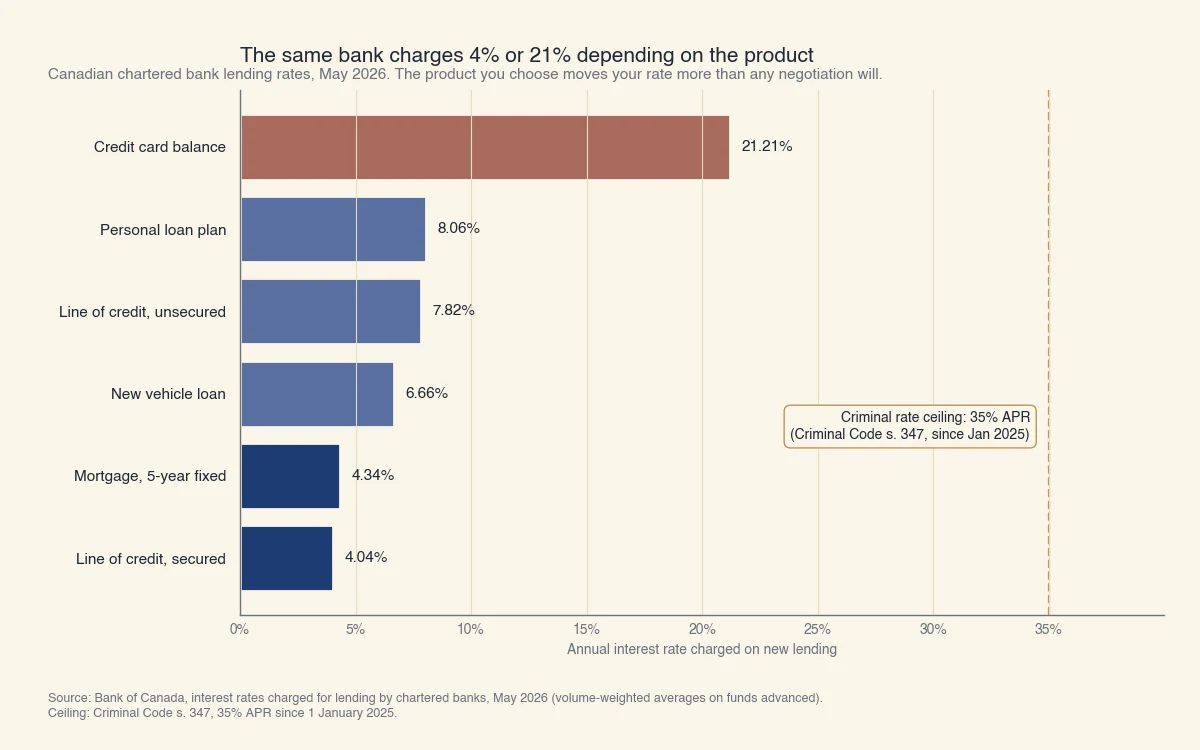
Source: Bank of Canada, interest rates charged for new and existing lending by chartered banks, May 2026 (volume-weighted averages on funds advanced). Ceiling: Criminal Code s. 347, 35% APR since 1 January 2025.
That spread is the single most important thing to understand about interest rates. Choosing to carry a balance on a credit card rather than on a secured line of credit costs more than any amount of negotiating will ever save you. The product decision outranks the rate negotiation. Moving an existing balance from the top of that chart to a lower row is what debt consolidation does, and the size of the gap is the whole reason it is worth doing.
What the rate is actually paying for
A lender charges interest to cover four separate things:
- The cost of the money itself. Banks fund loans with deposits and borrowed money, and that funding is not free.
- Expected losses. Some borrowers will not repay. The rate on a product spreads that expected loss across everyone who takes it.
- Operating costs. Underwriting, servicing, and collecting the loan.
- Profit. What is left over.
Expected losses explain most of the spread in the chart above. A secured line of credit sits behind collateral the lender can recover, so the loss rate is low and the price is low. An unsecured revolving balance has nothing behind it, so the price is high.
How does the Bank of Canada set the rate you pay?
The Bank of Canada does not set consumer interest rates directly. It sets a target for the overnight rate, and that target ripples through the banking system into the products you actually buy. As of 15 July 2026, the target sits at 2.25% (Bank of Canada). The Bank reviews it on eight fixed dates a year. For how that 2.25% target compares with earlier rate cycles, see what the interest rate was in recent years.
The chain works like this:
- The Bank of Canada sets the overnight rate, the rate major financial institutions charge each other for one-night loans.
- Chartered banks set their prime rate off that target. Prime is the reference rate they publish for their strongest borrowers.
- Variable-rate products are priced as prime plus or minus a spread. A variable line of credit might be quoted as "prime plus 1%".
- Your specific offer is prime, plus the product spread, plus whatever the lender's assessment of you adds or subtracts.
Fixed mortgage rates skip this chain almost entirely. Lenders price fixed mortgages off Government of Canada bond yields of a similar term, which is why a fixed rate can fall in a month when the Bank of Canada holds its target steady.
Fixed or variable: which rate of interest is which?
A fixed rate stays the same for the whole term of the contract. A variable rate moves whenever the lender's prime rate moves, which in practice means whenever the Bank of Canada changes its target.
| Fixed rate | Variable rate | |
|---|---|---|
| What it tracks | Government bond yields | The lender's prime rate |
| Changes during the term | No | Yes, on each prime move |
| Payment predictability | Complete | Payment or amortization shifts |
| Usually cheaper at signing | Not always | Historically yes, not guaranteed |
| Best for | Fixed budgets, short horizons | Tolerance for payment movement |
Neither is inherently better. A fixed rate buys certainty and you pay for that certainty; a variable rate is a bet that the average rate over your term will land below today's fixed quote.
Why does a 5% Canadian mortgage not cost 5%?
Because Canadian fixed mortgage rates are quoted on a semi-annual compounding basis, a quoted rate always works out to a slightly higher effective annual rate. Section 6 of the Interest Act requires that a mortgage on real property state the rate "calculated yearly or half-yearly, not in advance" (Interest Act, s. 6). Canadian lenders use the half-yearly option, and almost nobody explains what it does to the arithmetic.
Take a real example. A $500,000 mortgage, 25-year amortization, quoted at 4.34% fixed:
- Compounded semi-annually, the effective annual rate is (1 + 0.0434 ÷ 2)² − 1 = 4.39%, not 4.34%.
- The monthly payment works out to $2,723.
- Over the full 25 years you would pay about $316,920 in interest, on top of the $500,000 you borrowed.
- Over the first five-year term you would pay $163,384 in total, of which $101,195 is interest and only $62,189 reduces the principal.
The Canadian convention is a small break, not a penalty. An American mortgage quoted at the identical 4.34% compounds monthly, which produces a payment of $2,734, about $11 more per month and roughly $3,265 more across 25 years. The point is not that one is better. The point is that a quoted rate is a convention, not a cost, and you cannot compare two quotes without knowing which convention each one uses.
Simple interest, compound interest, and why the difference grows
Simple interest is charged only on the original principal. Compound interest is charged on the principal plus any interest already added, so the balance grows on itself.
Almost every Canadian consumer product compounds. Credit cards compound daily on unpaid balances, mortgages compound semi-annually, and savings accounts typically compound monthly (FCAC). Over one year the difference is small. Over 25 years it is most of what you pay.
The rate is not the cost
Here is the part almost every explainer skips. Two loans at the identical rate can cost wildly different amounts, because the repayment structure does the real work.
Take a $5,000 balance at 21.21%, the Bank of Canada's May 2026 average credit card rate:
| Repayment structure | Time to clear | Total interest |
|---|---|---|
| Three-year installment loan, $188.91 per month | 3 years | $1,801 |
| Credit card, minimum payment of 3% of balance | 21.8 years | $6,590 |
Same balance. Same rate. Three and a half times the interest. When someone asks what rate of interest they are paying, the follow-up question that actually determines the answer is how fast they intend to repay. The credit card interest calculator runs both structures against your own balance and shows the month-by-month schedule behind each total.
How does a lender decide what rate of interest to give you?
Lenders price every applicant individually, so the posted rate is a starting point and your offer is the output of a risk assessment. This is called risk-based pricing: the higher the lender's estimate of the chance you will not repay, the higher the rate they quote to cover that expected loss.
Six inputs move the number more than anything else:
- Credit score. The single largest lever on most consumer products; an excellent credit rating earns the lowest tier of every product above.
- Income stability and how easily it is verified. A salaried employee with T4 slips is cheaper to underwrite than a self-employed applicant filing T2125s.
- Debt service ratios. How much of your gross income already goes to housing and to total debt payments.
- Collateral. Secured lending is priced far below unsecured lending, which is why the top and bottom bars in the chart above sit so far apart.
- Term length. Longer terms carry more uncertainty and often more price.
- Relationship and product bundling. Some lenders discount for existing customers.
Put those together and the same $25,000 personal loan request produces very different offers:
| Borrower profile | Typical rate range | What drives it |
|---|---|---|
| Prime, salaried, score 760+, low debt ratios | Roughly 7% to 10% | Verifiable income, strong repayment record |
| Near-prime, self-employed, score 660 to 720 | Roughly 11% to 18% | Income harder to verify, thinner cushion |
| Subprime or thin file, score under 620 | Roughly 20% to 32% | Limited history, higher expected loss |
The self-employed case is the one most people get wrong. A self-employed applicant earning $150,000 can be quoted worse than a salaried applicant earning $75,000, not because they earn less but because two years of tax returns showing deducted expenses are harder for a lender to model than a T4. The income is real; the file is just harder to read.
That gap between a real borrower and a legible file is the problem Sphera Credit works on. When an applicant falls outside a lender's standard credit box, our AI agents assemble and verify the additional evidence a human underwriter would need to price the file accurately, so the decision rests on what the borrower can actually support rather than on what the standard template happened to capture.
What limits the rate of interest a Canadian lender can charge?
Section 347 of the Criminal Code makes it a criminal offence to charge an effective annual percentage rate above 35% on most loans, a ceiling that took effect on 1 January 2025. The previous limit was 60% expressed as an effective annual rate. The new limit is expressed as an APR, so it captures mandatory fees, not just the stated interest rate (Criminal Code s. 347).
The rules are not uniform across every kind of credit:
| Type of credit | Ceiling |
|---|---|
| Most consumer loans | 35% APR |
| Pawn loans under $1,000 | 48% APR |
| Commercial loans of $10,000 to $500,000 | 48% APR |
| Commercial loans above $500,000 | No statutory cap |
| Licensed payday loans | Provincially regulated, cost of borrowing capped at 14% of the amount advanced |
Two more disclosure rules are worth knowing. Section 4 of the Interest Act says that if a contract states interest at a weekly or monthly rate without also stating the equivalent yearly rate, the lender cannot collect more than 5% per year (Interest Act, s. 4). And federally regulated lenders must disclose the cost of borrowing before you sign (FCAC).
Notice where the mainstream bank products in the chart sit relative to that 35% line. Even the most expensive of them, a credit card at 21.21%, is nowhere near the legal ceiling. The ceiling is not what protects most borrowers. What protects them is choosing the right product and repaying it on a schedule they can hold.