

Underwriting on a clean home loan file usually takes one to three weeks of active work, and it sits inside a purchase timeline that currently averages about 37 days from application to closing. Those are two different clocks, and confusing them is why the answers you find vary so wildly.
ICE Mortgage Technology, which processes a large share of US originations, measured the average purchase loan closing in 36.8 days in March 2026. That is the fastest average since the company began tracking the metric in 2019. The typical file moved from application to rate lock in 11 days, then from rate lock to closing in another 26 days. Across all origination types including refinances, the average was 38.2 days (ICE Mortgage Technology).
Underwriting is the lender's verification that you can repay the loan and that the property is worth what you are borrowing against it. It is one stage inside that 37-day span, not the whole thing. The person who signs off on it is the underwriter on your mortgage loan.
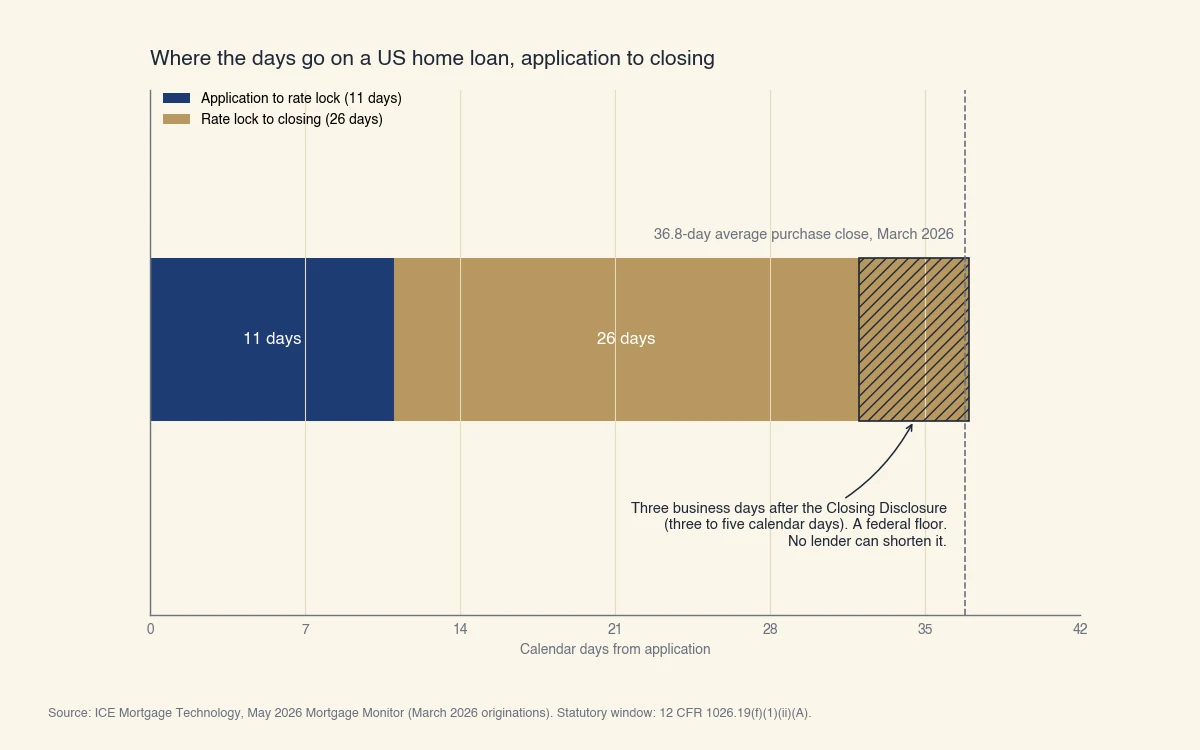
Source: ICE Mortgage Technology, May 2026 Mortgage Monitor (March 2026 originations). Statutory window: 12 CFR 1026.19(f)(1)(ii)(A).
The chart shows something most guides leave out. A defined slice at the end of that calendar is not negotiable. Once your Closing Disclosure is issued, federal law imposes a three-business-day waiting period before you can sign. No lender, however motivated, closes inside it.
A home loan moves through six stages, and the underwriter's own review is one of the shortest. The bulk of the calendar goes to third parties the lender is waiting on.
| Stage | Typical duration | Who controls it |
|---|---|---|
| Application and document collection | 1 to 5 days | You |
| Processing and verification | 3 to 7 days | Lender's processor |
| Appraisal | 5 to 15 business days | Appraiser and market |
| Title search and commitment | 5 to 14 days | Title company |
| Underwriting decision | 1 to 3 business days | Underwriter |
| Conditions, final review, closing window | 5 to 12 days | Shared, with a federal floor |
Two features of this table matter more than the individual numbers.
First, the underwriter's decision is fast. On an automated file the initial pass often returns in 24 to 72 hours. The weeks come from everything queued around it. That speed comes from training and delegated signing authority rather than from any shortcut, and how to become an underwriter covers how that authority is earned.
Second, the stages overlap. A competent processor orders the appraisal and opens title the same week the file enters processing, which is why the total is 37 days rather than the sum of the rows.
Conditional approval means the underwriter has said yes subject to a list of outstanding items, and final approval means every item on that list has been satisfied. The list is usually mundane: an updated bank statement, a letter explaining a deposit, proof a collection was paid, a homeowner's insurance binder.
Clearing conditions is the stage where borrowers lose the most time, because the clock stops entirely while the lender waits on you. A condition returned in two hours and a condition returned in six days produce the same underwriting work and a four-day difference in closing date.
Clear to close means final approval is done and the file has moved to the closing department. It is the signal that the only remaining wait is the federal review window.
The credit decision on a government-backed loan takes about as long as a conventional one. The extra days come almost entirely from the property, not from you. This is the most common misunderstanding about FHA and VA timelines.
For an FHA loan, the appraisal must be performed by an appraiser on the FHA roster, and that appraiser also confirms the property meets HUD's Minimum Property Requirements covering safety, security, and soundness (HUD Handbook 4000.1). A conventional appraisal answers one question, what is it worth. An FHA appraisal answers two, and the second one can generate required repairs that must be completed and re-inspected before the loan closes. That is where FHA files lose a week or more, and it happens after underwriting has already approved the borrower.
For a VA loan, the timeline is partly a matter of geography, and the VA publishes the numbers. It sets a binding maximum appraisal turnaround for every state and county in its Appraisal Fees and Timeliness schedule (US Department of Veterans Affairs).
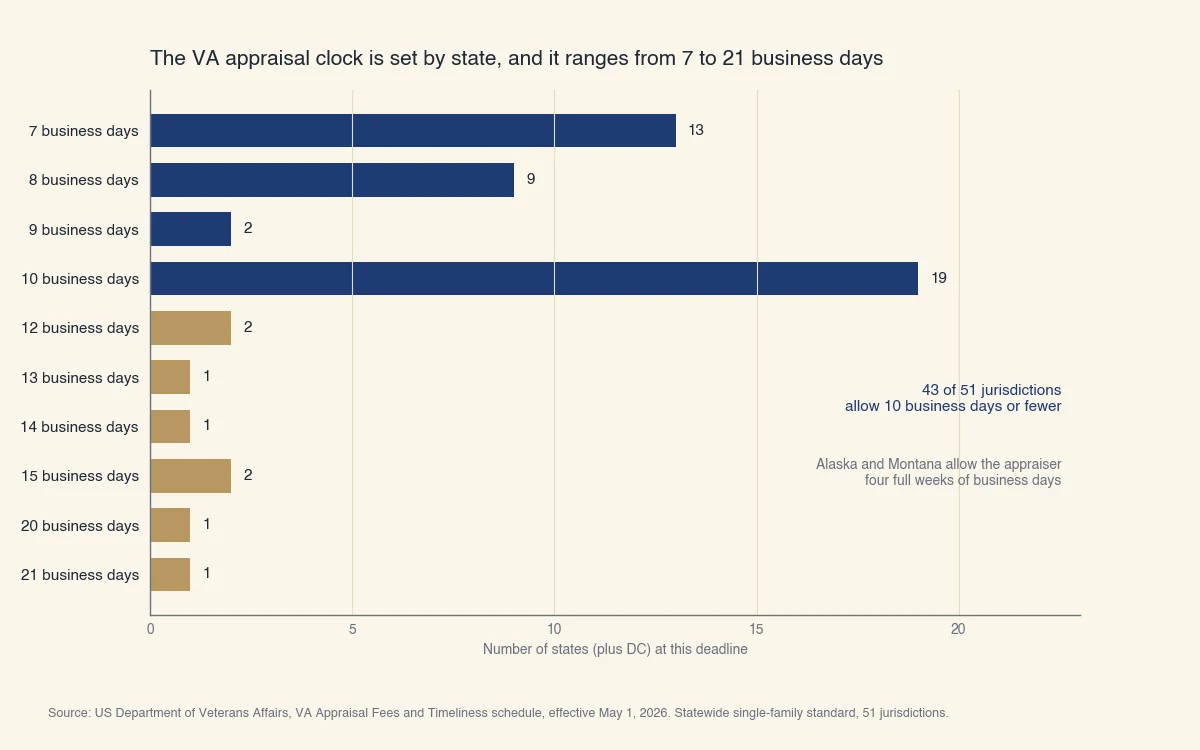
Source: US Department of Veterans Affairs, VA Appraisal Fees and Timeliness schedule, effective May 1, 2026. Statewide single-family standard, 51 jurisdictions.
Forty-three of the 51 jurisdictions allow 10 business days or fewer. The tail is long: Washington sits at 13, Oregon at 14, the Dakotas at 15, Montana at 20, and Alaska at 21. Buying in Anchorage rather than Phoenix can add three calendar weeks to one stage of your loan before anyone has looked at your income.
The VA also specifies how the clock runs. Appraiser timeliness starts the first business day after the assignment date, and weekends and federal holidays do not count. Many states publish shorter county-level standards for their metro areas, so a borrower in Maricopa County, Arizona works to 6 business days while the Arizona statewide standard is 7.
The practical takeaway: before you promise a seller a closing date on a VA file, look up the standard for the county the property sits in.
Federal law requires you to receive your Closing Disclosure no later than three business days before consummation, and only three specific changes can restart that clock. This is the part of your timeline that no amount of preparation, lender choice, or urgency will compress.
The requirement lives in 12 CFR 1026.19(f)(1)(ii)(A): the consumer must receive the disclosures no later than three business days before consummation (Consumer Financial Protection Bureau). The purpose is to give you time to compare final terms against what you were quoted (CFPB Closing Disclosure explainer).
There is a wrinkle that catches people. For this particular waiting period, business day does not mean "a day the bank is open." Regulation Z uses a stricter definition here: all calendar days except Sundays and federal public holidays (12 CFR 1026.2(a)(6)). Saturday counts. A federal holiday does not. So the same three-day rule spans three calendar days when the disclosure lands on a Monday and five when it lands on a Friday.
Only three, and knowing them protects your closing date (CFPB):
- The APR becomes inaccurate. More than 1/8 of a percentage point on a fixed-rate loan, or 1/4 of a point on an adjustable-rate loan. It helps to know what separates the APR from the interest rate before you read the corrected disclosure.
- The loan product changes. Switching from fixed to adjustable, for example.
- A prepayment penalty is added.
Almost everything else does not restart it. Typos, issues found on the final walkthrough, and most adjustments to cash due at closing are corrected without a new waiting period.
This is the counterintuitive part. The instinct at the end of a long process is to squeeze out one more improvement, renegotiate the rate, or switch products. Do that in the final week and you can push your own closing back by days, having done everything else right.
Here is a single purchase file walked day by day, using the ICE segment averages. Assume you apply on Monday, March 2, 2026.
| Milestone | Date | Days elapsed |
|---|---|---|
| Application submitted | Mon, Mar 2 | 0 |
| Processing, appraisal ordered, title opened | Mar 3 to Mar 12 | 1 to 10 |
| Rate locked | Fri, Mar 13 | 11 |
| Underwriting decision, conditional approval | Mar 16 to Mar 20 | 14 to 18 |
| Conditions cleared, clear to close | Late March | 25 to 30 |
| Closing Disclosure received | Fri, Apr 3 | 32 |
| Federal waiting period | Sat Apr 4, Mon Apr 6, Tue Apr 7 | 33 to 36 |
| Closing | Wed, Apr 8 | 37 |
Note the waiting period. The Closing Disclosure arrives Friday, April 3. Saturday counts as business day one. Sunday is excluded. Monday is day two, Tuesday is day three, and you sign Wednesday. Five calendar days for a three-day rule.
Now run the same file with one late change. On Monday, April 6, your rate is adjusted and the APR rises by more than 1/8 of a point. The lender must issue a corrected Closing Disclosure, and a fresh three-business-day period starts: Tuesday, Wednesday, Thursday. The earliest you can sign is Friday, April 10, two days past the date on your purchase contract, with a rate lock that may now need extending.
That is the whole argument for treating the last ten days of a home loan as a period to protect rather than optimize.
The dominant cause of delay is not lender speed. It is a document that arrives late, a property problem, or a change to your finances after application. Ranked by how often they push a closing date:
- Slow responses to conditions. Every day you hold a requested document is a day added, one for one.
- Appraisal problems. A value below the contract price, or required repairs on an FHA or VA file, restarts part of the property review.
- New credit activity. Lenders re-pull credit shortly before closing. A car loan or a new card opened mid-process can change your debt-to-income ratio and force a re-underwrite.
- Income that is harder to document. Self-employment, commission, bonus, and gig income need more evidence, typically two years of returns plus a year-to-date profit and loss statement. Gather these before you apply rather than after the underwriter asks.
- Title defects. Liens, boundary disputes, and estate issues sit outside the lender's control entirely.
- Large unexplained deposits. Any deposit that is not obviously payroll needs a paper trail. Move gift funds early and document them.
What genuinely helps:
- Send a complete file at application. Two months of statements for every account, two years of W-2s or returns, and recent pay stubs. Completeness at day zero beats speed later.
- Answer conditions the same day. This is the single largest lever you control.
- Freeze your finances. No new credit, no job changes, no large transfers between application and closing.
- Check the property's clock. On a VA file, look up your county's appraisal standard. On an FHA file, expect the possibility of repair conditions.
- Protect the last week. Once the Closing Disclosure is issued, avoid changes that touch the APR, the product, or prepayment terms.
One thing that does not help: locking your rate earlier. A rate lock fixes your pricing for a set number of days. It does not move you up the underwriting queue, and if it expires before closing you pay for an extension or accept current market pricing.
Underwriting has a floor you cannot go below and a ceiling set mostly by how fast documents move. Sphera Credit builds AI agents that help lenders assess borrowers whose files fall outside the standard credit box, so a self-employed or thin-file applicant gets a decision grounded in evidence rather than a decline by template. The goal is an accurate, explainable answer on files that would otherwise be judged by a rule that was never written for them.