

Underwriting a loan means the lender measures how likely you are to repay it, then decides whether to lend, how much, and at what price. The underwriter checks your income, your credit history, and your existing debts, values any collateral, and produces one of three outcomes: approve, approve with conditions, or decline (FCAC).
Underwriting is the step between applying and receiving money. Everything before it is intake, where you state your numbers. Underwriting is where the lender verifies those numbers against evidence and commits its own capital to the answer. The word comes from Lloyd's of London, where individuals accepting a share of a risk signed their names underneath the policy.
Here is where most explanations of this question go wrong. Search the phrase and you will mostly be shown mortgage underwriting: appraisals, property files, stress tests, a human underwriter working through a thick folder. That describes one kind of loan. It does not describe the loan most Canadians are actually applying for.
Canadian chartered banks held $682.3 billion in personal loans for consumer goods and services at the end of the first quarter of 2026, against $114.0 billion on credit cards and $99.6 billion in vehicle loans (Statistics Canada). Almost none of that book is underwritten the way a mortgage is. So the honest answer to "what does underwriting a loan mean" starts with a fork: which loan?
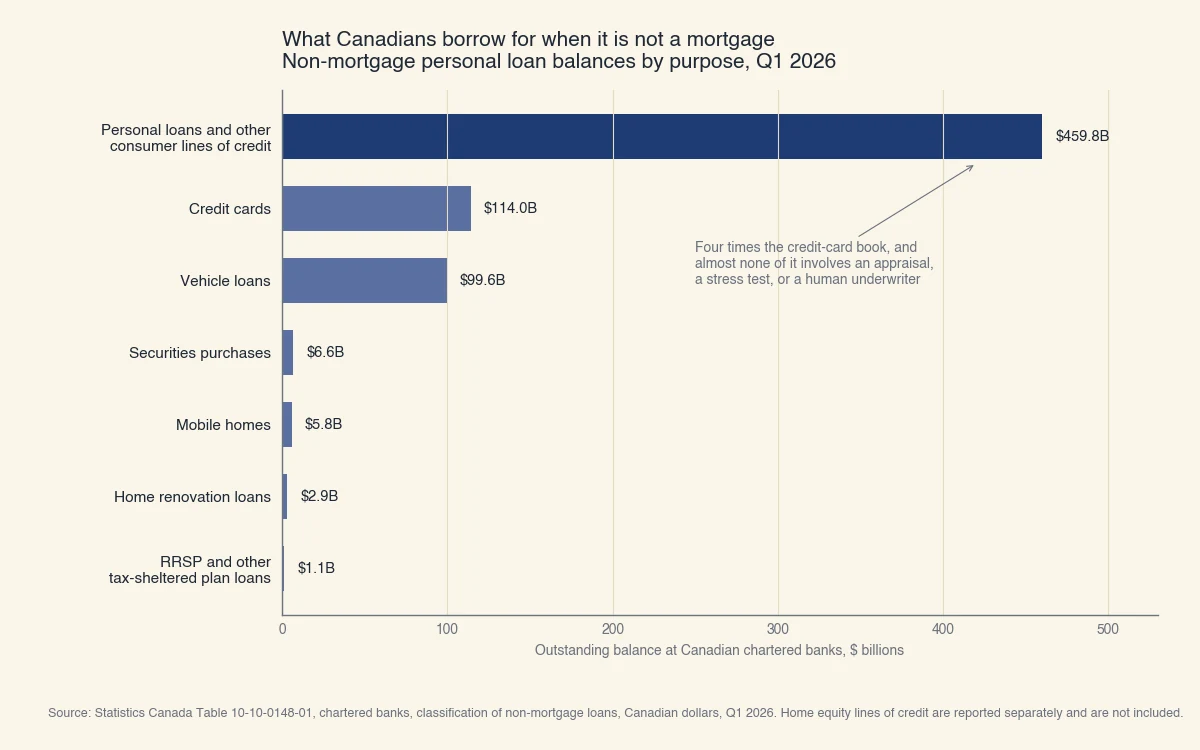
Source: Statistics Canada Table 10-10-0148-01, chartered banks, classification of non-mortgage loans, Canadian dollars, Q1 2026. Home equity lines of credit are reported separately and are not included.
A personal loan is usually underwritten by a rules engine in minutes against your credit file and your income, while a mortgage is underwritten against a national rulebook that adds a property appraisal, a stress test, and hard ratio ceilings. Same word, two genuinely different processes.
| Personal loan or line of credit | Residential mortgage | |
|---|---|---|
| Who decides | Automated rules engine, human only on exceptions | Human underwriter, often with an automated first pass |
| Typical time | Minutes to one business day | 24 to 72 hours, one to two weeks if manual |
| Collateral assessed | None on unsecured loans | Property appraisal required |
| Regulatory rulebook | Lender's own credit policy | OSFI Guideline B-20 for federally regulated lenders |
| Rate you are tested at | The rate you will actually pay | The qualifying rate, contract rate plus 2% or 5.25% |
| Hard ratio ceilings | Set by the lender, not published | GDS 39% and TDS 44% on insured mortgages |
| What sinks a file | Credit history and existing payment load | Ratios at the qualifying rate, or a short appraisal |
Two mechanics drive that whole table.
The first is collateral. A mortgage is secured by a property, so the lender orders an appraisal, an independent estimate of market value, and lends against it. An unsecured personal loan has nothing to seize, so the lender's only real protection is your willingness and ability to pay. That pushes far more weight onto your credit history.
The second is regulation. Federally regulated lenders underwrite residential mortgages to OSFI Guideline B-20, a published national standard (OSFI). Nothing equivalent governs the underwriting of an unsecured consumer loan. Each lender writes its own credit policy, which is why two banks can return opposite answers on the same personal loan application in the same afternoon.
Across both paths, four things are always assessed:
- Income and its stability. Pay stubs, T4s, and notices of assessment for salaried applicants. Two years of business financials for self-employed applicants.
- Credit history. Payment record, current balances, defaults, collections, and recent applications, pulled from Equifax or TransUnion (FCAC). See how a credit rating is calculated.
- Existing debt load. Every monthly obligation you already carry, expressed as a share of your gross income.
- Collateral, where the loan is secured. The property on a mortgage, the vehicle on a car loan, nothing on an unsecured loan.
The difference is not what gets checked. It is how strictly each item is measured, and against which ceiling.
An underwriter converts your income and debts into ratios, then compares those ratios against a ceiling. Every threshold you have read about becomes meaningful only once you can compute your own, so here is the arithmetic on one borrower applying for two different loans.
Take someone earning $78,000 a year, which is $6,500 gross a month. They carry a car loan at $340 a month and credit card minimums at $180 a month, so $520 a month of existing debt payments. All figures below are illustrative. If you are paid by the hour, the hourly to salary calculator converts your wage into the annual and monthly gross figures used here.
The borrower applies for $20,000 over 60 months at 11.99%. The rules engine calculates the payment first:
- Monthly rate: 11.99% ÷ 12 = 0.9992%
- Payment on $20,000 over 60 months: $445 a month
- Total monthly debt payments if approved: $520 + $445 = $965
- As a share of gross income: $965 ÷ $6,500 = 14.8%
There is no appraisal, no qualifying rate, and no published ceiling. The engine weighs the credit score band, the verified income, and that 14.8%, and returns a decision. For a clean file at a major bank, the whole assessment finishes in minutes.
The same borrower now applies for a mortgage. Their existing debt has grown to $965 a month, because last year's personal loan is now one of their obligations.
Mortgage underwriting tests them at the qualifying rate, the greater of their contract rate plus 2% or 5.25% (OSFI). At a 4.29% contract rate, they are tested at 6.29%, on a payment they will never actually make.
Then two ratios apply. Gross Debt Service (GDS) is housing costs (principal, interest, property tax, heat, and half of any condo fees) divided by gross income. Total Debt Service (TDS) adds every other debt payment. CMHC caps GDS at 39% and TDS at 44% on insured mortgages (CMHC).
Working backwards from those ceilings, with property tax of $330 and heat of $120:
- GDS ceiling: 39% × $6,500 = $2,535 of housing costs
- TDS ceiling: 44% × $6,500 = $2,860, minus $965 of other debt = $1,895 of housing costs
- The lower ceiling binds, so housing is capped at $1,895
- Less tax and heat: $1,895 − $450 = $1,445 of mortgage payment, at the 6.29% qualifying rate
- That supports a mortgage of roughly $220,000
Now run the same file without last year's personal loan, so other debt is $520 rather than $965:
- TDS ceiling: $2,860 − $520 = $2,340 of housing costs
- Less tax and heat: $1,890 of mortgage payment at the qualifying rate
- That supports a mortgage of roughly $288,000
The $20,000 personal loan cost this borrower about $68,000 of mortgage borrowing power. Their income never changed. What changed is that a payment the personal-loan engine treated as comfortable became the binding constraint in a process governed by a published ceiling. This is the practical reason the two kinds of underwriting are worth telling apart, and it is invisible if you only ever read about one of them.
It means your file has been accepted for assessment and no decision exists yet. The lender is verifying what you declared, pulling your credit, and calculating the ratios. "In underwriting" is a status, and the single most useful thing to know about it is which stage you are actually at.
| Stage | What the lender is doing | Rough duration | What you should do |
|---|---|---|---|
| Application received | Logging the file, checking it is complete | Minutes to hours | Answer document requests the same day |
| Verification | Confirming income, employment, and down-payment source | Hours to days | Send originals, not summaries |
| Adjudication | Scoring the file, calculating ratios, pulling credit | Minutes to days | Nothing; wait |
| Conditional approval | Issuing the decision with conditions attached | Same day as adjudication | Read every condition carefully |
| Clearing conditions | Reviewing the appraisal and documents you supplied | Days to weeks | Supply conditions in one batch |
| Final approval or decline | Committing the funds, or declining | Same day as clearing | Confirm funding date in writing |
Three things matter while a file sits in this window.
- Do not take on new credit. A new loan, a new card, or a large purchase changes the ratios the underwriter just calculated. Lenders commonly re-pull credit before funding, and a file can be pulled back after a conditional approval.
- Do not change jobs if you can avoid it. Income stability is being assessed. A change mid-file usually restarts verification.
- Send documents in one batch. The most common source of delay is a back-and-forth over a missing page. For more on timing, see how long underwriting takes.
A conditional approval is the outcome that confuses people most. It is a real approval, contingent on named items being satisfied: a satisfactory appraisal, proof that the down payment is genuine savings, a letter explaining a gap in employment. Until every condition is cleared, the money is not committed.
Underwriting ends in one of three ways, and only one of them is final approval. The other two are worth understanding before you apply.
- Approved. The lender commits the funds and sets the rate, amount, and term. On a mortgage this arrives as a commitment letter.
- Approved with conditions. The decision is favourable, but funding waits on named items. Most files land here.
- Declined. The lender will not lend on this application as submitted.
If you are declined, you have a right to understand why. Ask the lender for the specific reason, then pull your own credit report from Equifax and TransUnion, which you can do at no cost and without affecting your score (FCAC). A meaningful share of declines trace to reporting errors on a credit file rather than to the borrower's actual finances, and you have the right to dispute an inaccurate item.
Where a decline traces to the numbers themselves, the fix follows from which constraint bound. Ratios too high means clearing a monthly payment, as the worked example above shows. A short appraisal means a larger down payment or a different property. Unverifiable income means better documentation rather than a different lender. Applying again immediately at another lender, with the same file, mostly produces the same answer plus another hard inquiry. Renewal is the one case that breaks this pattern: staying with your current lender is not a new credit decision at all, while moving the same mortgage to another lender is underwritten as a fresh origination, which is why a denied mortgage renewal plays out differently depending on which of the two turned you down.
There is a wider point here about who gets assessed well. Automated underwriting is accurate on borrowers who look like the data it was built on: salaried, long credit history, conventional file. Applicants outside that box, including self-employed people, newcomers to Canada, and anyone with a thin credit file, get pushed to manual review or declined by default, even when they are genuinely creditworthy. Sphera Credit's work focuses on those cases, giving lenders better and explainable information on the borrowers an automated system cannot score cleanly, so the decision reflects the borrower rather than the gaps in the file.
For the broader concept, see what underwriting is and what underwrite means. For the property-specific version, see underwriting in real estate and what credit rating you need for a mortgage. If your file is with a lender right now, should I be worried about underwriting covers what is and is not worth worrying about.