

A Canadian mortgage underwriter usually takes 1 to 5 business days to review a complete file, firm approval usually arrives 5 to 10 business days after a complete application, and the whole application-to-funding calendar runs about 25 to 45 days. Those are three different clocks, and most of the confusion about mortgage timing comes from answers that quote one of them without saying which.
Underwriting is the lender's risk assessment: someone confirms your income, debts, credit history, and down payment, values the property, and decides whether to fund the loan and on what terms. OSFI Guideline B-20 sets the standards every federally regulated Canadian lender follows, so the workflow looks broadly similar at the Big Six banks, the credit unions, and the monoline lenders (OSFI).
Here is what each clock actually measures:
| Clock | What it measures | Typical length |
|---|---|---|
| Underwriter's review | Time spent assessing a complete file and issuing a conditional commitment | 1 to 5 business days |
| Application to firm approval | Complete application through appraisal, conditions, and insurer to a firm commitment | 5 to 10 business days |
| Application to funding | Everything, including the lawyer's title work and the release of funds on closing day | 25 to 45 calendar days |
These are ranges observed in market practice, not published statistics. No Canadian regulator publishes a days-to-close series, which is why the figures circulating online range from 24 hours to 60 days without any of them being wrong.
The clock that decides whether your purchase survives is the middle one. If you are buying rather than refinancing, your purchase agreement almost certainly contains a financing condition with a fixed expiry date. Firm approval has to land before it.
Because the underwriter spends very little of the calendar working on your file, and most of it waiting on people you have never met. Most lenders run the application through an automated underwriting engine first, which returns a recommendation in minutes, and a human underwriter reviews only the exceptions the engine flags. Judging those exceptions is the core of the job, and what it takes to become a mortgage underwriter explains the training behind it. The weeks come from the inputs.
Split the calendar into three buckets and the whole timeline becomes legible:
| Who controls it | What sits in this bucket | Can you compress it? |
|---|---|---|
| The lender | Queue position, the underwriter's review, the conditions list, firm approval | Only by submitting a complete file, or by using a broker who pre-checks it |
| You | Income documents, 90-day account statements, gift letters, responses to conditions | Yes, and this is the only bucket you control outright |
| Third parties | Appraisal booking and report, employment verification call-back, default insurer, your lawyer's title search and closing package | Almost never, but you can start them earlier |
The practical consequence is that the generic advice to "have your documents organized" only addresses the middle bucket. It is worth doing, and it is not where most lost days live.
Three specific third-party steps do the damage:
- The appraisal. The lender orders it, an independent appraiser books a visit around the seller's availability, and the report comes back a day or two after the visit. This is usually the single longest wait in the file, and nothing in your control moves it.
- Employment verification. Many lenders phone your employer's payroll or HR line to confirm your role, salary, and status. If that call goes to voicemail on a Friday, you have lost the better part of a week to a phone tag you never see.
- The solicitor. Canadian lenders will not release funds without a registered lawyer or notary acting for you. Most buyers hire one after firm approval, which is several days later than they could have.
Retriggering the file is the fourth risk, and it is self-inflicted. OSFI requires lenders to re-verify income and credit if a file ages past 90 days, and any change to your rate, income, or debt load re-runs the qualifying math at the minimum qualifying rate, currently the greater of your contract rate plus two percentage points or 5.25%. OSFI reaffirmed that rate unchanged in January 2026 (OSFI). Applying for a car loan mid-process is not a small mistake. It restarts arithmetic that was already finished.
In a Canadian purchase, the financing condition in your agreement of purchase and sale sets a hard expiry date, and underwriting has to produce a firm approval before it. This is the mechanic that makes Canadian mortgage timing different from the American version, and it is missing from most of what is written about underwriting timelines.
A financing condition is a clause making your purchase agreement conditional on you obtaining a mortgage acceptable to you by a stated date and time. Ontario's standard-form agreement of purchase and sale carries one, British Columbia's Contract of Purchase and Sale uses a subject-to-financing clause with a subject-removal date, and the other provinces have close equivalents. In practice the window runs about 5 to 10 business days from acceptance, negotiated with the seller as part of the offer. The Real Estate Council of Ontario advises buyers to include the condition rather than rely on a pre-approval (RECO), and OREA now writes a specific date and time into the clause rather than a count of business days, which removes arguments about what counts as a business day.
Three things follow, and they change how you should read every timeline estimate:
- A pre-approval does not satisfy the condition. A pre-approval reserves a rate and estimates what you can borrow. No property has been appraised and no underwriter has seen a real file. Only a firm commitment on this property clears the condition (FCAC).
- You waive the condition in writing. When firm approval arrives you sign a notice of fulfilment and deliver it to the seller before the deadline. Silence is not fulfilment.
- Letting the deadline pass is expensive. Depending on the province and the wording, an expired condition can either end the agreement or let it become firm on its own terms, which puts your deposit at risk. If underwriting is going to be late, ask the seller for a written extension days before the deadline, not hours.
In a competitive market some buyers shorten the condition to three business days, or drop it entirely. That decision is made at the offer stage, before a single underwriting document has moved, and it is the moment when the timeline gets set. A three-business-day condition on a file that needs an appraisal is a bet on the appraiser's calendar.
Refinances and renewals have no financing condition, which is why they feel slower and matter less. Nothing collapses if a refinance takes an extra week.
A mortgage with less than 20% down is underwritten twice, once by the lender and again by the default insurer, and the second pass usually adds close to nothing. Canada requires mortgage default insurance below a 20% down payment, supplied by CMHC, Sagen, or Canada Guaranty. Intuition says the insurer's own underwriter means a second wait. The data says otherwise: CMHC states that its emili application system "can process mortgage insurance applications in just a few seconds" and can approve insurance for any residential property with up to four units (CMHC).
So the insurer pass is a decision the lender's system requests and receives inside the same afternoon, for the large majority of files. The exceptions are real but narrow: a file emili refers out for manual review, an unusual property type, or an income structure the automated model cannot score. Those can add a few business days.
This matters more each year, because more Canadian buyers are now on the insured path.
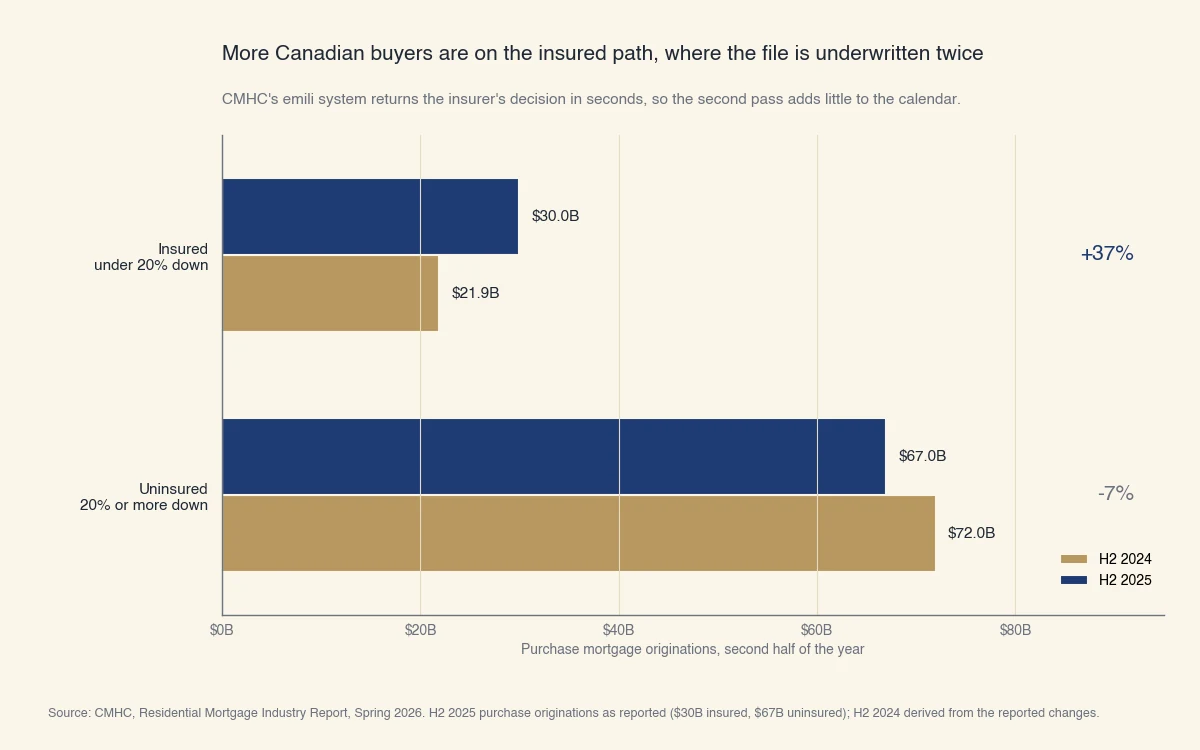
Source: CMHC, Residential Mortgage Industry Report, Spring 2026 edition. H2 2025 purchase originations as reported ($30B insured, $67B uninsured); H2 2024 levels derived from the reported changes of +37% and -7%.
CMHC reports that insured purchase originations rose 37% to $30 billion in the second half of 2025 while uninsured purchase originations fell 7% to $67 billion, and that 54% of mortgages chartered banks extended to first-time home buyers in the fourth quarter of 2025 were insured, up from the mid-40s before eligibility rules changed (CMHC). A majority of first-time buyers now go through the two-pass process, and most of them will never notice the second pass happened.
One practical note: the insurance premium is added to your mortgage principal, so an insured file also triggers a premium calculation the lawyer needs before closing. That is a paperwork step, not an underwriting delay.
On a clean insured purchase with a 10-business-day financing condition, firm approval typically lands on business day 8, leaving two days of buffer before the deadline. Here is that calendar, assuming an offer accepted on a Monday and a lender that orders the appraisal the day after the application is complete.
| Business day | What happens | Who is holding the file |
|---|---|---|
| 0 (Mon) | Offer accepted, financing condition starts | You and your agent |
| 1 (Tue) | Broker or banker submits the complete application | You |
| 2 (Wed) | Lender pulls credit, runs automated underwriting, orders the appraisal | Lender |
| 3 (Thu) | Appraiser contacts the seller's agent to book access | Third party |
| 4 (Fri) | Underwriter issues the conditional commitment with a conditions list | Lender |
| 5 (Mon) | Appraisal visit | Third party |
| 6 (Tue) | Appraisal report returned to the lender | Third party |
| 7 (Wed) | You deliver 90-day account statements and the employment letter | You |
| 8 (Thu) | Insurer pass returns, underwriter clears conditions, firm approval issued | Lender and insurer |
| 9 (Fri) | Buffer | Nobody |
| 10 (Mon, 5 p.m.) | Notice of fulfilment signed and delivered | You |
Now change one thing. The appraiser cannot get access until business day 8 because the seller is away, so the report lands on day 9 and firm approval on day 11. The condition expired the previous afternoon. Nothing in that sequence was anyone's fault, no document was missing, and the buyer is now asking a seller for an extension from a weak position.
That is the whole argument for reading these timelines as a deadline problem. The fix is not faster paperwork. It is a longer condition window at the offer stage, an appraisal ordered on day 1 instead of day 2, and a lawyer retained before firm approval instead of after.
For the same timing question across auto loans, personal loans, HELOCs, and business lending, see how long does underwriting take. For what the underwriter is actually assessing, see what is underwriting and should I be worried about underwriting.
Work on the two buckets you can move: submit a genuinely complete file on day one, and start the third-party steps earlier than the lender asks you to. In that order, because the second only helps once the first is done.
The complete-file half is well covered elsewhere and worth stating plainly:
- Two recent pay stubs, your last two Notices of Assessment, and an employment letter dated within 30 days
- Ninety days of statements for every account holding the down payment, with any large transfer explained in writing
- Signed gift letters for any gifted portion of the down payment
- The signed agreement of purchase and sale and the property tax bill
- T1 General returns and corporate financial statements if you are self-employed
The earlier-start half is the part most buyers skip:
- Retain your real estate lawyer before firm approval. The lender can send closing instructions the moment the file clears, instead of waiting for you to find someone.
- Confirm appraisal access in advance. Ask your agent to line up the seller's availability the day your offer is accepted, before an appraiser has even been assigned.
- Warn your employer that a verification call is coming. Name the person who can answer it and give the lender that name directly.
- Negotiate the condition window against the file you have. A self-employed buyer with corporate returns and a rural property should be asking for ten business days, not five.
Two things not to do: applying for any new credit while the file is open, and changing jobs before closing. Both restart underwriting work that was already finished, and neither is recoverable inside a tight condition window.
If you want to see how a given rate and amortization translate into a monthly payment while the file is under review, run the numbers through the mortgage payment calculator. For where your credit file needs to be before you apply, see what credit rating do I need for a mortgage.
Underwriting is a decision made under uncertainty, and the parts of it that take real time are the parts where a lender is waiting for evidence about a specific borrower and a specific property. Sphera Credit builds AI agents that do that evidence-gathering work for lenders when a borrower sits outside the standard credit box, so the assessment rests on a fuller picture rather than on whatever fit the template. The goal is an accurate, explainable decision on files that would otherwise get a thin one.