

What is an underwriter?
An underwriter is the person or institution that decides whether to take on someone else's risk, and on what terms. At a lender, the underwriter decides whether to lend you money. At an insurance company, the underwriter decides whether to insure you and at what premium. In a share or bond sale, the underwriter is the investment dealer that buys the new securities to resell them to investors.
The word is older than all three jobs. In the 1610s an underwriter was a subscriber, someone who wrote their name under a document. By the 1620s, to underwrite meant to accept the risk of insurance, from the practice of signing a marine insurance policy, which made the signer answerable for the losses it listed (Etymonline). The word predates Lloyd's of London, which grew out of a coffee house first recorded in 1688 (Lloyd's). To underwrite still means to put your name, and your money, behind someone else's risk. The verb has its own page on what underwrite means, from loans to share issues.
What does an underwriter do?
An underwriter checks what an applicant says, measures the risk of saying yes, and returns one of three answers: approve, approve with conditions, or decline. For a Canadian mortgage, the checks follow Guideline B-20, the rulebook for residential mortgage underwriting set by the Office of the Superintendent of Financial Institutions (OSFI), the federal regulator of banks and federally regulated insurers (OSFI Guideline B-20). Its principles sort the work into three questions:
- Who are you, and do you pay your debts? The underwriter records your identity and background and reads your credit history for evidence that you repay on time.
- Can you afford the payments? The underwriter verifies your income and weighs your housing costs and other debts against it. B-20 asks lenders to "demonstrate rigour in the verification of a borrower's income".
- What is the property worth? The home secures the loan, so the underwriter checks the loan amount against an appraisal or another valuation.
Conditions let an underwriter approve a file that still has a gap: proof of where the down payment came from, a letter from your employer, a debt paid off before closing. The steps around the decision, from application to funding, are covered in how underwriting works.
What are the main types of underwriter?
The four main types of underwriter are loan and mortgage underwriters, mortgage insurance underwriters, insurance underwriters and securities underwriters. Each one decides on a different risk, works for a different kind of employer and answers to a different set of rules.
| Type | What they decide | Who employs them in Canada | Rules they work under |
|---|---|---|---|
| Loan and mortgage underwriter | Whether to lend, how much, and on what conditions | Banks, credit unions, caisses populaires, trust and mortgage companies | The lender's credit policy, plus OSFI Guideline B-20 at federally regulated lenders |
| Mortgage insurance underwriter | Whether to insure the lender against the borrower's default | CMHC, Sagen, Canada Guaranty | The insurer's criteria, plus OSFI Guideline B-21 at federally regulated mortgage insurers |
| Insurance underwriter | Whether to cover a person, home, car or business, and at what premium | Property and casualty insurers, life insurers | The insurer's guidelines and provincial insurance law |
| Securities underwriter | Whether to buy an issuer's new shares or bonds and resell them | Investment dealers | Provincial securities law, such as Ontario's Securities Act |
A home buyer can meet the first two types on the same file. Mortgage loan insurance protects the lender if you stop paying, and you need it when your down payment is less than 20% of the price (CMHC, mortgage loan insurance). CMHC, a federal Crown corporation, and two private insurers, Sagen and Canada Guaranty, provide it.
The other two types sit further from a mortgage. In life insurance, the agent who meets you does the first screening as a field underwriter, and an underwriter at the insurer makes the decision. In securities, Ontario's Securities Act defines an underwriter as a person or company that buys securities as principal to distribute them, or offers or sells them as an agent in a distribution (Ontario e-Laws).
Who is the underwriter on your mortgage?
On a Canadian mortgage, the underwriter is an employee of the lender, and when the mortgage is insured, an underwriter at the mortgage insurer must approve it as well. The person who takes your application is usually someone else. Three roles handle a typical insured file:
- The mortgage broker or the bank's mortgage specialist gathers your documents and presents the file. The Financial Consumer Agency of Canada (FCAC) notes that brokers "don't lend money directly to you" and usually receive a commission from the lender (FCAC).
- The lender's underwriter checks the file against the lender's credit policy and, at a federally regulated lender, against B-20. Most credit unions and caisses populaires answer to a provincial regulator instead. This is the person who approves, attaches conditions or declines.
- The mortgage insurer's underwriter decides whether to insure the loan. OSFI's Guideline B-21 notes that lenders "typically carry out the mortgage loan underwriting function", yet expects a federally regulated mortgage insurer "to retain responsibility for approving or denying mortgage insurance" (OSFI Guideline B-21). The insurer also keeps responsibility for valuing the property.
An insured mortgage is therefore underwritten twice. Guideline B-20 explains why the lender's own review still counts: mortgage insurance "should not be a substitute for sound underwriting practices by FRFIs" (Guideline B-20). FRFIs are federally regulated financial institutions, such as banks and federally regulated trust and loan companies.
The same job runs under different rules in the United States, where mortgage underwriters work to US lending rules such as automated underwriting systems and loan programs.
How does an underwriter decide on a mortgage?
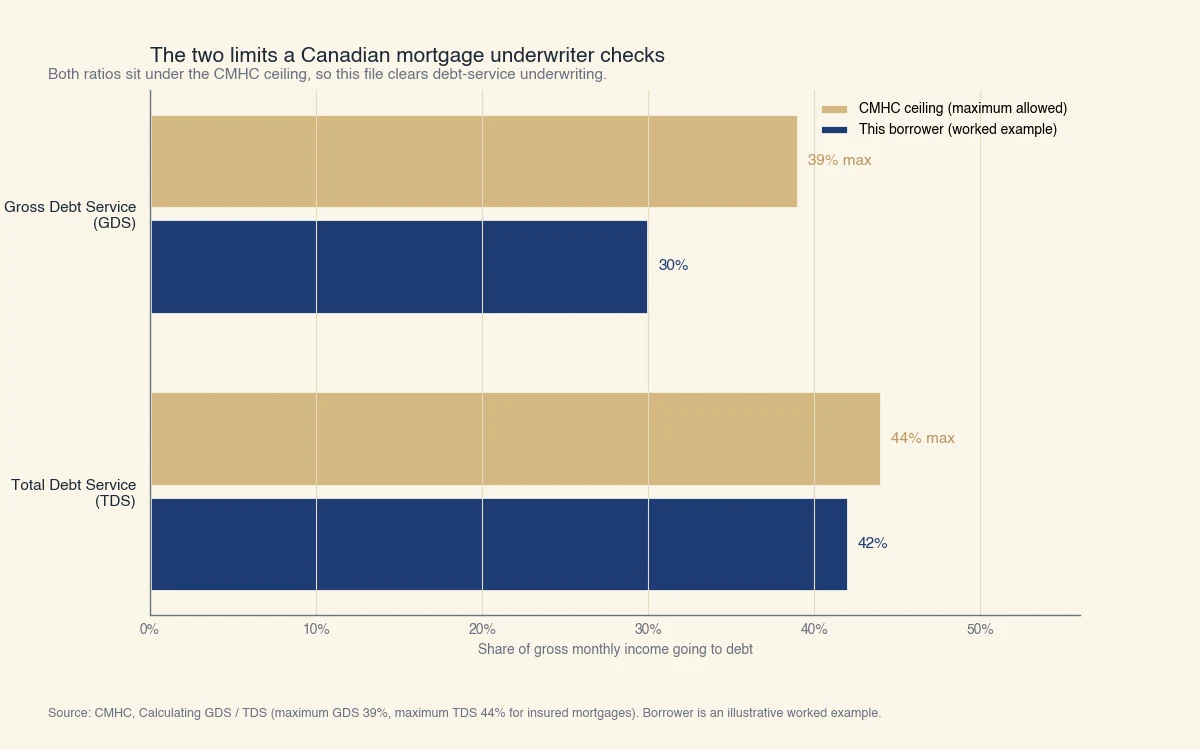
A Canadian mortgage underwriter tests whether you could afford the payment at a higher rate than the one you will pay, and keeps two debt ratios under set limits. For an insured mortgage, CMHC caps your housing costs at 39% of gross income, the gross debt service (GDS) ratio, and all your debt payments at 44%, the total debt service (TDS) ratio (CMHC, GDS and TDS). Housing costs are the mortgage payment, property tax, heating and half of any condo fees. For uninsured mortgages, B-20 leaves each lender to set its own debt-service limits in its mortgage policy.
The higher rate is the minimum qualifying rate, also called the stress test: the greater of your contract rate plus 2 percentage points or 5.25%. CMHC applies it to insured mortgages (CMHC), and OSFI requires it for uninsured mortgages at federally regulated lenders (OSFI, minimum qualifying rate).
What does a mortgage decision look like in numbers?
Here is one insured buyer who passes at the rate they would pay and fails at the qualifying rate. The buyer earns $90,000 a year, or $7,500 a month before tax. They want a $350,000 insured mortgage over 25 years at 4.29%, the Bank of Canada's June 2026 reading for a five-year fixed high-ratio mortgage, one with less than 20% down (Bank of Canada data). Property tax is $325 a month and heating $100. They also pay $450 a month on a car loan and $150 on a credit card.
| Monthly figures | At the contract rate (4.29%) | At the qualifying rate (6.29%) |
|---|---|---|
| Mortgage payment | $1,896.51 | $2,300.01 |
| Housing costs (payment, tax, heat) | $2,321.51 | $2,725.01 |
| GDS ratio (limit 39%) | 31.0% | 36.3% |
| Housing costs plus $600 of other debts | $2,921.51 | $3,325.01 |
| TDS ratio (limit 44%) | 39.0% | 44.3% |
The payments use semi-annual compounding, the Canadian convention for fixed-rate mortgages.
At the rate the buyer would pay, the file clears both limits. At the qualifying rate, the TDS ratio lands at 44.3%, just over the limit, so the file fails as submitted. The underwriter does not have to decline it. They can approve it with a condition: if the buyer pays off the car loan before closing, the TDS ratio at the qualifying rate falls to 38.3% and the file passes. Borrowing about $346,000 instead of $350,000 would also bring the TDS ratio down to the 44% limit.
What steps does an underwriter follow?
- Verify the documents. Identity, pay stubs or tax returns, an employment letter, and bank statements showing where the down payment came from.
- Read the credit history. Missed payments, balances and recent new credit all count. The credit rating you need for a mortgage has its own page.
- Run the ratios at the qualifying rate. GDS and TDS, as in the example above.
- Value the property. An appraisal or an automated valuation checks the price against the loan.
- Decide. Approve, approve with conditions, or decline. An insured file also needs the insurer's approval.
The mortgage affordability calculator runs your own numbers through the same qualifying rate and ratio limits.
Do these rules change who gets a mortgage?
The stress test changed who gets a mortgage: each time it reached a new group of borrowers, the share of new mortgages going to the most stretched of them fell within two quarters. The Bank of Canada tracks the share of new mortgages worth more than 4.5 times the borrower's gross income, the measure it uses "to identify the most vulnerable households" (Bank of Canada, financial stability indicators). The test was extended to every high-ratio insured mortgage on October 17, 2016, and to low-ratio insured mortgages on November 30, 2016 (Department of Finance). It reached uninsured mortgages at federally regulated lenders on January 1, 2018 (OSFI, revised B-20).
Source: Bank of Canada, financial stability indicators (household debt): share of new mortgages with a loan-to-income ratio above 450%, Q1 2014 to Q1 2026. Uninsured from Q1 2024: enhanced dataset (RESL2).
The insured share fell from 20.5% in the fourth quarter of 2016 to 9.1% two quarters later. The uninsured share fell from 19.1% in the fourth quarter of 2017 to 13.4% in the second quarter of 2018. A 2024 Bank of Canada staff analysis estimated that 26% of the high-ratio mortgages issued in the year before October 2016 would have failed the new test. It also found smaller increases in mortgage delinquency, the share of borrowers behind on their payments, in 2022 and 2023 in the areas where the 2016 rule had affected more borrowers (Bank of Canada staff note 2024-25).
The later swings follow interest rates. The qualifying rate moves with the contract rate, so when rates rose in 2022 the same income carried a smaller loan. From the second quarter of 2023 to the third quarter of 2024, fewer than 1% of new insured mortgages exceeded 4.5 times income. As rates came down, the insured share climbed back to 14.9% in the first quarter of 2026.
OSFI has also given each federally regulated lender, since the start of its 2025 fiscal year, its own cap on the volume of new uninsured mortgages above 4.5 times income (OSFI, loan-to-income limits). The cap applies to the lender's whole portfolio, and OSFI is explicit: "These limits do not apply to individual borrowers or transactions" (OSFI, November 2024). For a single file, the qualifying rate and the two ratios still carry the decision.
What do people get wrong about underwriters?
Three beliefs about underwriters trip up borrowers: that a pre-approval is an approval, that a good credit score is enough, and that software makes the decision. Each one runs against how the rules work.
Is a pre-approval the same as an approval?
A pre-approval is an estimate. FCAC puts it plainly: "This process does not guarantee your approval for a mortgage," and "A lender could refuse you for a mortgage even if you've been preapproved" (FCAC). The pre-approval rests on what you reported before you chose a home. The underwriter decides later, on verified documents and on the property itself, so a new car loan, a change of job or an appraisal below the price can change the answer. If your file is with an underwriter now, whether to worry about underwriting covers what triggers a decline.
Is a good credit score enough?
A strong score answers one of the underwriter's questions and leaves the others open. B-20 treats a borrower's willingness to repay and their capacity to repay as separate principles, each assessed on its own (B-20 principles 2 and 3). The buyer in the worked example could have a spotless credit history and still fail with a 44.3% TDS ratio at the qualifying rate.
Does software make the decision?
Software screens many files, and the institution keeps the responsibility for the answer. CMHC describes its emili system as "Canada's leading online decision system for mortgage loan insurance", weighing the borrower, the property, the market and the overall risk (CMHC, emili). OSFI still expects a mortgage insurer to keep responsibility for approving or denying insurance, and B-20 keeps the lender's own underwriting in place even on an insured loan. Whatever tool screens the file, an institution answers for the decision.