

The only mechanism that updates a United States credit file in days rather than weeks is a rapid rescore, and only a lender can order one. Every other fix runs on a clock you cannot compress: a credit bureau has 30 days to investigate a dispute, and a paid-down credit card balance reaches the bureaus when your issuer reports at the end of your billing cycle.
That distinction is missing from most advice on this question, and it is the whole answer. "Quickly" is not one speed. It is five different clocks, three of them written into federal law and one of them set by the date your statement closes.
| What you do | When it can show up | Who controls the timing | What it cannot do |
|---|---|---|---|
| Lender orders a rapid rescore | 2 to 5 business days | Your mortgage or auto lender | Change anything that has not already happened |
| Pay a card down before the statement closes | Days, once the issuer reports | Your card issuer's cycle date | Help if you pay after the cycle closes |
| Dispute an inaccurate item | Up to 30 days, 45 with added documents | The credit bureau, by statute | Remove information that is accurate |
| Add rent or utility payments to a file | Days to weeks | The reporting service and the bureau | Guarantee a lender's model will use it |
| Wait out an accurate late payment | 7 years | Nobody | Be accelerated by anyone, for any fee |
Two things follow from that table. First, if you are mid-application on a mortgage or an auto loan, you have access to a tool you cannot use at any other time. Second, if someone offers to remove accurate negative information faster than seven years, the offer is not real.
A rapid rescore is a lender-initiated request that asks a credit bureau to process documented account changes in two to five business days instead of waiting for the next monthly reporting cycle. Experian describes the window as "often completed within two to five days" and contrasts it with normal credit reporting, which it puts at 30 to 60 days (Experian).
The mechanics are simple. You pay down a card, settle a collection, or resolve a reporting error with the business that furnished it. You give your loan officer the proof: a payoff letter, a zero-balance statement, a correction confirmation. The lender submits that documentation to the bureau and pays a fee to have the file updated immediately, then pulls a fresh score.
Three facts about rapid rescore are worth knowing before you ask for one.
- You cannot start it yourself. Experian states that rapid rescores can only be requested by your mortgage lender and that you cannot initiate the process on your own. The bureaus sell the service to lenders with credit-reporting access, not to consumers.
- You cannot be billed for it. The lender absorbs the fee and is not permitted to pass it to you directly. That restriction follows from the Fair Credit Reporting Act, which requires a credit bureau to "free of charge, conduct a reasonable reinvestigation" when a file is disputed (15 U.S.C. 1681i). Experian notes the cost can still reach you indirectly, through closing costs or pricing.
- It accelerates reporting, not forgiveness. A rapid rescore moves a change that has already happened onto your file sooner. It cannot delete an accurate late payment, shorten a seven-year retention period, or invent payment history you do not have.
Ask when all three of these are true: you are inside an active application, a documented change has already occurred, and a small score increase would change your pricing or your approval.
The three changes that qualify most often:
- A revolving balance you just paid down. This is the most common trigger, because utilization responds immediately to a balance change and the documentation is a single statement.
- A collection you paid or settled. The account stays on the report, but showing a zero balance can matter to some scoring models and to some lender overlays.
- An error the furnisher has already agreed to correct. If the business that reported the item has confirmed the correction in writing, a rapid rescore posts it without waiting out the full 30-day reinvestigation.
Say so directly to your loan officer: "I paid this balance to zero on the 3rd and I have the statement. Is a rapid rescore worth ordering before we lock?" They will know whether the expected score movement justifies it.
It cannot remove accurate negative information, it cannot be ordered without a live application, and it does not guarantee a higher score. Experian is explicit that a rapid rescore does not guarantee improvement, because scores depend on several factors at once. If your file is dominated by a recent charge-off, clearing a $400 card balance will not rescue it.
Your total payment sets your overall utilization, but where you put that payment decides how many cards still report near their limit. Credit utilization is the share of your revolving credit limits you are currently using, and the Consumer Financial Protection Bureau notes that scoring models look at how close you are to being maxed out and advises keeping use at no more than 30 percent of your total limit (CFPB).
Here is the arithmetic on a real allocation decision. Three cards, $14,000 in total limits, $8,400 reported across them, and $4,200 available to pay.
| Card | Credit limit | Balance now | Utilization now | Payment applied | Balance after | Utilization after |
|---|---|---|---|---|---|---|
| Card A | $1,500 | $1,450 | 97% | $1,450 | $0 | 0% |
| Card B | $4,500 | $1,350 | 30% | $0 | $1,350 | 30% |
| Card C | $8,000 | $5,600 | 70% | $2,750 | $2,850 | 36% |
| Total | $14,000 | $8,400 | 60% | $4,200 | $4,200 | 30% |
Overall utilization falls from 60% to 30%, and the highest single card falls from 97% to 36%.
Now spend the identical $4,200 a different way. Pay half of every balance: $725 against Card A, $675 against Card B, $2,800 against Card C. Overall utilization still lands at exactly 30%, because the total paid is the same. But Card A now reports $725 against a $1,500 limit, which is 48%. The same money, the same overall ratio, and one card still reporting near half its limit.
That is the practical rule the arithmetic gives you: pay the total you can afford, then aim it at the card sitting closest to its limit rather than spreading it evenly. If you want the fuller picture of what else moves a score in either direction, our page on why your credit score dropped covers the other factors.
A paid-down balance reaches the credit bureaus when your card issuer reports, which is normally once a month at the close of your billing cycle, so the same payment can post in days or wait a full month depending on the date you make it. This is the step almost every "fix your credit fast" article skips, and it is the difference between a fix that lands before your lender pulls your file and one that lands after.
Take a card whose statement closes on the 12th.
- Pay $4,200 on the 3rd. The issuer reports the balance as of the 12th, and the bureaus post the new figure within a few days of that. Your lower utilization is visible around the 15th.
- Pay the same $4,200 on the 14th. The cycle already closed with the old balance. Your $8,400 reports, and the corrected figure waits for the next close on the 12th of the following month, roughly 30 days later.
- Pay on the 14th with a rapid rescore. Your lender submits the payoff documentation and the bureau processes it in two to five business days, skipping the wait entirely.
The statutory clocks work the same way. When you dispute an item, the bureau must complete its reinvestigation within "the 30-day period beginning on the date on which the agency receives the notice of the dispute," and that window "may be extended for not more than 15 additional days" if you send relevant information during the original 30 days (15 U.S.C. 1681i). The same section requires the bureau to notify the business that furnished the disputed item before the end of a five-business-day period.
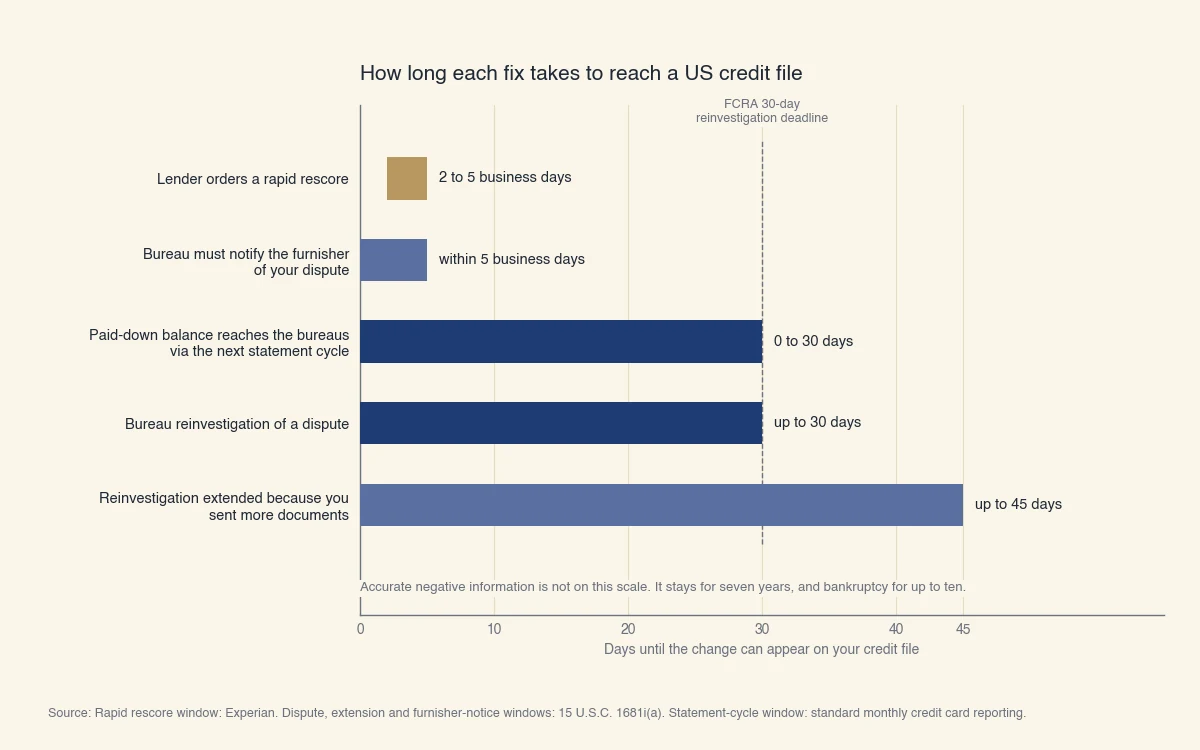
Source: Rapid rescore window per Experian. Dispute, extension and furnisher-notice windows per 15 U.S.C. 1681i(a). Statement-cycle window reflects standard monthly credit card reporting.
Read the chart as a planning tool. If your lender pulls credit in ten days, a dispute will not be resolved in time and a rapid rescore might be. If your closing is six weeks out, the dispute route fits comfortably inside the window. How much room you actually have depends on how long underwriting takes for a home loan, which sets the real deadline for every fix on this page.
Anything inaccurate can be fixed on a statutory clock, anything about your current balances can be fixed within a billing cycle, and anything accurate and negative stays for seven years regardless of what you pay anyone. The Federal Trade Commission puts it plainly in its guidance on fixing credit: no one promising to repair your credit can legally remove information if it is both accurate and current (FTC).
What responds quickly:
- Reported balances. The fastest self-serve lever, bounded by your statement cycle.
- Genuine errors. Accounts you did not open, balances already paid, late payments you made on time. Disputes are free and run on the 30-day clock.
- Available credit. A limit increase lowers utilization the same way a payment does, without requiring cash. Ask the issuer whether it triggers a hard inquiry first.
- Thin-file gaps. Rent and utility reporting services, secured cards and credit-builder loans add positive data, though a given lender's model may or may not read it.
What does not respond quickly:
- Accurate late payments, charge-offs and collections. The CFPB confirms most negative information stays for seven years and bankruptcy for up to ten (CFPB).
- Length of credit history. Only time adds age.
- A pattern of missed payments. One good month does not offset a year of them.
Start by reading the file. All three nationwide bureaus permanently extended free weekly access at AnnualCreditReport.com, so checking costs nothing. Write to both the credit bureau and the business that supplied the information, since the FTC notes both are responsible for correcting inaccurate or incomplete entries. Keep the correspondence, because the five-business-day furnisher notice and the 30-day reinvestigation clock both start from the date the bureau receives your dispute.
The FTC's answer is direct: anything a credit repair company can do legally, you can do for yourself for little or no cost. Federal rules also bar these companies from charging you before they deliver, require a written contract stating the services and total cost, and give you three days to cancel at no charge. A company that asks for payment up front, tells you not to contact the bureaus, or tells you to dispute information you know is accurate is describing a scam rather than a service.
That last point deserves emphasis, because the search results for this question are unusually commercial. Of the five pages currently ranking highest for it, three are attached to a product being sold. The genuinely fast tool on this page, the rapid rescore, is the one nobody is selling you, because it is only available through a lender who is already working on your file.
At Sphera Credit we build credit decisioning infrastructure for lenders, and the reporting clocks described here are the same ones our systems read on the other side of the application. A file is a snapshot with a timestamp, not a live feed. Knowing when yours was last written is often worth more than one more month of good behaviour on it.