

What is a perfect credit rating?
Three different systems in Canada are all called a "credit rating," and "perfect" means something different in each one: R1 on an individual account, 900 on your overall score, and AAA for a government or corporate issuer. Only the first two describe a person. The third describes a bond.
That overlap is why the question is confusing. A Canadian who reads an American article learns that perfect means 850, then hears their bank mention an R1, then sees a news story about Canada holding a AAA rating. All three statements are correct. None of them is about the same thing.
| System | Who it applies to | What "perfect" is | Who assigns it |
|---|---|---|---|
| Account rating codes | One credit account you hold | R1, I1, O1 or M1 | Your lender, reported to Equifax and TransUnion |
| Consumer credit score | You, as a whole file | 900 | Equifax Canada and TransUnion Canada |
| Agency letter grades | Governments, corporations, bond issues | AAA | Morningstar DBRS, S&P Global Ratings, Moody's, Fitch |
The practical answer for almost everyone reading this: your credit report carries an account code for each product you hold, and a separate three-digit score from 300 to 900 that summarizes the whole file (FCAC). Chasing "perfect" on the first is easy and largely pointless. Chasing it on the second is hard and also largely pointless. The sections below explain why.
Is a perfect R1 credit rating actually rare?
No. An R1 only certifies that you paid within 30 days of the due date, and roughly 95% of Canadian credit consumers cleared that bar last quarter. It is the normal state of an account in good standing, not a distinction.
An account rating is the code your lender reports each month for one specific product. The letter names the type of credit and the number describes how you paid it: R for revolving credit such as a card, I for installment credit such as a car loan, O for open credit, and M for a mortgage (Consolidated Credit Canada). So a credit card paid as agreed reports as R1, a car loan paid as agreed as I1, and a mortgage in good standing as M1.
The number scale is published by the Financial Consumer Agency of Canada as the North American Standard Account Ratings. R0 means the account is too new to rate. R1 means paid within 30 days of the due date, or not more than one payment past due. Each higher number adds roughly another 30 days of lateness, up to R9 for a debt written off, sent to collections, or included in a bankruptcy. R7 sits outside that ladder and flags a formal repayment arrangement such as a consumer proposal. Our guide to what an excellent credit rating means sets out the full R0 to R9 table.
Here is the part no one tells you. Equifax Canada reported that 1.5 million Canadians, about 1 in 21 consumers, missed at least one credit payment in the first quarter of 2026, while the national 90-day non-mortgage balance delinquency rate sat at 1.77% and the equivalent mortgage figure at 0.28% (Equifax Canada).
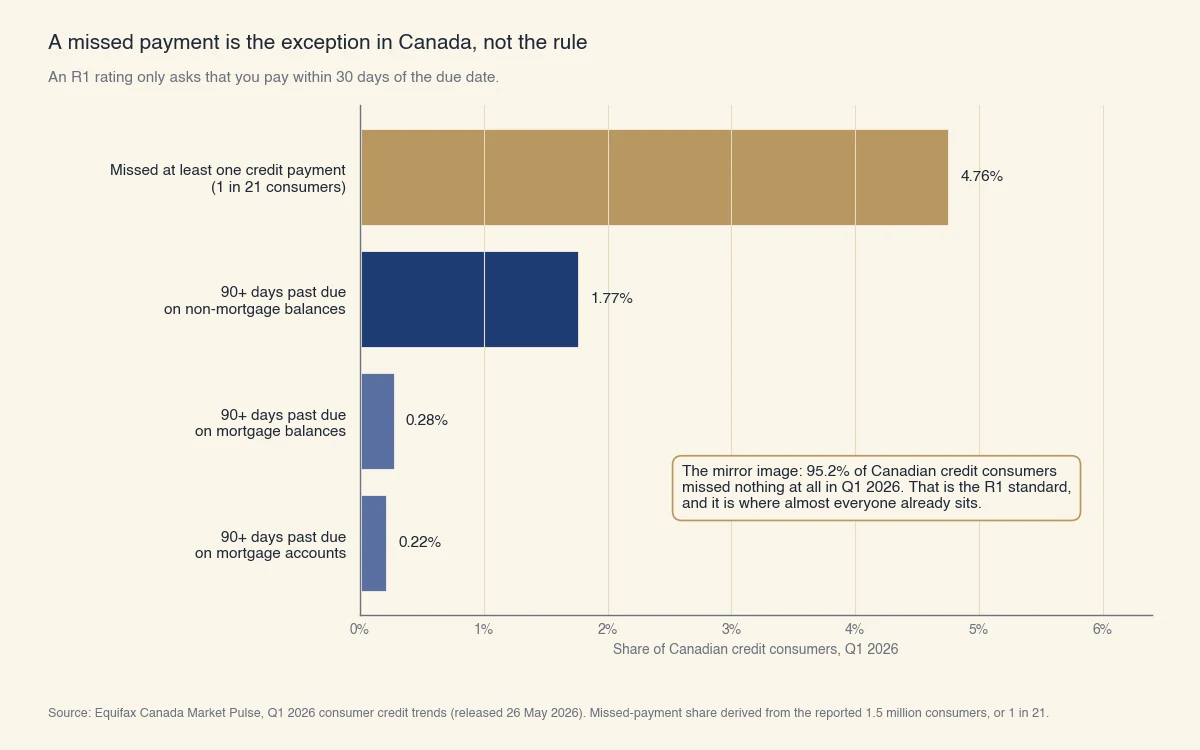
Source: Equifax Canada Market Pulse, Q1 2026 consumer credit trends (released 26 May 2026). Missed-payment share derived from the reported 1.5 million consumers, or 1 in 21.
Read the chart the other way around and the point lands: about 95 in every 100 Canadian credit consumers missed nothing at all. If you pay your bills, you almost certainly already hold an R1 on every account you have. There is no higher code to reach for, and no lender treats R1 as a badge, because nearly everyone has one.
Does a perfect rating on every account give you a perfect credit score?
No, and this is the costliest misunderstanding in the whole topic. Payment history drives roughly 35% of a credit score, so an R1 on every account leaves about 65% of your score untouched. A flawless payment record and a maxed-out credit card produce a mediocre score at the same time, with no contradiction.
Equifax and TransUnion build the three-digit score from five inputs, weighted approximately as follows (Equifax Canada, TransUnion Canada):
- Payment history, about 35%. Whether you paid on time. This is the input your account codes report.
- Amounts owed, about 30%. Credit utilization is the share of your available credit you are currently using. Under 30% is generally safe, and under 10% is better.
- Length of credit history, about 15%. The average age of your accounts.
- Credit mix, about 10%. A blend of revolving and installment credit.
- New credit, about 10%. Recent applications and newly opened accounts.
Your R1 codes speak to the first line only. Consider two borrowers. The first has an R1 on all four of her accounts, opened them eighteen months ago, and carries balances at 85% of her limits. The second has one four-year-old R2 from a single late payment, holds six-year-old accounts, and sits at 6% utilization. The second borrower will score materially higher despite the blemish, because the 30% utilization input and the 15% history-length input both run in his favour while the first borrower's perfect payment record is the only thing working for her.
The takeaway is a change of target. If you already pay on time, your payment history is finished business and cannot improve further. Every additional point has to come from the other 65%. Paying a card down before the statement date, keeping an old account open rather than closing it, and spacing out applications are the levers that still move. Our guide to improving a credit score in Canada works through each one.
Reaching the actual ceiling of 900 is a separate matter and worth far less than it sounds. We cover how rare it is and whether it is worth pursuing in what is the highest credit score in Canada.
What is a AAA or BBB credit rating, and can a person get one?
AAA is the top grade on the long-term scale that credit rating agencies apply to governments, corporations and bond issues, and no individual person can receive one. If you searched for a AAA, BBB or "A" credit rating expecting to find where you sit, this scale is not measuring you.
Agencies such as Morningstar DBRS, S&P Global Ratings, Moody's and Fitch Ratings assess the risk that an issuer fails to meet its financial obligations. The long-term obligations scale runs from AAA, the highest credit quality, down to D, meaning default or imminent default (Morningstar DBRS).
The dividing line that matters most is between investment grade and speculative grade:
| Band | Grades | What it signals |
|---|---|---|
| Investment grade | AAA, AA, A, BBB | From exceptionally high capacity to pay, down to adequate capacity that is more exposed to a downturn |
| Speculative grade | BB, B, CCC, CC, C | Increasing vulnerability to default, often called high yield or junk |
| Default | D | Default has occurred or is imminent |
BBB is therefore the lowest rung of investment grade, not a poor rating. Many large, stable companies sit there. Categories from AA down to CCC are further split with (high) and (low) modifiers, so AA (low) sits just below AA and just above A (high). A grade with no modifier sits in the middle of its category.
Two things follow for a consumer. First, an agency grade and a consumer score are not convertible: there is no arithmetic that turns a 780 into an "A." Second, sovereign ratings you read about in the news are ratings of a country's debt, not an aggregate of its residents' credit. We cover that separately in what is Canada's credit rating.
Should you chase a perfect credit rating?
Not past a point. Hold an R1 on every account because it costs nothing, and stop optimizing your score once you are comfortably inside the top band, because lenders price from tiers rather than from exact numbers. The last stretch toward 900 buys almost nothing.
What is worth doing:
- Pay every account on time, every month. One payment 30 days late converts an R1 into an R2 and can cost a large number of points. Automatic minimum payments are the cheapest insurance available.
- Keep utilization low, and pay before the statement date. The bureau sees the balance reported on your statement, not the balance after you pay. Paying early lowers the number that gets reported.
- Leave old accounts open. Closing a long-held card shortens your average account age and removes its limit from your utilization calculation, which pushes the ratio up.
- Space out applications. Each hard inquiry sits in the 10% new-credit input, and a cluster of them in a short window reads as strain.
- Check your own report at least once a year. Checking your own file is a soft inquiry and does not affect your score. Errors are common, and a wrongly reported R-code is worth disputing.
What is not worth doing: paying a service to chase the final points toward 900, carrying a small balance in the belief that it builds credit, or treating an R1 as an achievement to protect at the cost of a sensible financial decision. The score is a gate, and once you are through the gate the number stops mattering.
If you want to see where the tiers actually sit and what each one unlocks, what is a good credit score in Canada lays out the bands and the products they open.