

Three different things in Canada are called a credit rating, and each has its own ceiling: R1 on an individual account, 900 on your overall consumer score, and AAA for a government or corporate issuer. Which one answers your question depends on whether you are looking at one account, at yourself as a whole, or at a bond.
The confusion is reasonable. A Canadian reading an American article learns the top is 850, then sees an R1 on a credit report, then reads a news story about Canada holding a AAA rating. All three are accurate. None describes the same thing.
| Scale | What it rates | The highest value | Who assigns it |
|---|---|---|---|
| Account rating codes | One credit account you hold | R1 (also I1, O1, M1) | Your lender, reported to Equifax and TransUnion |
| Consumer credit score | You, as a complete file | 900 at Equifax Canada | Equifax Canada, TransUnion Canada |
| Agency letter grades | Governments, corporations, bond issues | AAA | Morningstar DBRS, S&P Global Ratings, Moody's, Fitch |
For almost everyone reading this, the first two rows are the relevant ones. Your credit report carries a rating code for each product you hold plus a separate three-digit score that summarizes the whole file (FCAC). The third row belongs to a different market entirely, and the section below shows how few Canadian institutions actually reach the top of it.
The highest consumer credit score in Canada is 900 on the Equifax Canada scale, which runs from 300 to 900. That ceiling is real but almost nobody touches it, and reaching it changes nothing about what a lender offers you.
Two details complicate the single number:
- TransUnion Canada tops out at 832, not 900, so the same borrower can look like an 812 at one bureau and a 795 at the other and be equally strong at both (TransUnion Canada).
- FICO-based scores top out at 850. Many Canadian lenders buy a FICO-family score rather than the free consumer score you see, and those models use the 300 to 850 range (myFICO).
Where the score sits matters far more than how close it is to the ceiling. Equifax Canada groups scores into bands, and the top band opens well below 900 (Equifax Canada):
| Band | Range | What lenders do with it |
|---|---|---|
| Excellent | 760 - 900 | Best advertised rates and terms |
| Very good | 725 - 759 | Nearly all prime products available |
| Good | 660 - 724 | Mainstream qualification range |
| Fair | 560 - 659 | Limited prime options, alternative lenders likely |
| Poor | 300 - 559 | Secured or subprime products only |
Our guide to the highest credit score in Canada goes deeper on how rare the 900 ceiling actually is.
On the account codes printed in your credit report, R1 is the highest rating, and it means you paid within 30 days of the due date or are not more than one payment past due. Unlike the 900 score, this ceiling is reachable on every account you hold.
The letter names the type of credit and the number describes how you paid it (Consolidated Credit Canada):
- R for revolving credit, such as a credit card or line of credit
- I for instalment credit, such as a car loan with fixed payments
- O for open credit, such as a charge account settled in full each month
- M for a mortgage
The number runs from 0 to 9 on the North American Standard Account Ratings published by the Financial Consumer Agency of Canada. R0 means the account is too new to rate. Each step up the number adds roughly another 30 days of lateness, R7 flags a formal repayment arrangement such as a consumer proposal, and R9 marks a debt written off, sent to collections or included in a bankruptcy (FCAC). The same ladder applies to the other letters, so a car loan paid on time reports as I1 and a mortgage in good standing as M1. Our guide to what an excellent credit rating means sets out the full R0 to R9 table.
The important point about R1 is how ordinary it is. It certifies that you paid on time, nothing more, and the large majority of Canadian credit consumers already hold one on every account. It is the normal condition of an account in good standing rather than a distinction, as our guide to a perfect credit rating explains with the delinquency data.
On the agency scale, AAA is the top grade, and in Canada only the federal government holds it. Not one Canadian bank does. This is the sense of "highest credit rating" that news coverage usually means, and it is the one consumer articles almost never explain.
The Government of Canada carries AAA from Moody's, S&P Global Ratings and Morningstar DBRS, and AA+ from Fitch, making Canada one of only two AAA-rated G7 countries (Department of Finance Canada). A AAA rating signals an extremely strong capacity to meet financial commitments and the lowest credit risk on the scale (Morningstar DBRS).
The country's largest banks, all of them strongly capitalized institutions, still sit below that ceiling:
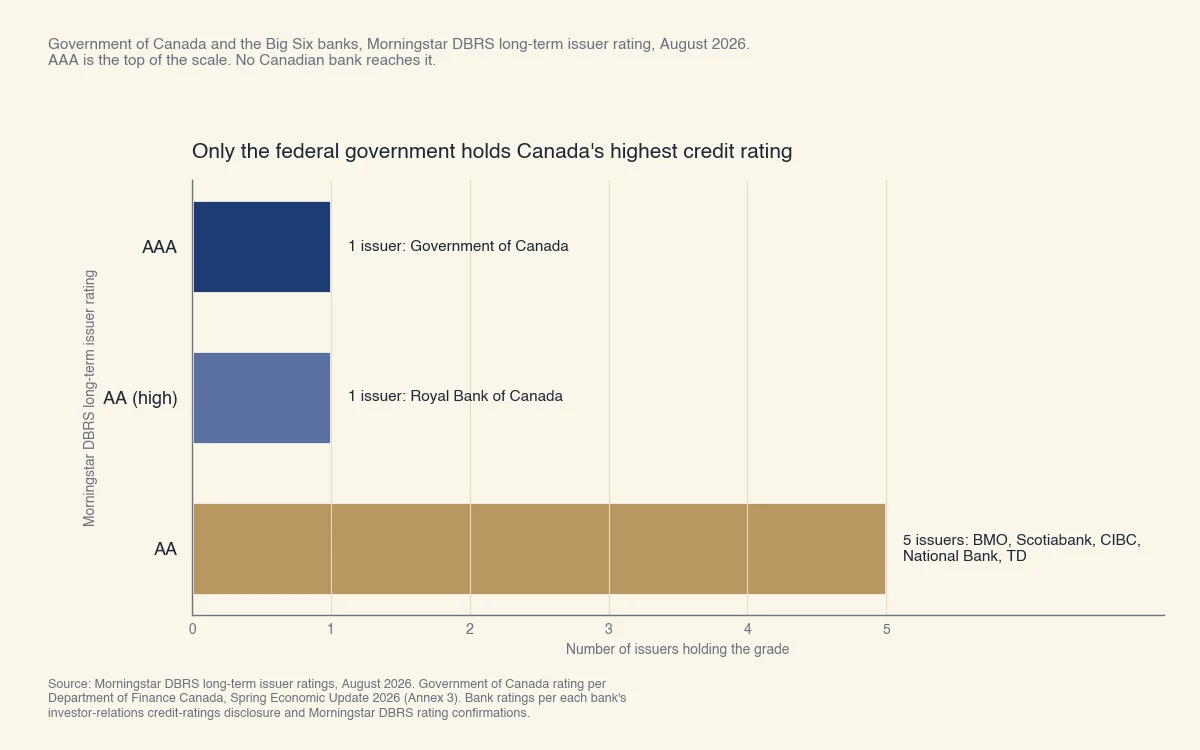
Source: Morningstar DBRS long-term issuer ratings, August 2026. Government of Canada rating per Department of Finance Canada, Spring Economic Update 2026 (Annex 3). Bank ratings per each bank's investor-relations credit-ratings disclosure and Morningstar DBRS rating confirmations.
Royal Bank of Canada holds an issuer rating of AA (high), one notch below the top, and Bank of Montreal, Scotiabank, CIBC, National Bank of Canada and Toronto-Dominion Bank each hold AA, two notches below. The gap exists because a sovereign that issues its own currency and taxes a diversified economy carries a different kind of risk than a commercial lender, however well run.
Two things follow for a consumer. First, AAA is not a rating an individual can hold, so any service offering to get you one is not describing Canadian consumer credit. Second, the agency scale is a useful reminder that even the strongest issuers rarely sit at the ceiling, which is exactly the pattern that holds on the consumer scale too.
Aiming for 900 is the wrong goal, because Canadian lenders price from bands rather than exact scores, and the top band opens at 760. Every point you earn above that threshold changes your borrowing cost by nothing at all.
Look at the arithmetic on the Equifax scale. The scale spans 600 points, from 300 to 900. The excellent band begins at 760. That leaves 140 points, roughly 23% of the entire range, sitting above the level where lender pricing stops improving. A borrower at 765 and a borrower at 890 are quoted the same rate on the same mortgage, because both land in the same band on the same rate sheet.
The money is in the bands below. Moving from the good band into the excellent band is what changes your rate, and on a large mortgage that single move is worth a six-figure difference in total interest over the amortization, as our breakdown of what an excellent credit rating is worth sets out in dollars. The mortgage amortization calculator puts your own balance and rate through the same comparison.
So the two ceilings behave in opposite ways:
- The 900 ceiling is unreachable and pays nothing. Almost no one gets there, and lenders do not reward the attempt.
- The R1 ceiling is reachable and matters. A single missed payment turns an R1 into an R2, and that one code can push a file out of prime eligibility, cost you the band you worked to reach, and stay on your report for about six years.
The practical target is not a number. It is an R1 on every account you hold and a score inside the top band, which for most Canadians means somewhere between 760 and 800 rather than anywhere near 900.
You reach the top band the same way you keep it: pay every account on time, keep card balances low, and let your accounts age. Payment history and amounts owed dominate the calculation, so the two habits that matter most are also the two that are easiest to name (FCAC).
- Pay on time, every time. This is what produces the R1 on each account. Automatic minimum payments protect the code even in a month you cannot pay in full.
- Keep utilization low. Using under 30% of each card's limit is the common guidance, and staying under 10% is better. This is the fastest lever, because balances update monthly.
- Leave old accounts open. Closing your oldest card shortens your credit history and can cost you points for no gain.
- Space out applications. Each hard inquiry from a new application takes a small bite, and several in a short window compound.
- Check your report for errors. A misreported late payment turns an R1 into an R2 on paper. Both Equifax Canada and TransUnion Canada must investigate a dispute you file.
Time does the rest. A file that is paid on time and lightly used drifts into the top band on its own, usually within 12 to 24 months from a fair starting point. There is no faster route, and no service can lawfully remove accurate negative information.
For lenders, this is also why a single score is a blunt instrument. A borrower sitting at 745 with an R1 on every account and a thin file is a very different risk from a borrower at 745 carrying an R2 from last quarter. Sphera Credit builds AI agents that read the underlying credit behaviour rather than stopping at the three-digit summary, so files that fall outside a rigid credit-box rule still get an accurate, explainable decision.