

What credit score is needed for a HELOC?
Most lenders publish a minimum credit score of 620 for a home equity line of credit, but 680 is the score at which mainstream lenders are genuinely comfortable, and 740 or above is where the best pricing starts. Experian reports that most lenders look for a FICO Score of at least 680, with some requiring 720 for their strongest offers.
A HELOC is an open-end line of credit secured by your home. The Consumer Financial Protection Bureau describes it as a line "that allows you to borrow repeatedly against your home equity," with a draw period that "could last 10 years" followed by a repayment period in which monthly payments are "often significantly higher."
Here is how the score bands actually behave in the market:
| FICO score | What it means for a HELOC | Realistic outcome |
|---|---|---|
| 760 and above | Best available pricing | Approved at the lowest margin over prime |
| 720 to 759 | Strong file | Approved by nearly all lenders, near-best pricing |
| 680 to 719 | The practical bar | Approved by most mainstream lenders |
| 660 to 679 | Thin but workable | Fewer lenders, higher margin, more conditions |
| 620 to 659 | The published floor | Few approvals, high margin, strong equity required |
| Below 620 | Outside most credit policies | Cash-out refinance or home equity loan instead |
The credit score is only one of four gates. You also need equity, a manageable debt load, and documented income. Miss any one of them and a strong score will not rescue the application.
Why is the advertised 620 minimum misleading?
The 620 figure is a credit-policy floor published by lenders who profit when you apply, not a description of who actually gets approved. The gap between the advertised floor and the operative bar comes from one structural fact: a HELOC sits in second-lien position, meaning that if the home is foreclosed and sold, the first-mortgage holder is repaid in full before the HELOC lender receives a single dollar.
That changes the shape of the lender's risk. A first-mortgage lender in a default usually recovers most of the loan from the sale. A second-lien lender frequently recovers nothing at all, because the first mortgage absorbs the proceeds. When a lender's downside is closer to all-or-nothing, it compensates by demanding a stronger borrower rather than by charging a slightly higher rate.
You can see the consequence in the market data. The Federal Reserve Bank of New York publishes total HELOC credit limits and balances every quarter in its Household Debt and Credit Report, built from the New York Fed Consumer Credit Panel and Equifax data.
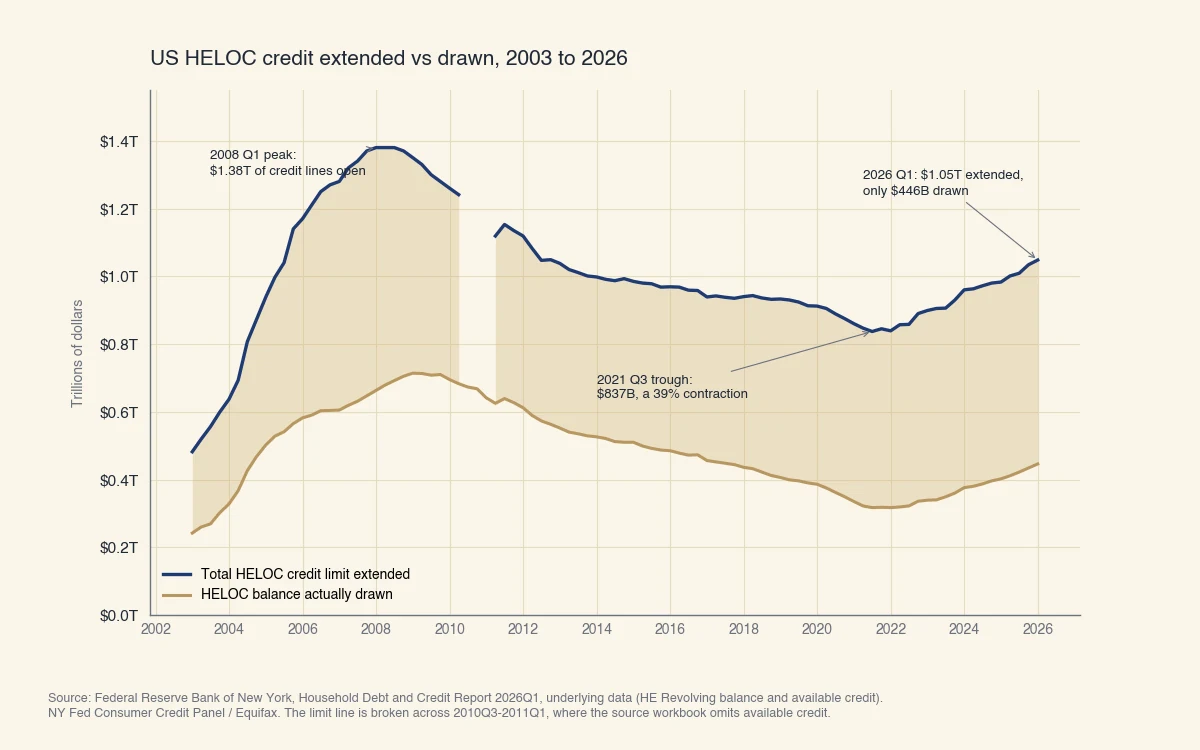
Source: Federal Reserve Bank of New York, Household Debt and Credit Report 2026 Q1, underlying data (HE Revolving balance and available credit). NY Fed Consumer Credit Panel / Equifax.
Aggregate HELOC credit lines peaked at $1.38 trillion in the first quarter of 2008, contracted by 39% to $837 billion by the third quarter of 2021, and have since recovered to $1.05 trillion. Eighteen years after the peak, lenders still extend less HELOC credit than they did in 2008, even though home values and total mortgage debt are far higher.
The published minimum did not move much across those two decades. Lender appetite did. That is the real reason a 620 applicant struggles: nothing in the rulebook forbids the loan, but very few lenders want it.
Two related beliefs are worth correcting directly:
- "I meet the minimum, so I will be approved." Meeting a published minimum makes you eligible to be considered. It does not make you approvable. Equity, debt-to-income, and income documentation are evaluated together, and a borderline score raises the bar on all three.
- "A HELOC is easier than a mortgage because the amount is smaller." The opposite is usually true at the same score. Second-lien position, not loan size, drives the underwriting standard. That standard also sets the clock, so plan on the same review window as how long underwriting takes for a home loan.
What else do HELOC lenders require?
Beyond the score, lenders check three things: how much equity you keep after borrowing, how much of your income is already committed to debt, and whether your income is documented and stable. All three carry roughly equal weight with the score.
How much equity do you need?
Lenders generally require you to retain 15% to 20% equity after the line is drawn, which caps your combined loan-to-value ratio (all mortgage debt divided by the home's appraised value) at 80% to 85% (Experian).
A worked example on a home appraised at $500,000 with an 85% cap:
- Appraised value: $500,000
- Maximum combined debt at 85% CLTV: $425,000
- Existing first mortgage: $310,000
- Available HELOC line: $425,000 minus $310,000 = $115,000
Drop the cap to 80%, which is what a borderline credit score often triggers, and the same borrower gets $400,000 minus $310,000, or $90,000. A weaker score costs this borrower $25,000 of borrowing capacity before anyone discusses the interest rate.
What debt-to-income ratio do lenders accept?
Lenders typically prefer a debt-to-income ratio (monthly debt payments divided by gross monthly income) of 43% or less, and some stretch to 50%. One detail catches applicants out: many lenders underwrite the payment on your entire approved line, not on the amount you intend to draw. A $115,000 line you never touch can still be treated as a monthly obligation.
Do the rules change by state?
Yes, and Texas is the case that matters most. Texas regulates home equity borrowing in Article XVI, Section 50 of its state constitution rather than leaving it to lender discretion. According to the Texas Real Estate Research Center at Texas A&M University:
- Combined loan-to-value is capped at 80% of fair market value, with no lender able to exceed it.
- Lenders must deliver a written notice at least 12 days before closing.
- Only one home equity loan may be made in a 12-month period, even if the previous one is repaid.
- Fees payable by the borrower are capped at 2% of the principal, excluding third-party costs.
- On a Texas HELOC, each draw during the draw period must be at least $4,000.
A Texas homeowner reading a national guide that promises 85% or 90% CLTV will be told something different by every Texas lender. Other states layer their own homestead protections on top of federal rules, so confirm the local rule before you build a plan around a national number.
Does your borrower profile change the answer?
Yes, and this is where most guidance fails, because HELOC applicants are rarely the default salaried borrower. Home equity accumulates over years, which means HELOC applicants skew older, more often self-employed, and more often retired than first-time mortgage borrowers. Each profile shifts the underwriting.
| Borrower profile | Practical score bar | What actually differs | Most common failure |
|---|---|---|---|
| Salaried W-2 | 680 | Pay stubs and W-2s settle income quickly | Debt-to-income, not the score |
| Self-employed / 1099 | 700 | Two years of tax returns; lenders use net income after deductions | Deductions cut documented income below the ratio |
| Retired on fixed income | 700 | Asset-depletion or drawdown calculations convert savings into qualifying income | Assets are large but documented monthly income is small |
| High equity, low score | 660 with strong compensating equity | Equity offsets some score risk, rarely all of it | Lender caps CLTV lower, shrinking the line |
Two of these deserve detail:
Self-employed applicants are underwritten on net income after business deductions, not on gross revenue. The deductions that reduce a tax bill also reduce the income a lender will count. An applicant billing $220,000 who deducts down to $110,000 of taxable income is a $110,000 borrower in the lender's file. Most lenders want two years of returns to establish that figure is stable.
Retired applicants often present the opposite problem: substantial assets, modest recurring income. Lenders address this with asset-depletion methods that convert a retirement balance into an imputed monthly income. The method varies by lender, so an applicant declined by one is not necessarily declined by all.
How do you improve your odds before applying?
Fix utilization first, because it moves fastest. Revolving balances update monthly, so paying cards down below 30% of their limits, and ideally below 10%, can lift a score within one or two billing cycles. Nothing else you can do produces a comparable gain in comparable time. That same utilization-first sequence is the core of how to boost your credit rating fast when an application is only weeks away.
In rough order of effect per month of effort:
- Pay down revolving balances. The single fastest lever, with visible results in 30 to 60 days.
- Stop opening new accounts. Each new account adds an inquiry and cuts your average account age, both of which work against you right before an application.
- Dispute genuine errors. You are entitled to free reports from all three bureaus at AnnualCreditReport.com. Errors do occur, and correcting one can move a score materially.
- Let recent late payments age. A late payment's weight fades over time. Waiting two or three quarters is sometimes worth more than any active step.
- Do not close old cards. Closing an old account shortens your history and removes its available credit, raising your utilization on both counts.
When you do apply, keep your applications close together. Scoring models treat multiple inquiries for the same product inside a short shopping window as a single event, so comparing four lenders over two weeks costs far less than spreading the same four applications across four months.
If you are declined, ask for the specific reason. Lenders must tell you, and the answer determines the fix: a score problem, an equity problem, and a debt-to-income problem each call for a different response, and only one of them is solved by waiting.
What are your alternatives if your score falls short?
A cash-out refinance, a home equity loan, or an unsecured personal loan each work at score levels where a HELOC does not. They trade away different things, so the right choice depends on the rate on your existing first mortgage.
- Cash-out refinance. Replaces your first mortgage with a larger one. Often available at lower scores because the lender ends up in first position. The catch is real: if your current mortgage carries a low rate, refinancing reprices all of it, not just the money you are taking out.
- Home equity loan. A fixed-rate lump sum in second position. Score requirements are close to a HELOC's, but the fixed rate suits borrowers who want payment certainty over the flexibility of a revolving line.
- Personal loan. Unsecured, so your home is not at risk, but rates run well above secured products and terms are shorter.
Before choosing any of them, read the CFPB's home equity line of credit booklet. Lenders are required under the Truth in Lending Act to give it to you at application, and it contains the comparison tables that make competing offers legible. Reading those tables well means knowing the difference between the interest rate and the APR, because a lower rate paired with higher fees can cost more than a higher rate with none.
One caution the CFPB states plainly: your home secures the line. "If you fall behind or can't repay the loan on schedule, you could lose your home." A HELOC is cheap credit precisely because the collateral is your house.
How Sphera Credit thinks about borderline files
Most declines at the 620 to 680 boundary are not judgments that the borrower cannot repay, they are judgments made with incomplete information. The score ends up doing work that a fuller picture of the borrower should be doing.
Sphera Credit builds AI agents that work alongside lenders' credit teams on exactly those files. The agents activate when an applicant falls outside the standard credit box, gathering and verifying the context a scorecard cannot see: income stability for a self-employed borrower, asset depletion for a retiree, the reason a two-year-old late payment happened. Every conclusion is traceable to the evidence behind it, so the credit team can accept, reject, or question the reasoning rather than take it on faith.
The goal is an accurate decision on a file that a score alone would round off to "no."