

How do you improve your credit score?
You improve your credit score by pulling a small set of proven levers: pay every bill on time, keep your reported credit utilization low, keep older accounts open, limit new applications, and fix errors on your report. The Financial Consumer Agency of Canada lists these as the levers that matter, and payment history is the single largest one.
What most guides leave out is timing. Some levers change your score within one monthly reporting cycle. Others take years, because you are waiting for old damage to age off your file. Knowing which is which tells you where to spend your effort first.
In Canada, your score is a three-digit number from 300 to 900 that Equifax and TransUnion calculate from your credit report. Very few files reach the top of that range, and what the highest credit rating means on each Canadian scale sets the ceiling these levers climb toward. This page ranks the improvement levers by how fast each one shows up, then walks through how to pull them. If you are starting from a thin file or rebuilding from scratch, our guides on how to build a credit rating and how to increase your credit score go deeper on those specific situations.
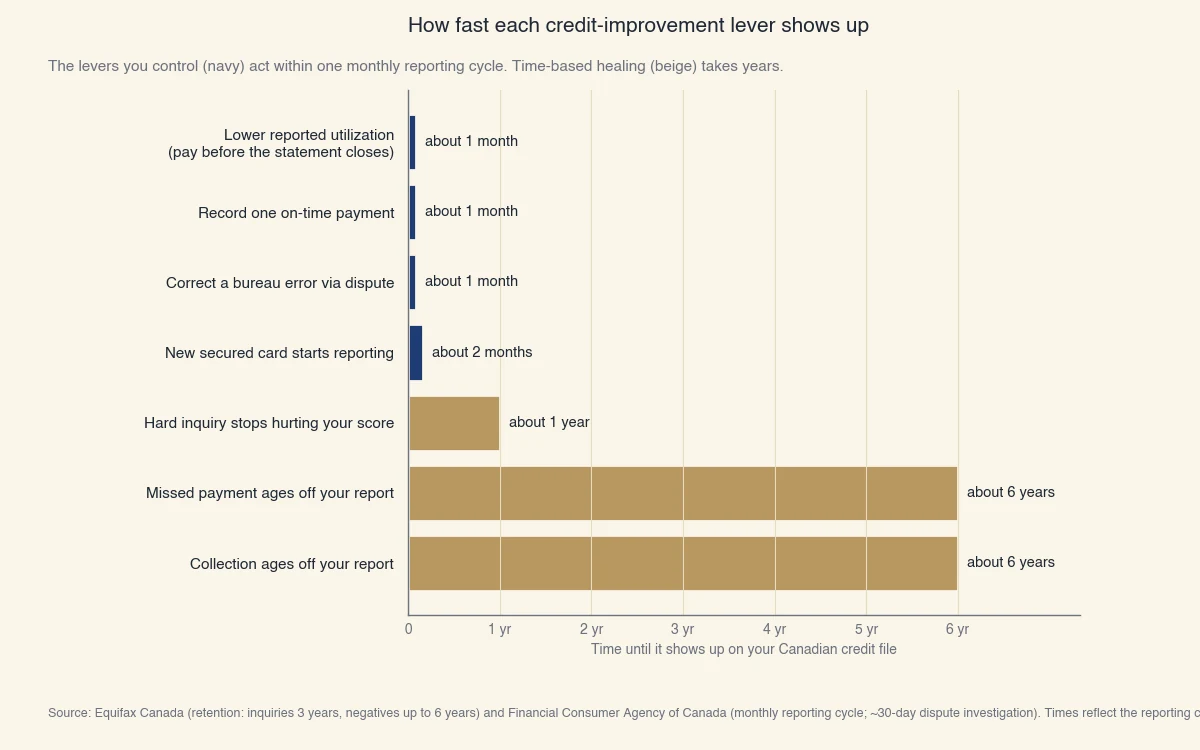
Source: Equifax Canada (information retention) and the Financial Consumer Agency of Canada (monthly reporting cycle and dispute investigation). Times reflect the reporting cycle, not a guaranteed point gain.
The pattern is clear. The levers you control act within about 30 days. The damage you are waiting out takes years. So the highest-return move is to work the fast levers hard rather than sit and wait.
Which credit-improvement actions work fastest?
The fastest lever is lowering the balance your card issuer reports to the bureau, which you do by paying before the statement closing date rather than the payment due date. Issuers send the bureau whatever you owe on the statement date, not the day you actually pay (FCAC). Pay the balance down before that date and the bureau sees a lower number in the next cycle, usually within 30 days.
This is why your utilization can look high even when you pay in full every month. If your statement closes on the 3rd with a $2,000 balance, the bureau records $2,000, even if you pay it off on the 10th. Move the payment to the 1st and the recorded balance drops.
Three levers land inside one reporting cycle:
- Lower your reported utilization. Pay your card down before the statement date. This is the single fastest way to move your score.
- Record an on-time payment. Each on-time payment posts to your file on the next reporting cycle and adds to the payment history that carries the most weight.
- Correct a bureau error. If your report shows a late payment you never made or an account that is not yours, file a dispute. The bureau must investigate, usually within about 30 days, and a corrected error can lift your score right away.
Two more levers are slower but still worth starting now. A new secured credit card (a card backed by a refundable deposit) begins reporting within a cycle or two and starts building history. A hard inquiry from a past application keeps weighing on your score for about a year, then fades, and drops off your Equifax report entirely after three years (Equifax Canada).
How do you lower your credit utilization the right way?
Keep the balance reported on your statement date under 30% of your total credit limit, and lower is better. Your credit utilization rate is how much of your available credit you are using. On a $5,000 limit, staying under 30% means keeping the reported balance below $1,500 (FCAC). Because utilization is a snapshot, not an average, the balance on the statement date is the only one the bureau sees.
Here is how the three ways to cut utilization compare:
| Action | How fast it shows up | Effort |
|---|---|---|
| Pay the balance before the statement closes | Next reporting cycle (about 30 days) | Low: change your payment date |
| Request a credit-limit increase | 1 to 2 cycles once granted | Low: one request, no new hard pull if pre-approved |
| Spread spending across two cards | Next reporting cycle | Medium: track two statement dates |
A limit increase lowers utilization without changing your spending, because the same balance now sits against a larger limit. Ask your issuer whether the increase uses a soft or hard pull first. And do not close the old card to tidy up: closing it removes its limit from the calculation and can push your utilization up overnight. The headcount itself carries no weight with the bureaus, though the total limit behind your cards does, which is the distinction our guide to how many credit cards you should hold works through.
How do you improve your score based on where you are starting?
The right first moves depend on your starting point, so match the levers to your situation instead of running the same generic checklist. A newcomer with a thin file, a borrower with a maxed card, and someone recovering from a missed payment each have a different fastest path.
- Thin or new credit file. You need active accounts reporting positive history. Open one secured credit card, put a small recurring bill on it, and pay it before the statement closes each month. Consider becoming an authorized user on a family member's long-standing card. Our guide on how to build a credit rating covers this path in detail.
- On time but high utilization. Your payment history is already working for you, so attack the reported balance. Pay before the statement date and, if you can, request a limit increase. This is often the fastest single jump in the whole list.
- Recovering from a missed payment or collection. Stop the bleeding first: bring every account current and keep it there, because new on-time payments start rebuilding history immediately. The old missed payment still ages off after six years, so focus your energy on the levers you control while time handles the rest.
Whatever your starting point, do not apply for several new products at once. Each application can add a hard inquiry, and too many close together signal risk to lenders (FCAC).
Which habits protect your score over the long run?
Once your score is climbing, protect it with a few durable habits: pay on time every time, keep utilization low, keep old accounts open, apply for credit sparingly, and review both bureau reports each year. These are the same levers, held steady over time. Payment history and length of history both reward consistency, so an account you keep open and active for years is worth more than a new one.
A few rules keep the long game on track:
- Never skip a payment, even a disputed one. A single missed payment can undo months of progress and stays on your Equifax file for up to six years (Equifax Canada).
- Keep your oldest card open. It anchors the average age of your accounts. Put a small recurring charge on it so the issuer keeps it active.
- Group rate shopping. When shopping for a car loan or mortgage, get your quotes within a two-week window. Canadian bureaus treat multiple inquiries of the same type in that window as one (FCAC).
- Read both reports once a year. Order your Equifax Canada and TransUnion Canada reports and check every account (FCAC). Requesting your own report is a soft inquiry and never affects your score. A full walkthrough of pulling both reports at no cost is in how to check your credit rating for free.
Building a strong score is less about any one trick and more about steady, correct habits repeated over months. The fast levers get you moving. The habits keep you there.
At Sphera Credit, we build credit-decision tools grounded in accuracy and explainability, so borrowers understand exactly what moves a lending decision. Knowing which levers move your score, and how fast, is the same principle applied to your own file.