

How do you boost your credit rating fast?
The fastest way to boost your credit rating is to lower your credit utilization by paying down credit card balances before your statement closing date, because amounts owed make up about 30% of a FICO Score and are recalculated every month with no memory of the past (myFICO). No other lever moves as quickly, because utilization is the one large scoring factor you can change this week and have re-scored on your next statement.
In the United States, credit rating and credit score mean the same thing for an individual. Both refer to a three-digit number, usually a FICO Score or VantageScore on a 300 to 850 scale, that lenders use to estimate how likely you are to repay. The average US FICO Score sits around 713 (Experian). "Boosting your rating fast" means moving that number in the shortest time the scoring models allow.
Credit utilization is the share of your revolving credit limit you are using. It carries no history: the model looks only at the balance most recently reported, so a balance you pay off today can lift your score on next month's report even though it was high all year (myFICO). That is why it is the fast lever, and why chasing older factors like account age is a slow game.
Here are the legitimate fast levers, ranked by how quickly they usually report:
| Lever | Typical speed to report | Effort | Effect |
|---|---|---|---|
| Pay a card below 10% before statement closes | 1 statement cycle (about 30 days) | Low if cash on hand | Strong |
| Request a credit-limit increase | Same or next statement | Low | Moderate |
| Dispute an inaccurate negative item | 30 days (FCRA) | Low | Strong if error is real |
| Become an authorized user on a healthy card | 1 to 2 cycles | Low | Moderate |
| Report rent and utilities (Experian Boost and similar) | Days to one cycle | Low | Small to moderate |
| Bring a past-due account current | 1 to 2 cycles | Varies | Moderate |
If you want the deeper playbook behind each move, our guides on how to boost your credit score and how to raise your credit score fast walk through them step by step. This page focuses on picking the one lever that will move your number soonest.
What is the single fastest lever for your situation?
Your single fastest lever depends on why your score is low: a clean file carrying high balances can jump in one statement cycle, while a thin file, a recent late payment, and a collection each move on a different clock. Diagnose the cause first, then pull the matching lever instead of trying all of them at once.
- High utilization, otherwise clean file. Your fastest lever is paying revolving balances below 10% of their limits before each statement closes, or requesting a limit increase to shrink the ratio without spending cash. This is the classic one-cycle gain.
- One recent missed payment. Bring the account current immediately, then call the lender and ask for a goodwill adjustment to remove the late mark. There is no guaranteed removal, but a single late payment on an otherwise clean account is the kind lenders sometimes waive for long-standing customers.
- Thin file or no score yet. You cannot pay down what you do not have, so the fast lever is adding positive data: become an authorized user on a family member's healthy card, open a secured card, or turn on rent and utility reporting. Our note on what your credit score starts at explains how a file first forms.
- A collection or charge-off on file. Paying may or may not help depending on the model, so first check whether the item is even accurate, and dispute it if it is not. If it is valid and recent, ask about a pay-for-delete in writing before paying.
Matching the lever to the cause is what separates a real 30-day gain from a month of scattered effort. If you are not sure why your number fell in the first place, why your credit score dropped is the place to start.
How much can paying down your cards actually move your score?
Cutting utilization from the 60% range to under 10% before your statement closes commonly adds 20 to 50 points within a single billing cycle, and that gain is often enough to cross a lending tier and cut the interest rate you are offered. The exact points depend on your full file, but the direction and the size of the move are consistent because utilization is such a large, memory-free factor.
Work through a concrete case. Say you carry a $7,440 balance on a card with a $12,000 limit. That is 62% utilization, deep in the range that drags a score down. You use savings to pay the balance to $1,050 two days before the statement closing date, dropping utilization to about 8.75%. On the next report, that single change can lift a mid-600s score by roughly 30 to 50 points, moving a borrower from the Near prime band (601 to 660) into Prime (661 to 780).
That tier change is where the money is. The average APR on a new-car loan falls sharply as you move up the tiers, and a good interest rate for a car shows where each band lands:
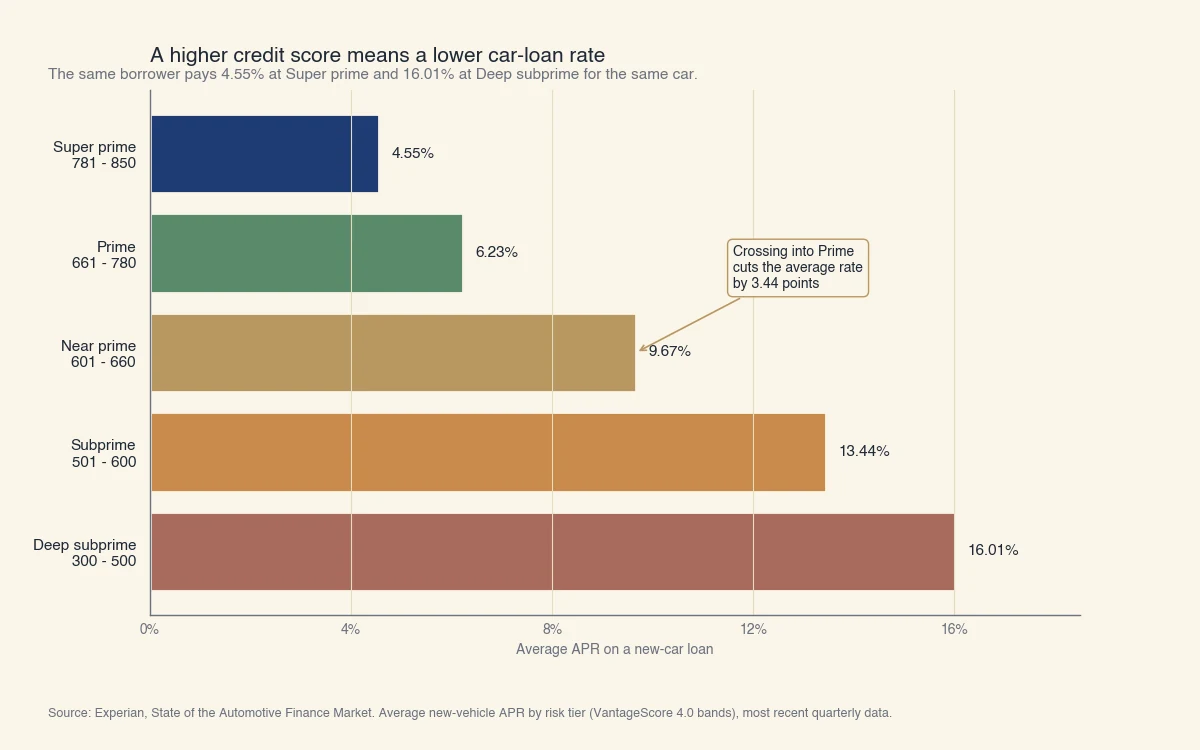
Source: Experian, State of the Automotive Finance Market. Average new-vehicle APR by credit-score tier.
Crossing from Near prime into Prime cuts the average new-car rate from 9.67% to 6.23% (Experian). On a $30,000 loan over 60 months, that is a monthly payment of about $583 instead of $633, and total interest of roughly $4,992 instead of $7,953. Paying one card down at the right time saves close to $2,960 over the life of that single loan, on top of the score gain itself.
Timing is everything, so plan the fast levers against the calendar:
| Window | What moves | What to do |
|---|---|---|
| 0 to 30 days | Utilization, reporting errors | Pay cards below 10% before the statement date; file disputes on inaccurate items |
| 30 to 60 days | Authorized-user history, limit increases | Get added to a healthy card; request higher limits so utilization keeps falling |
| 60 to 90 days | A second clean statement, resolved disputes | Keep balances low so a low-utilization pattern reports twice; confirm disputed items were removed |
Deeper problems sit outside this window. A maxed-out recovery or a rebuild after derogatories is a six-month-and-up project, not a 30-day one.
Which "fast credit" fixes are real, and which are myths?
Most viral credit hacks are just the utilization rule in disguise, and a few widely repeated tips can quietly hurt your score. Knowing which is which keeps you from wasting a billing cycle on a move that does nothing.
- The 15/3 trick is real but oversold. Paying half your balance 15 days before the due date and the rest three days before works only because it lowers the balance your issuer reports. Any payment that cuts your reported balance before the statement closes does the same thing. There is no magic in the specific dates.
- Checking your own rating never hurts it. Pulling your own score or report is a soft inquiry with zero score impact (CFPB). You can check as often as you like, including free weekly reports at AnnualCreditReport.com.
- Carrying a small balance does not help. Paying your statement in full each month builds the same payment history as carrying a balance and costs you no interest. The idea that you must leave a balance to "show activity" is false.
- Closing an old card usually backfires. It shortens your average account age and cuts your total available credit, which raises utilization on your remaining cards. Keep your oldest card open, even if you rarely use it.
- Paying a collection may not move FICO 8. Older FICO 8 scoring, still common in lending, can keep counting a collection after you pay it, while FICO 9 and VantageScore 3.0 and newer ignore paid collections. Dispute inaccurate collections first; roughly 1 in 20 consumers has a report error serious enough to raise their borrowing costs (FTC).
How do you lock in a higher rating once you have it?
Keep utilization low every month, pay every bill on time, and leave your oldest card open, because the same factors that raised your rating fast are the ones that hold it in place. A fast gain built on one low statement can slip back the moment balances climb again, so treat the low-utilization habit as permanent, not a one-time stunt.
Payment history is the largest scoring factor, so a single missed payment can undo a month of careful paydown. Automate at least the minimum payment on every account so a due date never slips. From there, the durable rules are simple: charge what you can repay before the statement closes, avoid opening several new accounts at once, and dispute any inaccurate item the moment you spot it. The Consumer Financial Protection Bureau's guide to disputing report errors is the free, primary-source path for that last step.
Fast is real, but only utilization and error correction are genuinely fast. Everything else that lasts is built one clean statement at a time. If you want to see how high the number can actually go, the highest credit score possible puts the ceiling in context.