

What is an excellent credit rating?
An excellent credit rating in Canada is generally a score of 760 or higher on the 300-900 scale, the top tier that signals to lenders you are very likely to repay what you borrow. Equifax Canada groups scores this way, and the excellent band tells a lender you carry the lowest lending risk they are likely to see (Equifax Canada).
A credit rating is a lender's summary judgment of how reliably you repay credit, expressed either as a three-digit score or, on your actual credit report, as a set of account-by-account codes. The score and the codes describe the same behaviour from two angles, which is why the word "rating" gets used for both.
Here is where the excellent tier sits on the Equifax scale, alongside the other bands most Canadian lenders use:
| Score range | Rating tier | What it means to a lender |
|---|---|---|
| 760 - 900 | Excellent | Lowest risk; best rates and premium products |
| 725 - 759 | Very good | Strong; most prime products available |
| 660 - 724 | Good | Mainstream qualification range |
| 560 - 659 | Fair | Limited prime options; alternative lenders likely |
| 300 - 559 | Poor | Subprime or secured products only |
One detail the tier table hides: Canada has two credit bureaus, and their scales do not match. Equifax runs from 300 to 900, while TransUnion Canada's CreditVision score tops out at 832 (TransUnion Canada). An excellent rating therefore means roughly 760+ at Equifax and roughly 780 to 832 at TransUnion. The number is a band, not a bright line, which matters for how you read your own report.
What are the R1 to R9 credit ratings on your Canadian credit report?
When you pull your own Equifax or TransUnion Canada report, you will not see a single tier label next to each account. You see a letter-and-number code such as R1 or I3, and an excellent rating is built from an R1 on every account you hold. The score is a summary; the codes are the raw record that feeds it.
The letter shows the type of credit and the number shows how you have paid it (Consolidated Credit Canada):
- R stands for revolving credit, such as a credit card or line of credit where the balance and payment vary.
- I stands for installment credit, such as a car loan with fixed payments.
- O stands for open credit, and M stands for a mortgage.
The number after the letter runs from 0 to 9. It is the part that separates an excellent rating from a damaged one:
| Code | Meaning |
|---|---|
| R0 | Account is too new to rate, or approved but not yet used |
| R1 | Paid as agreed, within 30 days of billing (the best rating) |
| R2 | Payment 31 to 59 days late |
| R3 | Payment 60 to 89 days late |
| R4 | Payment 90 to 119 days late |
| R5 | Payment 120+ days late, not yet rated R9 |
| R6 | Not used by Canadian bureaus |
| R7 | Paying through a consumer proposal, consolidation order, or debt management program |
| R8 | Repossession, or assets being reclaimed to recover the debt |
| R9 | Bad debt written off, sent to collections, or a bankruptcy |
So R1 is the code an excellent borrower wants on every line, R7 flags a borrower working through a formal debt arrangement, and R9 is the most damaging mark on the scale. Negative codes do not last forever: most stay on your report for about six years from the date of last activity before they drop off (Equifax Canada). The same code exists for installment and mortgage accounts too, so a car loan paid on time shows as I1 and a mortgage in good standing as M1.
What is an excellent credit rating worth in dollars?
An excellent credit rating is worth roughly six figures over the life of a large loan, because the rate a lender offers is tied directly to the risk your rating signals. Every competitor page says excellent credit gets you "the best rates." Few of them show the number, so here it is.
Take a representative $500,000 mortgage on a 25-year amortization. As of July 2026, the best conventional 5-year fixed rate advertised to well-qualified borrowers is about 4.39% (Ratehub), against a Bank of Canada policy rate of 2.25% and a prime rate of 4.45% (Bank of Canada). A borrower whose credit pushes them to an alternative lender, also called a B lender, commonly pays around two percentage points more, near 6.39%.
Hold everything else equal and the rating alone changes the outcome:
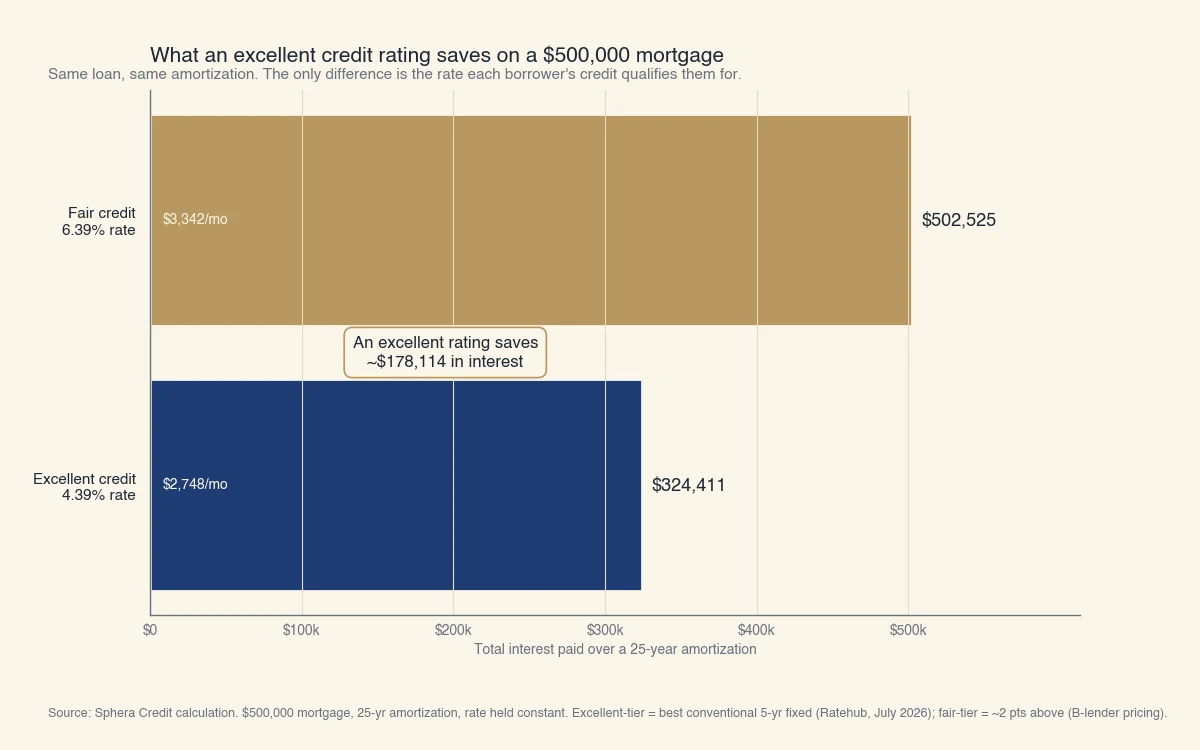
Source: Sphera Credit calculation. $500,000 mortgage, 25-year amortization, rate held constant. Excellent-tier rate = best conventional 5-year fixed (Ratehub / WOWA, July 2026); fair-tier rate reflects documented alternative or B-lender pricing (about two points above the best A-lender rate). Bank of Canada policy rate 2.25%, prime 4.45%.
- The excellent-credit borrower pays about $2,748 a month and roughly $324,411 in total interest.
- The fair-credit borrower pays about $3,342 a month and roughly $502,525 in total interest.
- The rating alone accounts for about $178,000 in extra interest, close to a third of the amount borrowed.
The same pattern, at a smaller scale, plays out on car loans, personal loans, and credit-card rates. That is the real answer to why the top tier is worth the effort: an excellent rating is not a bragging point, it is a lower price on money.
The truth about excellent credit: there is no single magic number
The most common misconception about an excellent credit rating is that it is one fixed number everyone agrees on. It is not, and three specifics prove it. Naming them is the difference between chasing a myth and understanding how lenders actually decide.
First, the cutoff moves by lender. Some banks call 760 excellent; others reserve the label for 780 or 800. A major Canadian bank publicly uses 800+ for excellent, while the bureaus and most fintechs use 760+. Both are defensible, because "excellent" is a marketing label on top of a risk model, not a regulated threshold.
Second, the scales differ by bureau. Equifax runs to 900 and TransUnion to 832, so the same borrower can look like an 810 at one bureau and a 795 at the other and be equally excellent at both (TransUnion Canada). Chasing a specific number is less useful than staying in the top band.
Third, an R1 is not a score. People searching for an "A credit rating" often expect a letter grade like the AAA ratings applied to governments and corporations. Consumer credit in Canada does not work that way. Your report uses the R, I, O, and M codes above, where R1 is the top consumer rating, and your score is a separate three-digit summary built from those codes (FCAC). Knowing the difference stops you from hunting for a rating that does not exist for individuals.
The practical takeaway: aim to sit inside the top band and hold an R1 on every account, rather than fixating on a single target number.
How do you reach and keep an excellent credit rating?
You reach an excellent rating the same way you keep it: pay every account on time and keep credit-card balances low, then let time do the rest. The bureaus weigh the same core factors, and two of them do most of the work (FCAC).
- Pay on time, every time. Payment history is the single largest factor. One payment 30 days late turns an R1 into an R2 and can cost a large number of points, so automatic payments are the cheapest insurance you can buy.
- Keep utilization low. Credit utilization is the share of your available credit you are using. Excellent-tier borrowers typically stay well under 30%, and often under 10%. Paying a card down before the statement date lowers the balance the bureau sees.
- Let accounts age. The average age of your accounts helps your score, so keeping an old card open, even lightly used, supports an excellent rating.
- Keep a healthy mix. A blend of revolving credit (cards) and installment credit (a loan) shows you manage different obligations well.
- Apply sparingly. Each application creates a hard inquiry that can shave a few points and lingers for a couple of years. Rate-shopping for a single mortgage or car loan within a short window is usually treated as one inquiry.
Two things an excellent rating does not require: carrying a balance and paying interest to "build credit" is a myth, and checking your own score is a soft inquiry that never lowers it. If you are climbing from a lower tier, the honest timeline is one to three years of consistent behaviour, because the top band is earned through history rather than a single move.
If you are still mapping out where you stand, it helps to see the whole ladder: our guides on what is a good credit score and what is a decent credit score cover the tiers below excellent, and how to increase your credit score walks through the steps to climb.