

What is a decent credit score?
A decent credit score in Canada is roughly 660 to 724 on the 300 to 900 scale, the band that Equifax and TransUnion label "good" and that most prime lenders treat as low risk. It is the score that gets you approved for mainstream credit cards, car loans, and mortgages, even if it does not always earn the lowest advertised rate (FCAC).
A credit score is a three-digit number that lenders use to estimate the chance you will repay borrowed money on time. In Canada it runs from 300 to 900, and the two national credit bureaus, Equifax and TransUnion, each calculate their own version from your credit report. That personal score is a different thing from Canada's credit rating, the sovereign grade agencies assign to the federal government's own debt.
The word "decent" is not an official rating. It maps most closely to the good band, plus the upper edge of the fair band. Here is where it sits:
| Score range | Bureau rating | Is it "decent"? |
|---|---|---|
| 760 - 900 | Excellent | Above decent |
| 725 - 759 | Very good | Above decent |
| 660 - 724 | Good | Yes, this is the core of decent |
| 560 - 659 | Fair | Borderline, only the upper end is passable |
| 300 - 559 | Poor | Below decent |
So when someone asks whether their score is decent, the practical test is simple: 660 or higher clears the bar for prime lending. A 650 is close but sits just under it, which is why lenders often treat 650 and 665 very differently. A score of 700 sits comfortably inside that decent band, though whether 700 is a good credit score still comes down to the same prime-lending threshold.
Why does 660 act as the line? Lenders sort applicants into risk tiers, and the good band is where the historical default rate drops to a level most banks are comfortable pricing at standard rates (TransUnion Canada). Below it, the odds of missed payments rise enough that lenders either add a rate premium or ask for more security. A decent score, then, is less about a specific number and more about landing on the safe side of that line.
Is a decent score the same as an average one?
A decent score and an average score in Canada are almost the same thing: the average Canadian credit score was 679 in 2026, which lands inside the 660 to 724 decent band. People assume "average" means mediocre, but in credit scoring the national average already clears the threshold most lenders call good (Borrowell).
The average also rises steadily with age, because the length of your credit history is one of the factors that builds a score. Younger Canadians have thinner files and lower averages, while older Canadians have decades of payment history.
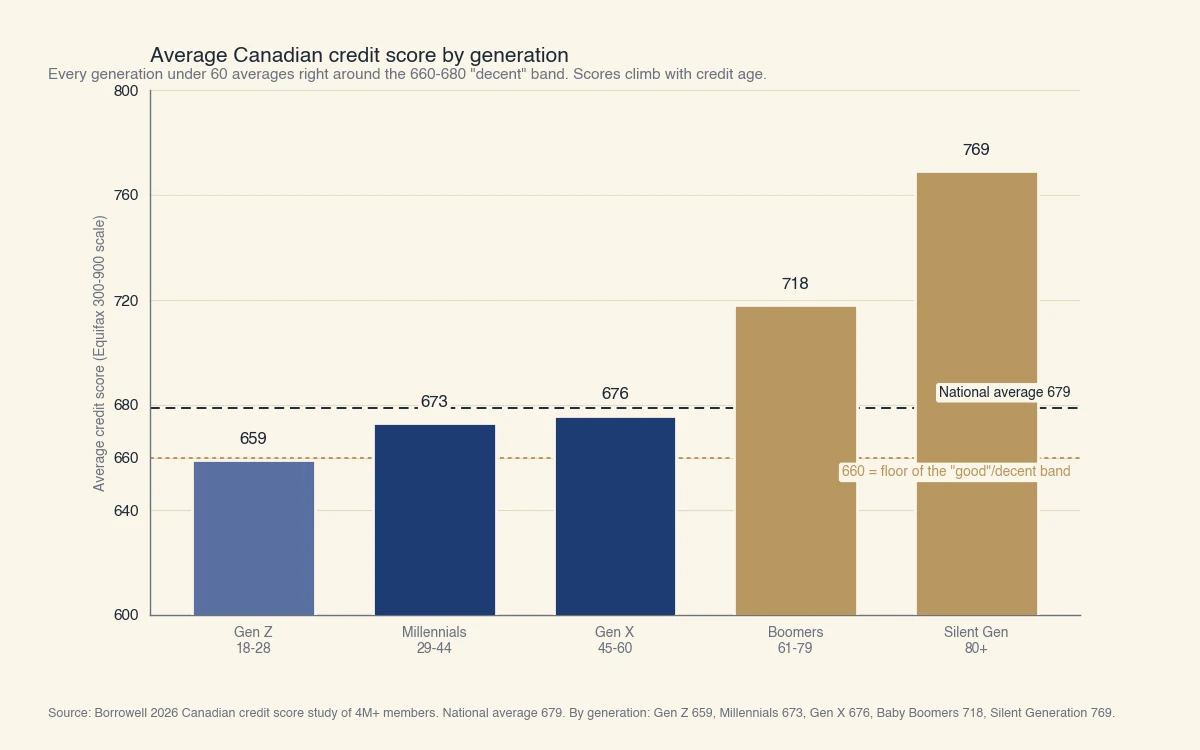
Source: Borrowell 2026 Canadian credit score study of 4M+ members. National average 679.
Two things stand out. First, every generation under 60 averages right around the 660 to 680 mark, so a score people call "just decent" is actually at or above the typical Canadian. Second, decent is not the same as excellent. A 679 average sits comfortably in the good band but well short of the 760 line where the best rates begin. That gap between decent and excellent is where the real cost lives, which the next two sections make concrete.
Is a decent credit score good enough for you?
Whether a decent score is good enough depends less on the number and more on what you are trying to borrow and how thick your credit file is. A 665 attached to ten years of history behaves differently from a 665 attached to eight months of it, because lenders read the whole report, not just the score.
A thin file is a credit history with few accounts or little time behind it. Even a decent score built on a thin file can prompt a lender to ask for more, because there is less data to trust. Here is how a decent score (roughly 660 to 700) tends to play out across common situations in Canada:
| Your situation | What a decent score usually gets you | The mechanism behind it |
|---|---|---|
| First-time renter | Approved by most landlords; a thin file may trigger a guarantor or larger deposit | Landlords run a soft check and treat 660+ as low risk |
| Newcomer with a short history | Approved for entry cards and loans, but with modest limits | Short history means less data, so lenders cap exposure |
| Car-loan shopper | Approved at a standard prime rate, above the best tier | Lenders price by risk tier; decent is prime, not super-prime |
| First mortgage | Qualifies with most prime lenders if 660+; below 660 leans to alternative lenders | Prime lenders want 660+, and you still pass the stress test |
The mortgage stress test is a federal rule that requires you to qualify at a higher interest rate than the one you actually get, to prove you could handle a rate increase. A decent score gets you in the door with a prime lender, but the stress test, your income, and your down payment still decide the final approval.
The takeaway: a decent score rarely blocks you outright. It changes the terms, the limits, and how much supporting evidence a lender wants.
What does a decent credit score actually cost you?
A decent score gets you approved, but it usually costs more than an excellent score, because lenders reserve their lowest rates for the top tier. On a mortgage that gap can total tens of thousands of dollars over a single term. The score does not change the loan you want; it changes the rate attached to it.
The numbers below are illustrative. They hold the loan amount and term fixed and change only the interest rate that a decent tier versus an excellent tier typically receives, so you can see the mechanism rather than a quoted offer.
| Loan | Amount and term | Excellent-tier rate | Decent-tier rate | Extra interest you pay |
|---|---|---|---|---|
| New car loan | $30,000 over 5 years | 5.50% | 7.00% | about $1,260 over the term |
| Home mortgage | $400,000, 25-year amortization, 5-year term | 4.75% | 5.75% | about $19,700 over the term |
Walk through the car loan. At 5.50% the total interest on a $30,000 five-year loan is about $4,382. At 7.00% it climbs to about $5,642. Same car, same term, roughly $1,260 more, purely because of the rate tier your score placed you in.
The mortgage shows why the stakes rise with the size of the loan. A one-point rate difference on a $400,000 mortgage adds about $236 to the monthly payment and close to $19,700 in extra interest across a five-year term. For context, the average 5-year fixed conventional rate in Canada was near 5.07% in July 2026, so a one-point spread between tiers is realistic (Bank of Canada).
This is the honest case for pushing a decent score higher: not because decent gets you rejected, but because the difference between decent and excellent is money you keep.
How do you turn a decent score into a good or excellent one?
The fastest lever is your credit utilization, and the most durable one is an unbroken record of on-time payments. Both feed the two factors that carry the most weight in a Canadian credit score. If you want the full playbook, how to better your credit score ranks every lever by how fast it moves the number.
Bureaus build the score from five factors, weighted roughly like this:
- Payment history (about 35%): every on-time or missed payment over the past six to seven years. This is the single biggest factor.
- Credit utilization (about 30%): the share of your available credit you are using. Credit utilization is your balance divided by your limit. Keeping it under 30%, and ideally under 10%, protects the score.
- Length of credit history (about 15%): the average age of your accounts.
- Credit mix (about 10%): a blend of revolving credit, such as cards, and installment credit, such as loans.
- New credit (about 10%): recent applications. Each hard inquiry, the credit check a lender runs when you apply, can shave a few points temporarily.
Three moves push a decent score toward excellent:
- Pay every bill on time, every month. One 30-day late payment can undo months of progress.
- Lower your utilization before the statement date, not just before the due date, since the reported balance is what counts.
- Avoid opening several new accounts at once, which stacks hard inquiries and lowers your average account age.
You can watch the effect for free. In Canada you can check your score at no cost through Equifax, TransUnion, or services like Borrowell, and these soft checks never lower your score (Equifax Canada). Checking often and acting on utilization is how a decent score becomes a very good or excellent one.