

Qu'est-ce qu'un souscripteur?
Un souscripteur est la personne ou l'institution qui décide d'assumer ou non le risque d'autrui, et à quelles conditions. Chez un prêteur, le souscripteur décide de vous prêter de l'argent ou non. Dans une compagnie d'assurance, il décide de vous assurer et à quelle prime. Lors d'une émission d'actions ou d'obligations, le souscripteur est le courtier en placement qui achète les nouveaux titres pour les revendre aux investisseurs.
Le mot anglais que souscripteur traduit, underwriter, est plus ancien que ces trois métiers. Dans les années 1610, un underwriter était un souscripteur au sens propre : quelqu'un qui écrivait son nom sous un document. Dans les années 1620, to underwrite voulait dire accepter le risque d'une assurance, parce que signer une police d'assurance maritime rendait le signataire responsable des pertes qu'elle énumérait (Etymonline). Le mot précède la Lloyd's of London, issue d'un café dont la première mention remonte à 1688 (Lloyd's). Souscrire, c'est encore mettre son nom, et son argent, derrière le risque de quelqu'un d'autre. Le verbe a sa propre page sur ce que signifie souscrire, des prêts aux émissions d'actions.
Que fait un souscripteur?
Un souscripteur vérifie ce que déclare le demandeur, mesure le risque de dire oui et rend l'une de trois réponses : approuver, approuver sous conditions ou refuser. Pour un prêt hypothécaire canadien, ces vérifications suivent la ligne directrice B-20, les règles de souscription des prêts hypothécaires résidentiels fixées par le Bureau du surintendant des institutions financières (BSIF), l'organisme fédéral qui encadre les banques et les assureurs sous réglementation fédérale (ligne directrice B-20 du BSIF). Ses principes ramènent le travail à trois questions :
- Qui êtes-vous, et payez-vous vos dettes? Le souscripteur consigne votre identité et vos antécédents, et lit votre historique de crédit pour vérifier que vous remboursez à temps.
- Pouvez-vous assumer les versements? Le souscripteur vérifie votre revenu et y compare vos frais de logement et vos autres dettes. La ligne directrice B-20 demande aux prêteurs de « faire preuve de rigueur » quand ils vérifient le revenu de l'emprunteur.
- Que vaut la propriété? La maison garantit le prêt, alors le souscripteur compare le montant du prêt à une évaluation ou à une autre estimation de sa valeur.
Les conditions permettent à un souscripteur d'approuver un dossier qui présente encore une lacune : la preuve de la provenance de la mise de fonds, une lettre de l'employeur, une dette remboursée avant la clôture. Les étapes autour de la décision, de la demande au déboursement, sont expliquées dans le fonctionnement de la souscription.
Quels sont les principaux types de souscripteurs?
Les quatre principaux types de souscripteurs sont les souscripteurs de prêts et de prêts hypothécaires, les souscripteurs d'assurance prêt hypothécaire, les souscripteurs d'assurance et les souscripteurs de valeurs mobilières. Chacun se prononce sur un risque différent, travaille pour un type d'employeur différent et obéit à des règles différentes.
| Type | Ce qu'il décide | Qui l'emploie au Canada | Règles applicables |
|---|---|---|---|
| Souscripteur de prêts et de prêts hypothécaires | S'il faut prêter, combien et à quelles conditions | Banques, coopératives de crédit, caisses populaires, sociétés de fiducie et sociétés de prêts hypothécaires | La politique de crédit du prêteur, plus la ligne directrice B-20 du BSIF chez les prêteurs sous réglementation fédérale |
| Souscripteur d'assurance prêt hypothécaire | S'il faut assurer le prêteur contre le défaut de paiement de l'emprunteur | SCHL, Sagen, Canada Guaranty | Les critères de l'assureur, plus la ligne directrice B-21 du BSIF chez les assureurs hypothécaires sous réglementation fédérale |
| Souscripteur d'assurance | S'il faut couvrir une personne, une maison, une voiture ou une entreprise, et à quelle prime | Assureurs de dommages, assureurs de personnes | Les lignes directrices de l'assureur et le droit provincial des assurances |
| Souscripteur de valeurs mobilières | S'il faut acheter les nouvelles actions ou obligations d'un émetteur pour les revendre | Courtiers en placement | Le droit provincial des valeurs mobilières, comme la Loi sur les valeurs mobilières de l'Ontario |
Un acheteur de maison peut croiser les deux premiers types dans le même dossier. L'assurance prêt hypothécaire protège le prêteur si vous cessez de payer, et elle est obligatoire quand votre mise de fonds est inférieure à 20 % du prix (SCHL, assurance prêt hypothécaire). La SCHL, une société d'État fédérale, et deux assureurs privés, Sagen et Canada Guaranty, l'offrent.
Les deux autres types s'éloignent du prêt hypothécaire. En assurance vie, le représentant qui vous rencontre fait un premier tri à titre de souscripteur sur le terrain, et un souscripteur de l'assureur prend la décision. En valeurs mobilières, où le français juridique canadien parle plutôt de « placeur », la Loi sur les valeurs mobilières de l'Ontario définit le placeur comme une personne ou une compagnie qui achète des valeurs mobilières à titre de contrepartiste en vue de les placer, ou qui les offre ou les vend à titre de mandataire dans le cadre d'un placement (Lois-en-ligne de l'Ontario).
Qui est le souscripteur de votre prêt hypothécaire?
Pour un prêt hypothécaire canadien, le souscripteur est un employé du prêteur, et quand le prêt est assuré, un souscripteur de l'assureur hypothécaire doit aussi l'approuver. La personne qui prend votre demande est habituellement quelqu'un d'autre. Trois rôles se partagent un dossier assuré typique :
- Le courtier hypothécaire ou le spécialiste hypothécaire de la banque rassemble vos documents et présente le dossier. L'Agence de la consommation en matière financière du Canada (ACFC) précise que les courtiers hypothécaires « ne vous prêtent pas directement de l'argent » et qu'ils reçoivent habituellement une commission du prêteur (ACFC).
- Le souscripteur du prêteur vérifie le dossier au regard de la politique de crédit du prêteur et, chez un prêteur sous réglementation fédérale, de la ligne directrice B-20. La plupart des coopératives de crédit et des caisses populaires relèvent plutôt d'un organisme de réglementation provincial. C'est cette personne qui approuve, pose des conditions ou refuse.
- Le souscripteur de l'assureur hypothécaire décide s'il assure le prêt. La ligne directrice B-21 du BSIF reconnaît que « les prêteurs exercent normalement la fonction de souscription des prêts hypothécaires », mais précise qu'il est censé revenir à l'assureur hypothécaire sous réglementation fédérale « d'accepter ou de refuser d'assurer des prêts hypothécaires » (ligne directrice B-21 du BSIF). L'assureur reste aussi responsable de l'évaluation de la propriété.
Un prêt hypothécaire assuré passe donc deux fois en souscription. La ligne directrice B-20 explique pourquoi l'examen du prêteur compte toujours : l'assurance prêt hypothécaire « ne doit pas remplacer les saines pratiques de souscription de l'IFF » (ligne directrice B-20). Les institutions financières fédérales (IFF) sont, par exemple, les banques et les sociétés de fiducie et de prêt fédérales.
Le même métier obéit à d'autres règles aux États-Unis, où les souscripteurs hypothécaires suivent les règles de prêt américaines, comme les systèmes de souscription automatisée et les programmes de prêt.
Comment un souscripteur décide-t-il d'un prêt hypothécaire?
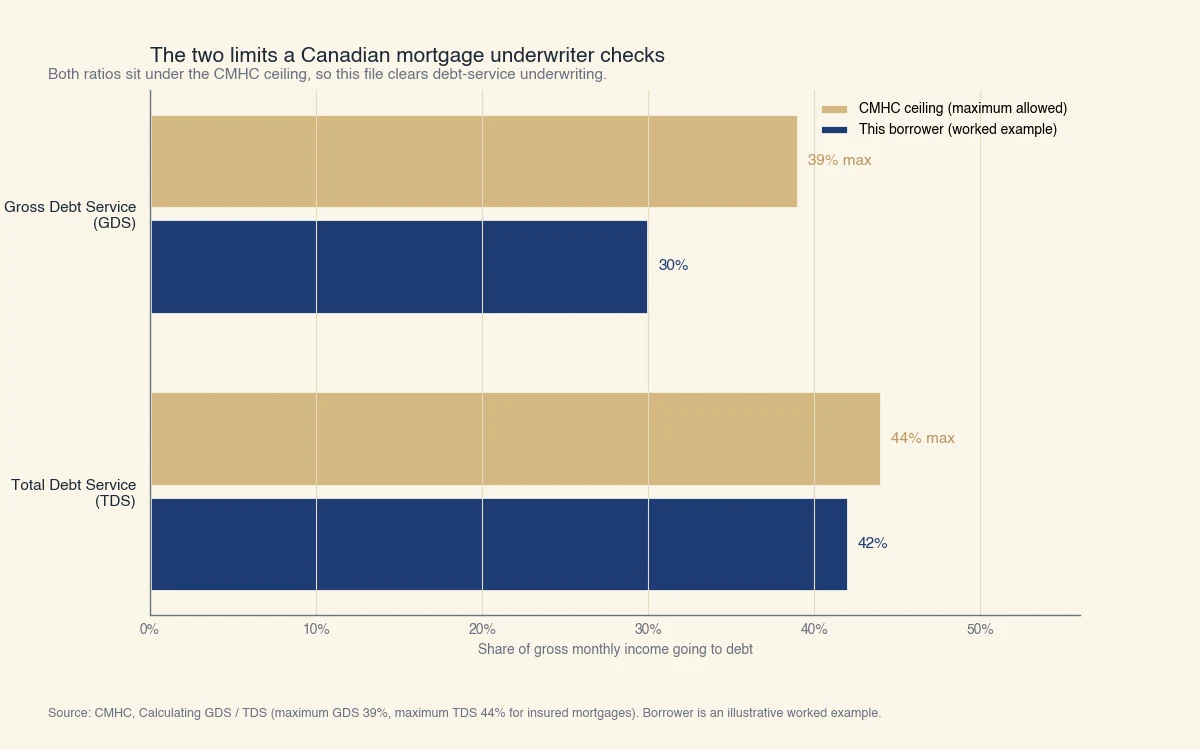
Un souscripteur hypothécaire canadien vérifie si vous pourriez assumer le versement à un taux plus élevé que celui que vous paierez, et maintient deux ratios d'endettement sous des plafonds établis. Pour un prêt assuré, la SCHL plafonne vos frais de logement à 39 % du revenu brut, le ratio d'amortissement brut de la dette (ABD), et l'ensemble de vos versements de dettes à 44 %, le ratio d'amortissement total de la dette (ATD) (SCHL, ratios ABD et ATD). Les frais de logement comprennent le versement hypothécaire, l'impôt foncier, le chauffage et la moitié des frais de copropriété, s'il y a lieu. Pour les prêts non assurés, la ligne directrice B-20 laisse chaque prêteur fixer ses propres plafonds dans sa politique hypothécaire.
Le taux plus élevé est le taux admissible minimal, aussi appelé test de résistance : le plus élevé entre votre taux contractuel majoré de 2 points de pourcentage et 5,25 %. La SCHL l'applique aux prêts assurés (SCHL), et le BSIF l'exige pour les prêts non assurés chez les prêteurs sous réglementation fédérale (BSIF, taux admissible minimal).
À quoi ressemble une décision hypothécaire en chiffres?
Voici un acheteur assuré qui passe au taux qu'il paierait et échoue au taux admissible. Il gagne 90 000 $ par année, soit 7 500 $ par mois avant impôt. Il veut un prêt hypothécaire assuré de 350 000 $ amorti sur 25 ans à 4,29 %, la lecture de juin 2026 de la Banque du Canada pour un taux fixe de cinq ans sur un prêt hypothécaire à ratio élevé, c'est-à-dire avec moins de 20 % de mise de fonds (données de la Banque du Canada). L'impôt foncier est de 325 $ par mois et le chauffage de 100 $. Il paie aussi 450 $ par mois sur un prêt auto et 150 $ sur une carte de crédit.
| Montants mensuels | Au taux contractuel (4,29 %) | Au taux admissible (6,29 %) |
|---|---|---|
| Versement hypothécaire | 1 896,51 $ | 2 300,01 $ |
| Frais de logement (versement, impôt, chauffage) | 2 321,51 $ | 2 725,01 $ |
| Ratio ABD (plafond 39 %) | 31,0 % | 36,3 % |
| Frais de logement plus 600 $ d'autres dettes | 2 921,51 $ | 3 325,01 $ |
| Ratio ATD (plafond 44 %) | 39,0 % | 44,3 % |
Les versements sont calculés avec une capitalisation semestrielle, la convention canadienne pour les prêts hypothécaires à taux fixe.
Au taux qu'il paierait, le dossier respecte les deux plafonds. Au taux admissible, le ratio ATD atteint 44,3 %, juste au-dessus du plafond : tel que présenté, le dossier échoue. Le souscripteur n'est pas obligé de le refuser. Il peut l'approuver sous condition : si l'acheteur rembourse son prêt auto avant la clôture, le ratio ATD au taux admissible tombe à 38,3 % et le dossier passe. Emprunter environ 346 000 $ au lieu de 350 000 $ ramènerait aussi le ratio ATD au plafond de 44 %.
Quelles étapes suit un souscripteur?
- Vérifier les documents. Pièces d'identité, talons de paie ou déclarations de revenus, lettre de l'employeur et relevés bancaires montrant la provenance de la mise de fonds.
- Lire l'historique de crédit. Les paiements manqués, les soldes et le crédit récent comptent tous. La cote de crédit qu'il faut pour un prêt hypothécaire a sa propre page.
- Calculer les ratios au taux admissible. ABD et ATD, comme dans l'exemple ci-dessus.
- Évaluer la propriété. Une évaluation par un évaluateur ou par un modèle automatisé compare le prix au montant du prêt.
- Décider. Approuver, approuver sous conditions ou refuser. Un dossier assuré doit aussi obtenir l'approbation de l'assureur.
Le calculateur d'admissibilité hypothécaire soumet vos propres chiffres au même taux admissible et aux mêmes plafonds.
Ces règles changent-elles qui obtient un prêt hypothécaire?
Le test de résistance a changé qui obtient un prêt hypothécaire : chaque fois qu'il a visé un nouveau groupe d'emprunteurs, la part des nouveaux prêts consentis aux plus endettés d'entre eux a chuté en deux trimestres. La Banque du Canada suit la part des nouveaux prêts hypothécaires supérieurs à 4,5 fois le revenu brut de l'emprunteur, la mesure sur laquelle elle s'appuie « pour repérer les ménages les plus vulnérables » (Banque du Canada, indicateurs de stabilité financière). Le test a été étendu à tous les prêts assurés à ratio élevé le 17 octobre 2016, puis aux prêts assurés à faible ratio le 30 novembre 2016 (ministère des Finances). Il s'applique aux prêts non assurés des prêteurs sous réglementation fédérale depuis le 1er janvier 2018 (BSIF, ligne directrice B-20 révisée).
Source : Banque du Canada, indicateurs de stabilité financière (endettement des ménages) : part des nouveaux prêts hypothécaires dont le ratio prêt-revenu dépasse 450 %, T1 2014 à T1 2026. Prêts non assurés à partir du T1 2024 : ensemble de données amélioré (RESL2).
La part des prêts assurés est passée de 20,5 % au quatrième trimestre de 2016 à 9,1 % deux trimestres plus tard. La part des prêts non assurés est passée de 19,1 % au quatrième trimestre de 2017 à 13,4 % au deuxième trimestre de 2018. Une analyse du personnel de la Banque du Canada publiée en 2024 estime que 26 % des prêts hypothécaires à ratio élevé consentis dans l'année précédant octobre 2016 n'auraient pas réussi le nouveau test. Elle constate aussi une hausse plus faible de la défaillance hypothécaire, soit la part des emprunteurs en retard dans leurs paiements, en 2022 et en 2023 dans les régions où la règle de 2016 avait touché le plus d'emprunteurs (note analytique 2024-25 de la Banque du Canada).
Les variations ultérieures suivent les taux d'intérêt. Le taux admissible évolue avec le taux contractuel : quand les taux ont monté en 2022, un même revenu permettait d'emprunter moins. Du deuxième trimestre de 2023 au troisième trimestre de 2024, moins de 1 % des nouveaux prêts assurés dépassaient 4,5 fois le revenu. Avec la baisse des taux, la part des prêts assurés est remontée à 14,9 % au premier trimestre de 2026.
Le BSIF impose aussi à chaque prêteur sous réglementation fédérale, depuis le début de son exercice 2025, son propre plafond sur le volume de nouveaux prêts non assurés supérieurs à 4,5 fois le revenu (BSIF, limites prêt-revenu). Ce plafond s'applique à l'ensemble du portefeuille du prêteur, et le BSIF est explicite : « ces limites ne s'appliquent pas aux emprunteurs ou aux opérations » (BSIF, novembre 2024). Pour un dossier donné, ce sont toujours le taux admissible et les deux ratios qui déterminent la décision.
Quelles sont les idées reçues sur les souscripteurs?
Trois idées reçues sur les souscripteurs piègent les emprunteurs : croire qu'une préapprobation vaut une approbation, qu'une bonne cote de crédit suffit et qu'un logiciel prend la décision. Chacune va à l'encontre du fonctionnement des règles.
Une préapprobation vaut-elle une approbation?
Une préapprobation est une estimation. L'ACFC est claire : « Ce processus ne garantit pas votre approbation pour une hypothèque », et « Un prêteur pourrait vous refuser une hypothèque même si vous avez obtenu une préapprobation » (ACFC). La préapprobation repose sur ce que vous avez déclaré avant de choisir une maison. Le souscripteur décide plus tard, à partir de documents vérifiés et de la propriété elle-même : un nouveau prêt auto, un changement d'emploi ou une évaluation inférieure au prix peuvent changer la réponse. Si votre dossier est en souscription en ce moment, la page faut-il s'inquiéter de la souscription explique ce qui déclenche un refus.
Une bonne cote de crédit suffit-elle?
Une excellente cote répond à l'une des questions du souscripteur et laisse les autres ouvertes. La ligne directrice B-20 traite la volonté de rembourser et la capacité de rembourser comme deux principes distincts, évalués chacun de leur côté (principes 2 et 3 de la B-20). L'acheteur de l'exemple pourrait avoir un historique de crédit impeccable et échouer quand même avec un ratio ATD de 44,3 % au taux admissible.
Un logiciel prend-il la décision?
Les logiciels trient de nombreux dossiers, et l'institution garde la responsabilité de la réponse. La SCHL présente emili comme « le principal système de décision en ligne pour l'assurance prêt hypothécaire au Canada »; son analyse tient compte de l'emprunteur, de la propriété, du marché et du risque global (SCHL, emili). Le BSIF s'attend tout de même à ce que l'assureur hypothécaire conserve la responsabilité d'approuver ou de refuser l'assurance, et la ligne directrice B-20 maintient la souscription propre du prêteur, même pour un prêt assuré. Quel que soit l'outil qui trie le dossier, c'est une institution qui répond de la décision.